
University of Hawaiʻi at Mānoa Admissions for International Students
Learn about UH Mānoa admissions for international students, including requirements, English scores, deadlines, costs, documents and application steps.
Studying in the United States is a major goal for many international students, and the University of Hawaiʻi at Mānoa (UH Mānoa) offers students the opportunity to study in Honolulu while experiencing a distinctive academic environment connected to the Pacific and Asia.
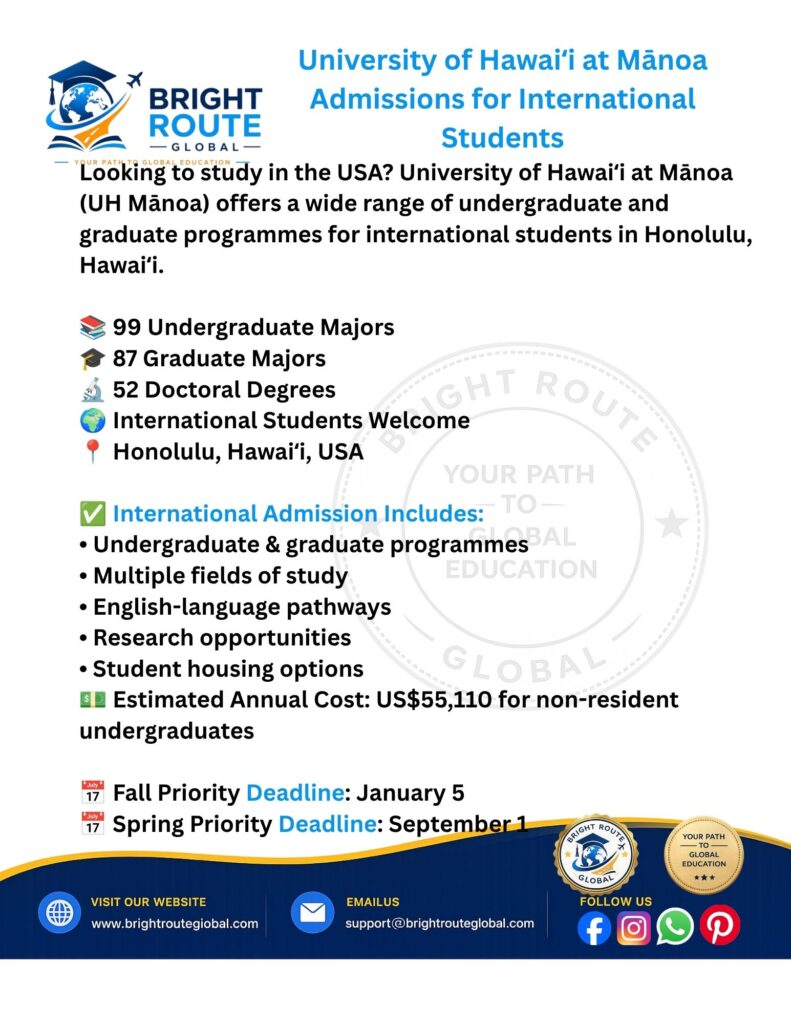
UH Mānoa is the flagship campus of the University of Hawaiʻi system and offers a wide range of undergraduate and graduate programmes. The university currently lists 99 undergraduate majors, 87 graduate majors, 52 doctoral degrees and 5 first-professional degrees.
For international students, UH Mānoa has a dedicated admission process with specific academic, English-language and documentation requirements. Applicants can apply as freshmen, transfer students or, where applicable, second-degree students.
This guide explains the admission requirements, application process, English proficiency requirements, costs, deadlines and important information international students should know before applying.
Admission Overview
UH Mānoa welcomes international students from around the world. International applicants who are not U.S. citizens or residents follow the university’s international admission requirements.
The university evaluates applicants based on their academic records and supporting documents. Freshman applicants must generally have completed, or be in the process of completing, secondary school with a cumulative GPA comparable to a 3.00 on a 4.00 U.S. scale. The university also reviews grades in Mathematics and Science courses.
Transfer applicants have a different set of requirements. International transfer applicants with 24 or more transferable semester credits are generally expected to have at least a 2.50 cumulative transfer GPA, although certain programmes may require higher GPAs or additional prerequisites.
At a Glance
| Category | Details |
|---|---|
| University | University of Hawaiʻi at Mānoa |
| Location | Honolulu, Hawaiʻi, USA |
| Institution Type | Public research university |
| Undergraduate Majors | 99 |
| Graduate Majors | 87 |
| Doctoral Degrees | 52 |
| First Professional Degrees | 5 |
| International Applicants | Eligible |
| Study Levels | Undergraduate & Graduate |
| Application Fee | US$70 |
| Fall Priority Deadline | January 5 |
| Fall Final Deadline | April 1 |
| Spring Priority Deadline | September 1 |
| Spring Final Deadline | October 1 |
| Late Application Deadline | May 1 for Fall; November 3 for Spring |
| Application | Online |
Deadlines can vary for specific programmes, and applicants should always verify the current deadline for their intended major.
University Overview
The University of Hawaiʻi at Mānoa is located in Honolulu, the capital city of Hawaiʻi.
The university provides an academic environment that combines U.S. higher education with the cultural and geographic setting of the Pacific. Its location also provides students with opportunities to study subjects connected to Asia-Pacific regions, ocean sciences, sustainability, health, business and other fields.
UH Mānoa operates research facilities including Coconut Island (Moku o Loʻe), which the university describes as a unique research facility built on a coral reef.
The university also promotes an international campus environment, with students from more than 100 countries represented in its broader international community.
Why Study at UH Mānoa?
Diverse Academic Choices
UH Mānoa offers a broad selection of academic programmes. Students can choose from undergraduate majors as well as master’s and doctoral programmes.
International Environment
Students can experience a multicultural campus environment with international students from different countries and backgrounds.
Location in Honolulu
The university is located in Honolulu, providing students with access to a major Pacific city while living in a tropical island environment.
Research Opportunities
UH Mānoa is a research-focused university with facilities and programmes covering areas such as ocean sciences, medicine, engineering, business, agriculture, sustainability and other disciplines.
Pacific and Asian Connections
Hawaiʻi’s geographic position provides an environment particularly relevant to students interested in the Pacific, Asia, environmental studies, international relations and related areas.
Degree Levels
UH Mānoa provides study opportunities at several levels.
Undergraduate
International students can apply for undergraduate programmes as freshmen, transfers or, where applicable, second-degree students.
Master’s
The university offers a wide range of graduate programmes through its Graduate Division.
Doctoral
Students interested in advanced research can apply for PhD and other doctoral programmes depending on the academic department.
UH Mānoa currently lists 87 graduate majors and 52 doctoral degrees.
Applicants should check individual programme requirements because graduate admission standards, deadlines and supporting documents can vary considerably.
Popular Fields of Study
The university offers programmes across many academic areas, including:
- Business and Management
- Computer Science
- Engineering
- Medicine and Health Sciences
- Nursing
- Education
- Natural Sciences
- Environmental and Ocean Sciences
- Agriculture
- Social Sciences
- Humanities
- Communication
- Architecture
- Information Technology
- Asian and Pacific Studies
The availability of specific programmes and admission requirements should be confirmed through the relevant UH Mānoa department before applying.
International Admission Requirements
International applicants must meet the academic requirements for their intended level of study.
Freshman Applicants
International freshman applicants must have completed, or be in the process of completing, secondary school.
UH Mānoa currently states that international freshman applicants should have a cumulative or overall GPA comparable to a B or 3.00 on a 4.00 scale. The university also considers performance in Mathematics and Science courses.
Transfer Applicants
Students who have already completed university-level study can apply as transfer applicants.
International applicants with at least 24 transferable semester credits are generally expected to have a minimum 2.50 cumulative transfer GPA. Applicants with fewer than 24 transferable credits may need to satisfy both freshman and transfer requirements.
Certain professional programmes may have higher GPA requirements or additional prerequisite courses.
English Language Requirements
English proficiency is an important part of the international admission process.
UH Mānoa currently lists different English-language score thresholds depending on whether the applicant will enter through the English Language Institute (ELI) or qualifies for an ELI exemption.
Examples of currently accepted test scores include:
| Test | ELI Admission | ELI Exempt |
|---|---|---|
| IELTS Academic | 5.5 | 7.0 |
| TOEFL iBT | 61 | 100 |
| Duolingo English Test | 90 | 135 |
| PTE Academic | 44 | 68 |
| Cambridge English | 161 | 185 |
| TOEFL PBT | 500 | 600 |
The university also provides experience-based pathways for certain applicants, including students who completed specified periods of education in English-speaking countries.
Applicants should check the official international admission page for the complete list of accepted tests and exemptions before booking an examination.

Application Fee
The current international undergraduate application fee is US$70.
The fee is non-refundable and non-transferable and applies only to the semester specified in the application.
Applicants should budget for this fee in addition to other possible expenses such as English-language testing, document certification, visa costs and travel.
Required Documents
International applicants need to submit academic and supporting documents as specified by UH Mānoa.
| Required Document | Checklist |
|---|---|
| UH Mānoa admission application | ☐ |
| US$70 application fee | ☐ |
| Official secondary school transcripts | ☐ |
| Official post-secondary transcripts, if applicable | ☐ |
| Examination certificates, if applicable | ☐ |
| English-language proficiency evidence | ☐ |
| Passport/identity information | ☐ |
| Additional programme-specific documents | ☐ |
For international applicants, official academic documents must be submitted directly by the issuing institution or Ministry of Education. Documents mailed or hand-delivered by the applicant are not accepted as official documents for admission consideration.
Applicants should also check whether their intended programme has additional requirements.
Step-by-Step Application Process
| Step | What to Do |
|---|---|
| 1 | Choose your intended UH Mānoa programme |
| 2 | Determine whether you will apply as a freshman or transfer student |
| 3 | Review the international admission requirements |
| 4 | Check the programme-specific requirements |
| 5 | Check the appropriate application deadline |
| 6 | Prepare your academic transcripts |
| 7 | Take an accepted English-language test if required |
| 8 | Complete the online UH Mānoa application |
| 9 | Pay the US$70 application fee |
| 10 | Arrange for official transcripts to be sent directly to UH Mānoa |
| 11 | Submit any additional required documents |
| 12 | Review your application for completeness |
| 13 | Monitor your application status |
| 14 | Respond promptly if Admissions requests additional documents |
| 15 | Wait for the admission decision |
| 16 | If admitted, complete the required enrollment and immigration procedures |
UH Mānoa states that admissions decisions are made on a rolling basis after the application is complete and required materials have been received.
Application Timeline
UH Mānoa currently lists the following general undergraduate deadlines:
| Intake | Priority Deadline | Final Deadline | Late Application |
|---|---|---|---|
| Fall | January 5 | April 1 | May 1 |
| Spring | September 1 | October 1 | November 3 |
The university encourages applicants to apply by the priority deadline because this can improve access to resources such as financial aid and student housing. Some programmes may have earlier deadlines.
Applicants should not assume that the general deadline applies to every major.
Admission Decision
UH Mānoa generally processes applications after all required documents have been received.
The university says that the average processing time for a complete application is approximately 6–8 weeks, although some programmes may take longer because an academic college or school may also need to review the application.
This is another reason applicants should avoid waiting until the final deadline.
Tuition & Cost of Attendance
Studying in Hawaiʻi can be expensive, and international students should prepare a realistic financial plan before applying.
UH Mānoa’s current published undergraduate cost-of-attendance estimate for non-resident students is approximately US$55,110 per academic year.
The university’s current estimate includes:
| Expense | Non-Resident Estimate |
|---|---|
| Tuition | US$33,552 |
| University Fee | US$882 |
| Books & Supplies | US$1,404 |
| Housing & Food | US$15,216 |
| Personal Expenses | US$2,778 |
| Transportation | US$1,278 |
| Total | US$55,110 |
These are projected costs and are subject to change. The housing and food estimate reflects the university’s highest-cost meal plan option.
International students should therefore not look only at tuition when calculating the total cost of studying at UH Mānoa.
Scholarships & Financial Aid
UH Mānoa provides scholarship and financial-aid opportunities, although eligibility depends on the applicant’s status and the particular award.
The university explains that scholarships may be awarded based on factors such as academic performance, athletic achievement or financial need.
International applicants should carefully check each scholarship’s eligibility rules. A scholarship available to U.S. residents or citizens should not automatically be assumed to be available to international students.
Applicants should also understand that scholarships are competitive and may not cover the complete cost of attendance.
Housing & Living Costs
UH Mānoa provides access to on-campus student housing, although housing availability and application deadlines should be checked separately.
The university encourages applicants to apply by priority admission deadlines partly because this can improve access to resources such as student housing.
Students should budget separately for:
- Accommodation
- Food
- Transportation
- Books and supplies
- Health-related expenses
- Personal expenses
- Mobile and internet costs
- Travel
For international students, Honolulu’s location can make living costs an important part of the overall study budget.
Part-Time Work
International students should not assume that admission automatically gives them unrestricted permission to work in the United States.
Students on an F-1 visa must follow U.S. immigration regulations and university policies concerning employment. Applicants should obtain current guidance from UH Mānoa’s International Student Services before accepting any employment.
Part-time work should be viewed as supplementary rather than as the primary source of funding for tuition and living expenses.
Student Visa Process
After admission, eligible international students must complete the appropriate U.S. student immigration process.
A typical process involves:
- Receiving an admission offer
- Demonstrating required financial support
- Receiving the appropriate immigration document from UH Mānoa
- Paying required SEVIS-related fees where applicable
- Applying for the appropriate U.S. student visa
- Attending the visa interview if required
- Travelling to Hawaiʻi
- Completing university and immigration check-in procedures
International graduate students must demonstrate sufficient funding for educational and living expenses before UH Mānoa issues visa documents. The university states that international graduate applicants who need visa documents must provide proof of sufficient funding.
New international students should follow the specific instructions provided by UH Mānoa after admission.
Tips for International Applicants
- Start preparing your application several months before the deadline.
- Check your programme before applying because some majors have earlier deadlines.
- Calculate the full cost of attendance, not just tuition.
- Arrange official transcripts early.
- Check whether you need an English-language test.
- Make sure your English test meets the appropriate UH Mānoa threshold.
- Apply by the priority deadline whenever possible.
- Keep copies of every document you submit.
- Monitor your email and application portal after submission.
- Do not book expensive travel until your admission and immigration arrangements are confirmed.
Common Mistakes
- Applying without checking international admission requirements
- Sending unofficial transcripts instead of official documents
- Missing programme-specific deadlines
- Assuming the general university deadline applies to every major
- Using an English test score that does not meet the required level
- Budgeting only for tuition and ignoring living costs
- Waiting until the final deadline to submit the application
Frequently Asked Questions
1. Is UH Mānoa open to international students?
Yes. UH Mānoa has a dedicated international admission process for students who are not U.S. citizens or residents.
2. Where is the University of Hawaiʻi at Mānoa located?
The university is located in Honolulu, Hawaiʻi, United States.
3. What GPA is required for international freshmen?
The current minimum academic guideline for international freshman applicants is a cumulative GPA comparable to 3.00/4.00, although the university also considers Mathematics and Science performance.
4. What GPA is required for international transfer students?
Applicants with at least 24 transferable semester credits are generally expected to have a 2.50 cumulative transfer GPA. Some programmes require higher GPAs.
5. How much is the international application fee?
The current application fee is US$70. It is non-refundable and non-transferable.
6. Is SAT or ACT required?
Freshman applicants currently have the option of submitting SAT or ACT scores. However, some scholarships or direct-entry programmes may require test scores.
7. What IELTS score does UH Mānoa require?
The currently listed IELTS Academic requirement is 5.5 for admission through ELI and 7.0 for ELI-exempt admission.
8. What TOEFL score is required?
UH Mānoa currently lists 61 TOEFL iBT for admission through ELI and 100 TOEFL iBT for ELI-exempt admission.
9. What is the Fall admission deadline?
The general Fall deadlines are January 5 for priority, April 1 for final, and May 1 for late applications. Some programmes may have earlier deadlines.
10. What is the Spring admission deadline?
The general Spring deadlines are September 1 for priority, October 1 for final, and November 3 for late applications.
11. How much does it cost to study at UH Mānoa?
The current estimated annual cost of attendance for a non-resident undergraduate is approximately US$55,110, including tuition, fees, books, housing/food, personal expenses and transportation.
12. Does UH Mānoa offer scholarships?
Yes. UH Mānoa offers scholarship opportunities, but eligibility varies by award. International students should check each scholarship’s specific requirements.
13. Can international students apply for both Fall and Spring?
Yes. UH Mānoa states that freshman and transfer students can apply for admission in both Fall and Spring semesters.
14. How long does admission processing take?
For a complete application, UH Mānoa indicates an average processing time of approximately 6–8 weeks, although some programmes may take longer.
15. Does UH Mānoa offer graduate programmes?
Yes. UH Mānoa currently lists 87 graduate majors and 52 doctoral degrees. International graduate students have a separate Graduate Division admission process.
Conclusion
The University of Hawaiʻi at Mānoa offers international students a chance to study at a U.S. public research university in the unique setting of Honolulu. With a wide range of undergraduate and graduate programmes, strong research opportunities and an internationally diverse campus, UH Mānoa can be an attractive choice for students seeking an American education with a strong Pacific and Asia-Pacific connection.
For international applicants, preparation is especially important. Academic qualifications, English proficiency, official transcripts, application deadlines and financial planning all play an important role in the admission process.
The university’s current general undergraduate deadlines are January 5 for Fall priority applications and September 1 for Spring priority applications, with final deadlines of April 1 and October 1 respectively. Applicants should always check their chosen programme because certain majors may have earlier deadlines.
Students should also prepare for the financial commitment. The current estimated annual cost of attendance for non-resident undergraduates is approximately US$55,110, so applicants should explore scholarships and other funding options well before enrolling.
For the most accurate and updated requirements, prospective students should review the official UH Mānoa international admission information before submitting an application.
University of Hawaiʻi at Mānoa Admissions
University of Hawaiʻi at Mānoa Admissions for International Students Learn...
Read More
Swiss Government Excellence Scholarships 2027–28
Swiss Government Excellence Scholarships 2027–2028 in Switzerland Apply for Swiss...
Read More
SEPT MBA Germany: DAAD EPOS Scholarship 2027
SEPT MBA in Small and Medium-Sized Enterprise Development, Germany: DAAD...
Read More
University of Oulu Finland: Admission & Scholarships
University of Oulu, Finland: Admission, Programmes, Scholarships & Study Guide...
Read More
ARES Scholarships in Belgium 2027–2028
ARES Scholarships in Belgium 2027–2028: Fully Funded Study & Training...
Read More
Belarusian State Technological University: Study Guide
Belarusian State Technological University (BSTU), Belarus: Study & Admission Guide...
Read More
Belarusian State University BSU Belarus
Belarusian State University (BSU), Belarus – Study Guide for International...
Read More
University of Milan Regional Scholarship 2026/27
University of Milan Regional Scholarships 2026/27 in Italy Apply for...
Read More
University of Hawaiʻi at Mānoa Admissions
University of Hawaiʻi at Mānoa Admissions for International Students Learn...
Read More
Schwarzman Scholars 2028–29: Fully Funded
Schwarzman Scholars 2028–29: Fully Funded Master’s in China Explore Schwarzman...
Read More
NYCU New Students Scholarship 2027 in Taiwan
NYCU New Students Scholarship Spring 2027 in Taiwan Apply for...
Read MoreHong Kong PhD Fellowship 2027/28: HK$344,400
Hong Kong PhD Fellowship Scheme 2027/28 – Fully Funded PhD...
Read More