MESPOM Erasmus Mundus Scholarship 2027–2029: Fully Funded Master’s in Europe
Apply for the MESPOM Erasmus Mundus Scholarship 2027–2029. Explore eligibility, €1,400 monthly funding, benefits, documents and deadline.
The MESPOM Erasmus Mundus Joint Master’s Degree in Environmental Sciences, Policy and Management is a two-year international master’s programme for students interested in environmental science, sustainability, environmental policy and management.
The programme is delivered by a consortium of leading European universities, allowing students to study in different European academic environments rather than remaining at one institution throughout the degree.
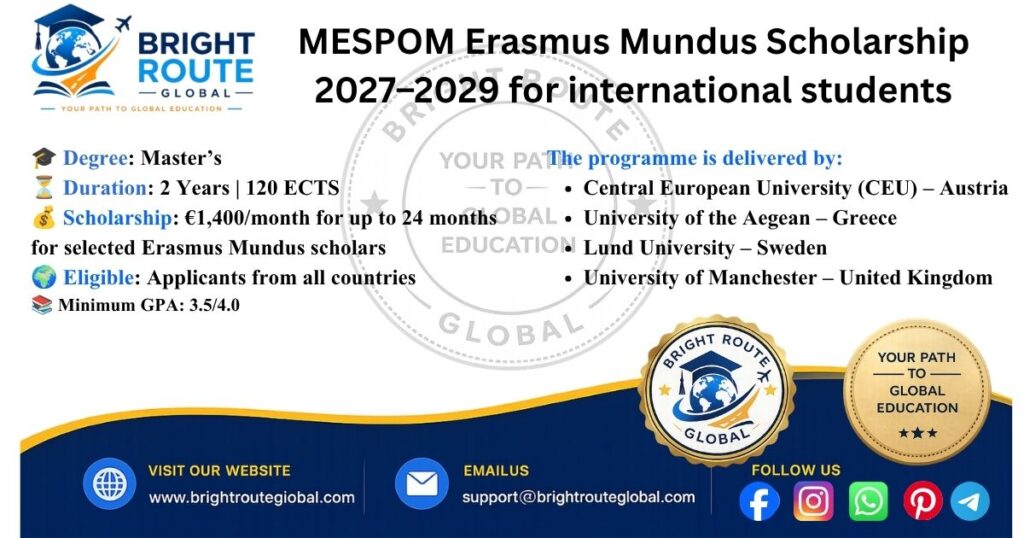
For the 2027–2029 intake, students seeking Erasmus Mundus scholarship or financial-aid consideration should submit their applications by 7 January 2027 at 23:59 CET. The programme is open to applicants from all countries and requires a minimum bachelor’s GPA of 3.5/4.0.
Scholarship Overview
MESPOM is particularly suitable for applicants who want an interdisciplinary understanding of environmental problems. Instead of focusing only on environmental science, the programme connects scientific knowledge with policy, governance and management.
At a Glance
| Category | Details |
|---|---|
| Programme | MESPOM – Environmental Sciences, Policy and Management |
| Degree Level | Master’s |
| Programme Type | Erasmus Mundus Joint Master |
| Intake | 2027–2029 |
| Duration | 2 years |
| Credits | 120 ECTS |
| Study Mode | Full-time |
| Language | English |
| Eligible Nationalities | Applicants from all countries |
| Partner Universities | Central European University, University of the Aegean, Lund University, University of Manchester |
| Study Countries | Austria, Greece, Sweden and the United Kingdom |
| Minimum Bachelor’s GPA | 3.5/4.0 |
| Scholarship/Funding Deadline | 7 January 2027, 23:59 CET |
| Application Route | Online application through the MESPOM/CEU admissions system |
MESPOM has been operating since 2005 and has developed an international alumni community. The programme prepares students to address complex environmental challenges in international settings.
About MESPOM
MESPOM stands for Environmental Sciences, Policy and Management.
The programme is designed around the idea that environmental challenges cannot be solved through science alone. Climate change, pollution, biodiversity loss, resource management and sustainable development also require effective public policy, governance and management.
Students therefore receive interdisciplinary training and gain experience working across different academic and national environments.
The programme is delivered by:
- Central European University (CEU) – Austria
- University of the Aegean – Greece
- Lund University – Sweden
- University of Manchester – United Kingdom
The consortium structure gives students exposure to different academic perspectives and environmental policy contexts.
Why Study MESPOM?
One of the biggest advantages of MESPOM is its international mobility.
Students do not simply complete a conventional two-year degree at one university. Instead, the programme includes study periods at different consortium institutions, providing exposure to different countries, academic systems and approaches to environmental problems.
The programme can be particularly valuable for students interested in:
- Environmental sustainability
- Climate change
- Environmental policy
- Sustainable development
- Biodiversity and conservation
- Environmental management
- Pollution and environmental protection
- Sustainable production and consumption
- Environmental governance
- Natural-resource management
- Environmental research
The interdisciplinary structure can also benefit applicants coming from different academic backgrounds who want to move into environmental policy or sustainability-related careers.
Degree Structure
MESPOM is a two-year, 120 ECTS master’s programme.
The study structure involves mobility between consortium universities. Students begin their studies in the first year and later follow a second-year track connected with their academic and professional interests.
The programme also includes practical experience through an internship and a final thesis/research period.
The international structure is one of the defining features of MESPOM and means students should be comfortable with moving between countries, adapting to new academic environments and managing international mobility.
Areas of Study
MESPOM covers environmental issues from scientific, policy and management perspectives.
Potential areas of interest include:
- Climate change and sustainable energy
- Biodiversity and ecosystem management
- Environmental policy and governance
- Sustainable development
- Environmental security and justice
- Land and water management
- Pollution control
- Sustainable consumption and production
- Industrial environmental management
- Urban sustainability
- Sustainable tourism
- Environmental planning
The exact courses and academic options depend on the programme structure and the student’s study pathway.
MESPOM Erasmus Mundus Scholarship Benefits
The Erasmus Mundus scholarship is highly competitive and is awarded to selected students rather than automatically to every MESPOM applicant.
Under the current Erasmus Mundus framework, the scholarship is calculated at €1,400 per month, with a maximum duration of 24 months for a two-year programme. This gives a potential maximum scholarship value of €33,600 over 24 months.
For MESPOM scholarship recipients, financial support can include:
| Benefit | Details |
|---|---|
| Monthly allowance | €1,400 per month under the Erasmus Mundus scholarship framework |
| Duration | Up to 24 months |
| Travel support | Included within the Erasmus Mundus scholarship framework |
| Visa support | Included within the scholarship framework |
| Installation support | Included within the scholarship framework |
| Subsistence | Financial support for living costs |
| Tuition/participation costs | Scholarship holders receive support according to Erasmus Mundus/MESPOM funding arrangements |
| International mobility | Study across multiple partner countries |
The official Erasmus+ programme explains that Erasmus Mundus scholarships contribute to participation costs and provide support for travel, visa and living expenses.
Important: Admission to MESPOM does not automatically mean that an applicant receives an Erasmus Mundus scholarship. Scholarship selection is competitive.
Hidden Costs
Even with substantial Erasmus Mundus funding, students should prepare financially for expenses that may not be completely covered or may arise before scholarship payments begin.
| Possible Expense | What Applicants Should Consider |
|---|---|
| Passport | Obtain or renew your passport before travelling |
| Initial travel expenses | You may need money before receiving scholarship funds |
| Accommodation deposits | Housing may require an initial deposit |
| Personal expenses | Clothing, communication, entertainment and other personal costs |
| Banking | International banking and currency-exchange charges may apply |
| Academic/personal materials | Some study-related or personal materials may require additional spending |
| Emergency expenses | Keep an emergency financial reserve |
Applicants should always follow the final financial instructions provided by MESPOM for their intake.
Eligibility Criteria
MESPOM is open to applicants from all countries, subject to the programme’s admission requirements.
Applicants generally need:
- A bachelor’s degree or equivalent qualification.
- A minimum bachelor’s GPA of 3.5/4.0.
- A relevant academic or professional connection to environmental challenges.
- Proof of English proficiency unless an applicable exemption is granted.
- Strong academic potential and motivation.
- The ability to complete the programme’s international mobility requirements.
Relevant academic backgrounds can include environmental sciences, natural sciences, agriculture, engineering, economics, social sciences, management, law, policy and related areas.
Applicants from other academic fields may also be considered when they can demonstrate meaningful interest or experience related to environmental challenges.
There is no general age limit stated for the 2027–2029 intake.
English Language Requirements
Applicants must demonstrate English proficiency unless they qualify for an exemption.
Current published requirements include recognised English-language tests such as:
| Test | Minimum Score |
|---|---|
| IELTS Academic | 6.5 |
| TOEFL iBT | 88 |
| TOEFL paper-based | 570 |
| Pearson Academic | 59 |
| Cambridge C1 Advanced/C2 Proficiency | 180 |
| Duolingo English Test | 125 |
| Euroexam Academic | Pass |
Applicants who completed a qualifying degree entirely in English may be able to request an exemption, but this should not be assumed automatically.
Applicants interested in the University of Manchester pathway should pay particular attention to its additional English-language requirements, as meeting the general MESPOM requirement may not automatically satisfy every Manchester condition.
Required Documents
Applicants should prepare their documents before starting the online application.
| Checklist | Document |
|---|---|
| ☐ | Online application form |
| ☐ | Bachelor’s degree certificate or equivalent |
| ☐ | Official academic transcript |
| ☐ | CV/Resume |
| ☐ | Career goals/personal statement |
| ☐ | Two recommendation letters |
| ☐ | English-language test result or exemption request |
| ☐ | Other supporting documents requested by the application portal |
| ☐ | Proof of residency, if requested |
The career-goals statement is particularly important because the published requirements limit it to 350 words. Applicants should use this limited space carefully to explain their environmental interests, career plans and reasons for choosing MESPOM.
How to Apply for MESPOM 2027–2029
Step 1: Check Your Academic Eligibility
First, verify that your bachelor’s qualification meets the programme requirements and that your GPA is at least 3.5/4.0.
Step 2: Review the Programme Structure
Understand the mobility structure and the different partner universities. Think carefully about how MESPOM fits your academic and career goals.
Step 3: Check the English Requirement
Determine whether you need an English-language test or can request an exemption.
Step 4: Prepare Your Documents
Prepare your academic transcripts, degree certificate, CV, recommendation letters and required statement before beginning the application.
Step 5: Select Your Referees
Choose two referees who can provide meaningful information about your academic, professional or research abilities.
Step 6: Complete the Online Application
Central European University manages the MESPOM application process on behalf of the consortium. Complete the online application carefully and upload the required documents.
Step 7: Apply for Financial Aid
If you want to be considered for Erasmus Mundus scholarship/financial aid, make sure your complete application is submitted by the 7 January 2027, 23:59 CET deadline.
Step 8: Check Your Application Portal
After submission, regularly monitor your application portal and make sure your referees complete their recommendation submissions.
Application Timeline
For the 2027–2029 intake, the key deadlines are:
| Application Category | Deadline |
|---|---|
| Erasmus Mundus scholarship/financial-aid applicants | 7 January 2027, 23:59 CET |
| Self-financing applicants from outside EU/EEA requiring a study visa | 15 April 2027 |
| Eligible later self-financing applicants | 15 July 2027 |
If you need scholarship funding, the January deadline is the important date. Applying during a later self-financing round does not provide the same scholarship opportunity.
Selection Criteria
MESPOM admission is competitive.
The selection process considers factors such as:
- Academic excellence
- Academic background
- Motivation
- Relevant professional or voluntary experience
- Interest in environmental challenges
- Career objectives
- Overall suitability for an interdisciplinary international programme
Meeting the minimum GPA does not guarantee admission or a scholarship.
Applicants should therefore demonstrate a clear connection between their previous studies or experiences, their environmental interests and their future career plans.
Accommodation & Living Costs
Because MESPOM involves international mobility, accommodation arrangements and living costs can vary significantly depending on the country and city where students are studying.
Vienna, Lesvos, Lund and Manchester have different housing markets and living expenses.
Students should research accommodation well in advance, particularly because mobility means they may need to arrange housing more than once during the programme.
Scholarship recipients receive financial support under the Erasmus Mundus funding framework, but students should still maintain a personal emergency fund for expenses that arise during international relocation.
Internship and Practical Experience
MESPOM is not limited to classroom-based study.
The programme includes an internship component that can help students connect academic knowledge with real environmental challenges.
This practical exposure can be useful for students planning careers in:
- Environmental consulting
- Government and public policy
- International organisations
- NGOs
- Sustainability
- Environmental research
- Corporate environmental management
- Development organisations
- Academia
Career Opportunities
MESPOM graduates can pursue careers in environmental policy, sustainability, research, government, international organisations, business and non-governmental organisations.
The programme’s interdisciplinary approach can be especially useful for applicants who want to work at the intersection of environmental science, public policy and management.
Some graduates also continue into doctoral research or other advanced academic opportunities.
Tips from Previous Applicants
- Start preparing your documents several weeks before the deadline.
- Do not treat the 350-word career statement as a generic motivation letter.
- Clearly connect your academic or professional background with environmental challenges.
- Research the different mobility options before applying.
- Ask your referees early so they have enough time to submit their recommendations.
- Check English requirements carefully if you are interested in the Manchester pathway.
- Apply early rather than waiting until the final hours.
Common Mistakes to Avoid
- Applying after the 7 January 2027 financial-aid deadline when you actually need scholarship funding.
- Ignoring the minimum 3.5/4.0 bachelor’s GPA requirement.
- Writing a generic statement without explaining your environmental interests.
- Exceeding the 350-word limit for the career-goals statement.
- Choosing referees at the last minute.
- Assuming an English-language exemption automatically satisfies every partner university’s requirements.
- Uploading incomplete or unclear academic documents.
Frequently Asked Questions
1. What is MESPOM?
MESPOM is an Erasmus Mundus Joint Master in Environmental Sciences, Policy and Management, delivered by a consortium of European universities.
2. How long is the MESPOM programme?
The programme lasts two years and carries 120 ECTS credits.
3. Is MESPOM an Erasmus Mundus programme?
Yes. MESPOM is an Erasmus Mundus Joint Master Degree supported through the Erasmus+ framework.
4. Who can apply for MESPOM?
Applicants from all countries can apply if they meet the academic, English-language and other programme requirements.
5. What is the minimum GPA for MESPOM?
The current 2027–2029 information states a minimum bachelor’s GPA of 3.5/4.0.
6. How much is the Erasmus Mundus scholarship?
The current Erasmus Mundus scholarship framework provides €1,400 per month, for up to 24 months for a two-year programme.
7. What can the Erasmus Mundus scholarship cover?
Erasmus Mundus scholarships contribute toward participation costs and provide support for travel, visa and living expenses.
8. What is the MESPOM scholarship deadline?
For the 2027–2029 intake, applicants seeking financial aid should apply by 7 January 2027 at 23:59 CET.
9. Do I need IELTS for MESPOM?
Applicants need to demonstrate English proficiency unless they qualify for an approved exemption. Several recognised English tests are accepted.
10. Can students from Bangladesh apply?
Yes. MESPOM is open to applicants from all countries, provided they meet the admission requirements.
11. What academic backgrounds are accepted?
Relevant backgrounds include environmental sciences, natural sciences, engineering, agriculture, economics, social sciences, management, law and related disciplines. Applicants from other fields may also be considered if they demonstrate meaningful engagement with environmental issues.
12. How many recommendation letters are required?
The current application information indicates that applicants should provide two recommendation letters.
13. Where will MESPOM students study?
The programme is delivered through Central European University, the University of the Aegean, Lund University and the University of Manchester, with mobility between partner institutions.
14. Is MESPOM fully funded?
Selected Erasmus Mundus scholarship recipients can receive substantial funding covering participation-related costs and contributing to travel, visa and living expenses. However, admission does not guarantee a scholarship.
15. Where can I apply?
Applications are submitted through the MESPOM admissions system managed by Central European University. Applicants should use the official MESPOM website and current application instructions.
Conclusion
The MESPOM Erasmus Mundus Joint Master 2027–2029 is a strong option for students who want an international career in environmental science, sustainability, environmental policy or management.
The two-year, 120-ECTS programme combines interdisciplinary education with international mobility and practical experience across several European universities.
The Erasmus Mundus scholarship can provide significant financial support, including a €1,400 monthly scholarship rate for up to 24 months under the current Erasmus Mundus framework.
For applicants seeking scholarship or financial-aid consideration, the most important deadline is 7 January 2027 at 23:59 CET. Because the programme is competitive, applicants should begin preparing their academic documents, English-language evidence, CV, recommendation letters and 350-word career statement well before the deadline.
Always check the official MESPOM application portal for the final requirements before submitting your application.
University of Southern Denmark Scholarships : How to Apply
University of Southern Denmark Scholarships 2027: Eligibility, Benefits and How...
Read More
Aalto University Scholarships 2027 Full Details
Aalto University Scholarships 2027: Eligibility, Tuition Fees and How to...
Read More
UN Volunteers Opportunities 2026–2027: How to Apply
UN Volunteers Opportunities 2026–2027: Eligibility, Benefits and Application Process Explore...
Read More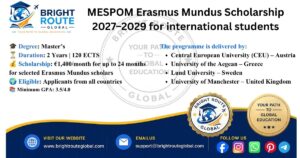
MESPOM Erasmus Mundus Scholarship 2027–2029
MESPOM Erasmus Mundus Scholarship 2027–2029: Fully Funded Master’s in Europe...
Read More
Australian Catholic University (ACU) Scholarships
Australian Catholic University (ACU) Admissions 2027: Courses, Scholarships and How...
Read More
University of Southern Denmark Scholarships : How to Apply
University of Southern Denmark Scholarships 2027: Eligibility, Benefits and How...
Read More
Aalto University Scholarships 2027 Full Details
Aalto University Scholarships 2027: Eligibility, Tuition Fees and How to...
Read More
UBD Graduate Research Scholarship 2027: PhD Funding
UBD Graduate Research Scholarship 2027: Fully Funded PhD in Brunei...
Read More