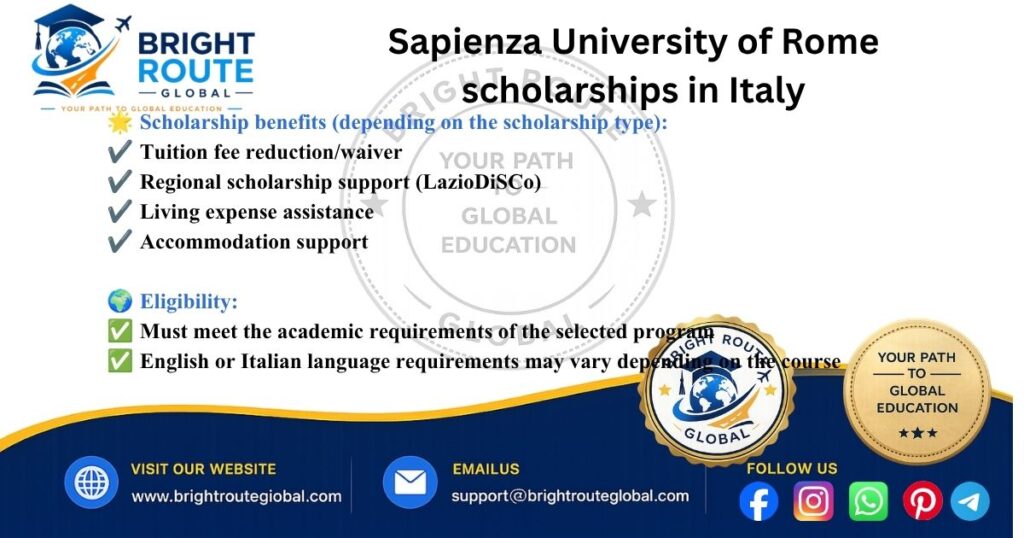
Sapienza University of Rome Scholarships 2026–2027
Explore Sapienza University of Rome scholarships, including Lazio DiSCo, merit awards, thesis funding, study abroad support and eligibility.
Studying in Italy can become more affordable through scholarships, tuition benefits, regional financial aid and university-funded opportunities. The Sapienza University of Rome provides a range of scholarships and financial support options for Italian and international students at different stages of study.
The university’s official scholarship page currently lists opportunities including regional scholarships and housing, merit-based awards, thesis scholarships, research and working scholarships, student-collaboration scholarships, study-abroad funding and scholarships for international students.
For international students, Sapienza is particularly attractive because tuition fees for Bachelor’s and Master’s programmes can be relatively low compared with many universities in other countries. For English-taught programmes, Sapienza currently states that annual tuition can range from approximately €300 to €1,500, depending on the student’s country of residence, while additional scholarships may be available based on academic merit and/or family income.
Scholarship Overview
The Sapienza scholarship system is not a single award. Students may apply for different opportunities depending on their nationality, academic level, financial situation, programme and type of study.
| Feature | Details |
|---|---|
| University | Sapienza University of Rome |
| Location | Rome, Italy |
| Study levels | Bachelor’s, Master’s, PhD/research and other study activities |
| Eligible students | Italian and international students, depending on the specific call |
| Main funding types | University scholarships, regional scholarships, merit awards, thesis funding, research/working opportunities and study-abroad funding |
| Regional funding | Lazio DiSCo scholarships and housing |
| Merit scholarship | “Wanted the Best” / Worthy Students Scholarship |
| International opportunities | Thesis, post-degree and study-abroad scholarships |
| Current notable call | 85 two-year scholarships of €3,000 per year for eligible Master’s students |
| Study options | Italian- and English-taught programmes |
| Official source | Sapienza University of Rome |
Sapienza advises students to check the individual call for each scholarship because eligibility, documents, deadlines and award amounts vary.
University Overview
Sapienza University of Rome is a major public university located in Rome, Italy. It offers a broad range of degree programmes and research opportunities across numerous academic disciplines.
International students can find Bachelor’s and Master’s programmes taught in English as well as programmes taught in Italian. For selected English-taught programmes, international applicants must complete a pre-selection procedure before proceeding with the rest of the admission process.
Sapienza also provides dedicated services for international students, including admission guidance, qualification assessment and enrolment support.
Why Study at Sapienza University of Rome?
Affordable tuition
Sapienza states that full tuition for its Bachelor’s and Master’s programmes is approximately €300–€1,500 per year for the English-taught programme framework, depending on the student’s country of residence.
Multiple scholarship options
Students can explore university, regional, government and merit-based funding rather than depending on a single scholarship programme.
Study in Rome
Students have the opportunity to study in one of Europe’s major academic and cultural cities while accessing a large public university system.
English-taught programmes
Sapienza offers a selection of Bachelor’s and Master’s programmes in English, although admission requirements and deadlines differ by programme.
International mobility
The university also supports study and traineeship opportunities abroad through Erasmus+ and other funding schemes.
Degree Levels and Scholarship Opportunities
The scholarship opportunities available through Sapienza cover different stages of academic study.
Bachelor’s and Master’s students
Students may benefit from regional scholarships, housing support, university scholarships, student-collaboration opportunities and other financial benefits.
Master’s students
Certain merit-based scholarships are specifically available to Master’s students. The current Wanted the Best call, for example, offers 85 two-year scholarships to eligible graduates from other Italian universities who enrol in a Master’s programme at Sapienza in 2026–2027.
Research and postgraduate students
Sapienza also offers research, thesis and post-degree opportunities.
Students studying abroad
International thesis scholarships and Erasmus+/study-abroad funding can support eligible Sapienza students undertaking approved academic activities abroad.
Main Scholarship Opportunities at Sapienza
Regional Scholarships and Housing – Lazio DiSCo
One of the important funding routes for students in Rome is the Lazio DiSCo regional scholarship system.
DiSCo is the regional agency responsible for scholarships and housing assignments. Students must participate in a competitive selection process to be considered for these benefits.
The exact financial support, eligibility requirements and application deadlines are determined through the relevant regional call.
International students should pay particular attention to requirements concerning family income, financial documentation and residency status.
Wanted the Best Scholarship
The Wanted the Best scholarship is a merit-based opportunity listed by Sapienza for the 2026–2027 academic year.
The current call provides:
- 85 scholarships
- €3,000 per year
- Two-year duration
- Master’s degree enrolment at Sapienza
- For eligible graduates of other Italian universities
- Required first-degree result between 105/110 and 110/110 cum laude
- Application deadline: October 30, 2026
This particular scholarship is therefore not a general scholarship open to every international applicant. Candidates should carefully read the official call before applying.
International Thesis Scholarships
Sapienza offers financial support for eligible students who undertake dissertation-related study abroad.
The university describes these scholarships as financial benefits designed to promote international mobility and study-abroad experiences for students enrolled in degree programmes.
International Post-degree Scholarship
This opportunity is intended for eligible Sapienza graduates undertaking third-cycle study or postgraduate advanced training at international university-level institutions outside Italy.
For the 2026 call, the scholarship provides €1,290 per month, with a duration of 6 to 12 months. The current call awarded a total of 400 months of scholarships.
For non-Italian citizens, the host institution must be located in a country different from the candidate’s country of origin.
The 2026 application deadline was September 16, 2026.
Student-Collaboration Scholarships
Sapienza also provides paid student collaboration opportunities for students enrolled beyond their first year.
Selected students may collaborate with university structures such as libraries, laboratories, information centres and other student services.
The official scholarship page states that these collaborations generally involve 150 hours of paid activities, with a standard grant of €1,295. A separate support activity for students with disabilities and specific learning difficulties is listed at €1,500 tax-free.
Study-Abroad Scholarships
Students can also access scholarships supporting study or traineeship experiences abroad through Erasmus+ and Sapienza-funded opportunities.
Sapienza’s Erasmus+ programme provides opportunities for student mobility at partner universities in Europe.
Scholarship Benefits
Benefits vary according to the scholarship and may include:
- Tuition fee reductions or exemptions
- Annual scholarship payments
- Monthly financial support
- Housing assistance
- Regional financial aid
- Study-abroad funding
- Thesis support
- Research-related funding
- Paid student collaboration opportunities
- Support for postgraduate activities abroad
Not every scholarship provides all of these benefits. Applicants should always check the individual call before assuming that tuition, accommodation or living expenses are covered.
Hidden Costs to Consider
Winning a scholarship does not necessarily mean that all study and living expenses will be covered.
| Possible Expense | What to Consider |
|---|---|
| Application fees | Some programmes may charge application or pre-selection fees |
| Tuition | Scholarship coverage depends on the specific award |
| Accommodation | Housing may require a separate application |
| Food | Regional or university support may have specific conditions |
| Visa | International students should budget for visa-related costs |
| Residence permit | Non-EU students may have additional administrative costs |
| Health insurance | Requirements depend on nationality and residence status |
| Travel | Flights to and from Italy are not automatically covered |
| Books and supplies | Students may need to pay for academic materials |
| Personal expenses | Transport and daily living costs remain important |
For English-taught programmes, Sapienza currently lists a pre-selection fee of €30 per application, with a maximum of two applications per candidate per intake where pre-selection is required.

Eligibility Criteria
There is no single eligibility requirement for all Sapienza scholarships because each opportunity has its own rules.
Depending on the scholarship, applicants may need to meet requirements related to:
- Academic performance
- Degree level
- Programme or faculty
- Family income or financial circumstances
- Nationality
- Residence status
- Previous university
- Year of study
- Research or thesis activity
- Age
- Academic merit
- Admission or enrolment status
For example, the current Wanted the Best scholarship has specific academic and university-of-origin requirements, while Lazio DiSCo scholarships operate under separate regional rules.
Required Documents
The exact document list should always be taken from the specific scholarship call.
| Document | May Be Required |
|---|---|
| Passport/ID | ✓ |
| Academic transcripts | ✓ |
| Degree certificate | ✓ |
| Proof of enrolment/admission | ✓ |
| Academic merit documents | Depending on scholarship |
| Family income documents | For income-based benefits |
| Research proposal | For research opportunities |
| Thesis information | For thesis scholarships |
| CV | Depending on the call |
| Motivation statement | Depending on the call |
| Language certificate | If required by the programme |
| Residence documents | Depending on eligibility |
| Financial documents | For regional/income-based scholarships |
International applicants should prepare certified translations, legalisation or other forms of qualification verification when required by the admission or scholarship procedure.
How to Apply for Sapienza Scholarships
Because Sapienza has several different scholarship schemes, there is no single application form for all scholarships.
Step 1: Choose your degree programme
First identify the Bachelor’s, Master’s or other programme you want to study at Sapienza.
Step 2: Check your admission requirements
Review the programme’s academic, language and admission requirements. International applicants should also check whether their programme requires pre-selection.
Step 3: Identify suitable scholarships
Visit the official Sapienza scholarship page and review opportunities based on your nationality, academic level, financial circumstances and type of study.
Step 4: Read the specific call
Check the official call carefully for:
- Eligibility
- Scholarship amount
- Required documents
- Application method
- Deadline
- Selection procedure
- Payment conditions
Step 5: Prepare your documents
Collect academic records, identification documents, financial documents and any programme-specific materials.
Step 6: Submit the scholarship application
Apply through the platform specified in the individual call. Some scholarships are administered by Sapienza, while others are managed by external or regional bodies such as Lazio DiSCo.
Step 7: Complete university admission separately
A scholarship application does not automatically replace the university admission process. International applicants must complete the applicable admission and enrolment procedures.
Step 8: Monitor the results
Check the relevant scholarship portal, Sapienza account or official publication for rankings and award decisions.
Application Timeline
Scholarship deadlines differ considerably.
For example, the current Wanted the Best 2026–2027 scholarship has a deadline of October 30, 2026, while the 2026 International Post-degree Scholarship had a deadline of September 16, 2026.
Lazio DiSCo and other scholarships have their own annual calls and deadlines.
Important: Do not rely on one general Sapienza scholarship deadline. Always check the individual call for the scholarship you intend to apply for.
Admission and Scholarship: An Important Difference
Students should understand that admission and scholarship applications can be separate processes.
For international applicants, Sapienza’s admission process may include qualification assessment, language requirements, pre-selection, Universitaly procedures and document verification depending on nationality and programme.
For English-taught programmes, Sapienza currently requires specific pre-selection procedures for applicable programmes. Non-EU applicants living abroad who require a visa had a 2026–2027 pre-selection deadline of May 15, 2026.
Therefore, students planning a future intake should start checking admission and scholarship deadlines well in advance.
Tips for Applicants
- Check the exact scholarship category before preparing your application.
- Do not assume that every Sapienza scholarship is available to international students.
- Keep academic and financial documents ready before the call opens.
- Apply separately for regional scholarships when required.
- Check whether your programme has an earlier admission deadline.
- Read the full call rather than relying only on scholarship summaries.
- Keep copies of submitted documents and application confirmations.
Common Mistakes to Avoid
- Treating the Sapienza scholarship page as one single scholarship.
- Assuming every scholarship covers full tuition and living expenses.
- Missing a programme-specific admission deadline.
- Applying without checking nationality or residency requirements.
- Submitting incomplete financial documents for income-based benefits.
- Confusing scholarship application deadlines with university admission deadlines.
- Waiting until the final day to prepare documents or translations.
Frequently Asked Questions
1. Does Sapienza University offer scholarships to international students?
Yes. Sapienza lists several opportunities involving international students, including regional scholarships, merit-based opportunities, thesis scholarships and other forms of financial support. Eligibility depends on the individual call.
2. Is there one Sapienza University scholarship for all international students?
No. Sapienza has multiple scholarship and financial-support schemes, each with its own eligibility requirements and application process.
3. How much is the Wanted the Best scholarship?
The current 2026–2027 call offers €3,000 per year for two years to eligible selected students. There are 85 scholarships.
4. Can international students apply for Lazio DiSCo scholarships?
International students may be eligible under the relevant regional rules, but applicants must check the current Lazio DiSCo call and its documentation requirements.
5. Does Sapienza offer scholarships based on family income?
Yes. Sapienza states that various scholarships and benefits can be awarded based on academic merit and/or family income.
6. Does Sapienza offer scholarships for students studying abroad?
Yes. The university lists International Thesis Scholarships and study-abroad opportunities through Erasmus+ and Sapienza funding.
7. What is the International Post-degree Scholarship?
It supports eligible Sapienza graduates undertaking third-cycle study or postgraduate advanced training at international university-level institutions outside Italy.
8. How much does the International Post-degree Scholarship pay?
The 2026 call states a monthly amount of €1,290, with a duration between six and twelve months.
9. Are tuition fees low at Sapienza?
For English-taught Bachelor’s and Master’s programmes, Sapienza currently states tuition of approximately €300–€1,500 per year, depending on country of residence.
10. Do I need to apply for a scholarship separately?
In many cases, yes. Sapienza’s international admissions information states that scholarships require a separate application. However, the exact process depends on the scholarship.
11. Can I apply for more than one scholarship?
This depends on the rules of the individual scholarship calls. Some benefits may also have restrictions on combining awards.
12. Is admission to Sapienza automatically granted when I receive a scholarship?
No. Scholarship selection and university admission can involve separate procedures and requirements.
13. Does Sapienza provide accommodation?
Accommodation support is available through schemes including Lazio DiSCo and Sapienza residence calls, subject to their respective eligibility and selection procedures.
14. Where can I find current scholarship deadlines?
The safest source is the official Sapienza scholarship page and the individual call for applications. Deadlines vary considerably between opportunities.
Conclusion
Sapienza University of Rome offers a broad range of scholarship and financial-support opportunities rather than a single universal scholarship. International students can explore regional funding through Lazio DiSCo, merit-based scholarships, thesis and study-abroad support, student collaboration opportunities and other university or government schemes.
For students considering Italy, Sapienza can also be attractive because the university currently lists relatively low tuition for its English-taught Bachelor’s and Master’s programmes, while additional financial support may be available depending on academic merit, family income and the student’s circumstances.
Before applying, always check the specific scholarship call, confirm your eligibility, prepare the required documents and keep the scholarship deadline separate from the university admission deadline.
Czech Government Scholarship 2027/28
Czech Government Scholarship 2027/28 for Developing Countries Scholarship Overview Learn...
Read More
Open Doors Russian Scholarship 2026–27
Open Doors Russian Scholarship 2026–27 Scholarship Overview Apply for the...
Read More
EMABG Erasmus Mundus Scholarship 2027
Apply for the EMABG Erasmus Mundus Master 2027 with €1,400/month...
Read More
Helmut Veith Stipend 2026 at Vienna, Austria
Helmut Veith Stipend 2026: €7,000 Scholarship at TU Wien Apply...
Read More
Czech Government Scholarship 2027/28
Czech Government Scholarship 2027/28 for Developing Countries Scholarship Overview Learn...
Read More
Open Doors Russian Scholarship 2026–27
Open Doors Russian Scholarship 2026–27 Scholarship Overview Apply for the...
Read More
Universiti Malaya Bright Scholarship 2026/27
Universiti Malaya Bright Scholarship 2026/27 Apply for the UM Bright...
Read More
University of Manitoba Scholarships & Admissions 2027
University of Manitoba International Admissions & Scholarships 2027 Explore University...
Read More