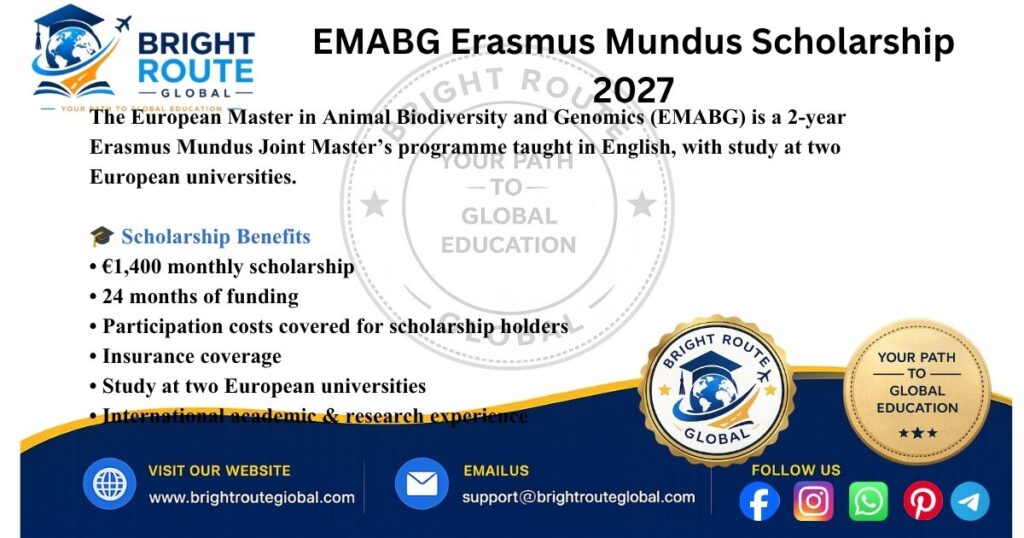
Apply for the EMABG Erasmus Mundus Master 2027 with €1,400/month for 24 months. Check eligibility, benefits, documents and deadline.
The European Master in Animal Biodiversity and Genomics (EMABG) is a two-year Erasmus Mundus Joint Master’s programme designed for students interested in animal science, biodiversity, breeding, genetics and genomics. The programme is taught in English and allows students to study at two universities within its international consortium.
The EMABG programme is particularly relevant for students who want to build careers in animal breeding, genomics, biodiversity, research, agriculture and related industries. For the third intake, the application round opens on 15 September 2026 and remains open until 15 January 2027 for Erasmus Mundus Joint Master (EMJM) scholarship applicants.
Scholarship Overview
EMABG is an Erasmus Mundus Joint Master (EMJM) programme. A limited number of EMJM scholarships are available for each intake, with the programme currently indicating around 15 scholarships.
The scholarship provides €1,400 per month for 24 months. Programme information states that scholarship holders have their participation costs and insurance covered. The scholarship is intended to help with food, accommodation, travel and visa-related costs.
At a Glance
| Feature | Details |
|---|---|
| Programme | European Master in Animal Biodiversity and Genomics |
| Degree | Master’s |
| Duration | 2 years |
| Teaching Language | English |
| Programme Type | Erasmus Mundus Joint Master |
| Scholarship | €1,400/month |
| Scholarship Duration | 24 months |
| Approx. Scholarships | Around 15 per intake |
| Tuition/Participation Costs | Covered for EMJM scholarship holders |
| Insurance | Covered by the programme |
| Application Opens | 15 September 2026 |
| Scholarship Deadline | 15 January 2027 |
| Application Method | Online application database |
| Main Fields | Animal science, biodiversity, breeding, genetics, genomics |
The official programme website confirms that the third intake application round begins on 15 September 2026 and closes on 15 January 2027.
University and Consortium Overview
EMABG is a joint European programme rather than a traditional Master’s degree offered by only one university. Students spend their studies at two of the consortium universities, depending on their selected study track.
The programme involves an international consortium including universities such as:
- BOKU University, Austria
- Norwegian University of Life Sciences (NMBU), Norway
- University of Göttingen, Germany
- Swedish University of Agricultural Sciences (SLU), Sweden
- Wageningen University & Research (WUR), Netherlands
- AgroParisTech (APT), France
This structure gives students the opportunity to experience different European academic and research environments during the Master’s programme.
Why Study EMABG?
EMABG is designed around major scientific and practical challenges involving animal production, biodiversity and genomics.
Students can develop knowledge relevant to:
- Animal breeding and genetics
- Genomics and biodiversity
- Biostatistics and bioinformatics
- Sustainable animal production
- Research and scientific analysis
- Conservation and biodiversity management
- International agricultural and animal industries
The programme combines academic study with international mobility, allowing students to experience two different consortium universities during their Master’s degree.
Degree Level and Programme Structure
EMABG is a two-year Master’s programme taught in English.
Students study at two different consortium universities. The programme therefore combines academic mobility with specialised study in animal biodiversity, genetics, genomics and related areas.
Study Tracks
The EMABG application asks students to indicate their preferred study tracks. The current programme information lists combinations involving:
- NMBU–BOKU
- NMBU–UGOE
- NMBU–APT
- NMBU–SLU
- NMBU–WUR
The study tracks represent different combinations of consortium universities and academic environments. Applicants should indicate their preferred options in their motivation materials.
Scholarship Benefits
Selected EMJM scholarship holders can receive:
- €1,400 monthly scholarship
- Scholarship for 24 months
- Coverage of EMABG participation costs
- Programme-provided insurance
- Financial support intended for living expenses
- Support toward travel and visa-related expenses through the scholarship
- Opportunity to study at two European consortium universities
- International academic and research exposure
The programme states that there are a limited number of scholarships, currently around 15 per intake.
Important Scholarship Conditions
Applicants should understand that the scholarship does not mean every expense is paid in advance.
According to the official scholarship information:
- Students must initially pre-finance travel expenses to the first-year university or Welcome Course location.
- Scholarship payments are made to a European bank account after arrival.
- Accommodation during the Welcome Course, Summer School and Graduation Event must be paid by the student.
- Applicants who have already received an EMJM scholarship are not eligible for another EMJM scholarship.
- Students cannot receive subsistence costs in their country of residence at the time of application.
Participation Costs for Self-Funded Students
Students who do not receive the EMJM scholarship may still be able to participate if they secure their own or third-party funding.
For students from Programme Countries, the current participation cost is €4,500 per year.
For students from third countries not associated with the Erasmus+ Programme, the cost depends on the study track:
| Study Track | Annual Participation Cost |
|---|---|
| NMBU–BOKU | €10,000 |
| NMBU–UGOE | €10,000 |
| NMBU–APT | €10,000 |
| NMBU–SLU | €19,000 |
| NMBU–WUR | €19,000 |
The programme also estimates that students should budget approximately €1,400 per month for living, accommodation and travel expenses over the programme period.
Hidden Costs
Even though EMJM scholarship holders receive substantial financial support, applicants should prepare for some expenses.
| Expense | What Applicants Should Know |
|---|---|
| Initial travel | Travel to the first university/Welcome Course may need to be paid in advance |
| Welcome Course accommodation | Not covered by participation costs |
| Summer Course accommodation | Not covered |
| Graduation accommodation | Not covered |
| Personal expenses | Food and other daily expenses should be planned |
| Travel between locations | Students may need to manage travel-related costs before reimbursement/payment |
| Visa-related expenses | The scholarship is intended to help with visa costs, but applicants should be prepared for upfront payments |
The programme specifically recommends budgeting around €1,400 per month for living, accommodation and travel costs.
Eligibility Criteria
Applicants should normally meet the following academic requirements:
- Hold an Academic Bachelor of Science degree of at least 180 ECTS in Animal Science.
- Graduates from other relevant Bachelor’s programmes may also be considered if they have appropriate academic knowledge.
- Relevant academic preparation should include areas such as agricultural sciences, animal production, mathematics/biostatistics/bioinformatics, zoology, animal anatomy and physiology, biodiversity, breeding, genetics and genomics.
- Applicants who already hold a similar Master’s degree cannot be accepted at the University of Göttingen.
- Meet the required English-language proficiency.
- Submit all required application documents through the official application database.
Applicants from other Bachelor’s backgrounds should carefully compare their previous coursework with the EMABG learning outcomes before applying.
English Language Requirements
The programme currently accepts several English-language qualifications.
| Test | Minimum Requirement |
|---|---|
| TOEFL iBT | 92 overall, including at least 23 in Speaking |
| Academic IELTS | 7.0 overall, including at least 6.5 in Speaking |
| Cambridge C1 Advanced | 180–210, Grade C |
| Cambridge C2 Proficiency | 180–230 or Grade C |
The certificate must normally have been obtained no more than two years before the application deadline. TOEFL paper-based/ITP is not accepted, and IELTS Online and IELTS One Skill Retake are not accepted.
Applicants who completed a qualifying Bachelor’s or Master’s degree completely in English at an eligible institution in Australia, Ireland, Canada except Quebec, New Zealand, the UK or USA may be exempt from submitting a separate English certificate, subject to the programme’s conditions.
Required Documents
Applicants should prepare their documents before beginning the online application.
| Document | Required |
|---|---|
| Passport/identity document | ✓ |
| Bachelor’s degree certificate | ✓ |
| Bachelor’s academic transcript | ✓ |
| English proficiency certificate, if applicable | ✓ |
| Curriculum Vitae | ✓ |
| Motivation materials | ✓ |
| Recommendation letter(s) | ✓ |
| Certificate of current residence | ✓ |
| Other supporting academic documents | If applicable |
Documents that are not in English should be accompanied by an official English translation. The programme also advises applicants to upload a passport by the application deadline.
Step-by-Step Application Process
| Step | What to Do |
|---|---|
| Check eligibility | Review the academic background and English requirements |
| Prepare documents | Collect degree, transcript, passport, CV, recommendations and language certificate |
| Choose study-track preferences | Review the available university combinations |
| Prepare motivation materials | Explain your academic background, interests and reasons for choosing EMABG |
| Register online | Create an account in the EMABG application database |
| Upload documents | Submit all required documents through the online system |
| Complete the application | Make sure no required document or section is missing |
| Submit before the deadline | Submit the complete application by 15 January 2027 for EMJM scholarship consideration |
| Wait for selection | Applications are assessed according to the programme’s selection criteria |
| Follow further instructions | Selected applicants may need to provide original documents or complete additional admission procedures |
The EMABG FAQ states that only applications submitted through the official application database are considered. Applicants should not send separate applications directly to the consortium universities unless specifically instructed.
Application Timeline
For the third EMABG intake, the current timeline is:
- 15 September 2026: Application round opens
- 15 January 2027: EMJM scholarship application deadline
- 15 February 2027: Deadline for non-EU self-paying applicants
- 15 April 2027: Deadline for EU self-paying applicants
The programme advises applicants to check the exact requirements and submit complete documents through the application system.
Selection Criteria
The current EMABG selection information gives the following weighting:
| Selection Area | Weight |
|---|---|
| Diploma/Transcript | 50% |
| Motivation Video | 20% |
| CV | 20% |
| Recommendation Letter | 10% |
Within the diploma/transcript assessment, academic excellence and the relevance of the applicant’s previous academic background are considered. Relevant areas include genetics/genomics, biostatistics/bioinformatics/mathematics, biodiversity and breeding.
The motivation video should demonstrate personal motivation and relevant experience, rather than simply repeating general information from the programme website.
Motivation Video
The motivation video is an important part of the selection process.
According to the current EMABG information, applicants should provide a personal motivation video of a maximum of 2 minutes, in MP4 format and no larger than 50 MB.
A strong video should clearly communicate:
- Why you want to study animal biodiversity and genomics
- Your relevant academic background
- Your research or practical interests
- Why EMABG fits your goals
- What you hope to contribute to the field
The selection committee specifically evaluates personal motivation and relevant experience.
Accommodation and Living Costs
Accommodation arrangements can vary because students move between different universities and countries during the programme.
The EMABG website recommends budgeting approximately €1,400 per month for living expenses, accommodation and travel during the 24-month programme. This is a planning estimate rather than a guaranteed monthly cost for every student.
Students should research accommodation options in their assigned study locations before arrival and keep additional funds available for initial deposits and travel.
Part-Time Work
Because EMABG is an intensive international Master’s programme involving study at multiple locations, students should treat academic responsibilities as their priority.
Part-time employment opportunities depend on the country, university, visa/residence conditions and local labour regulations. Students should not rely on part-time employment as the main source of funding for their EMABG studies.
Student Visa
International students may need visas or residence permits depending on their nationality and the countries where they will study.
Since EMABG students study at two different European universities, visa and residence requirements can differ between study locations.
Applicants should:
- Check the visa requirements after receiving the relevant admission documents.
- Prepare passport and financial documents early.
- Allow sufficient processing time.
- Check the immigration requirements of each country in the study track.
- Keep copies of admission, scholarship and insurance documents.
The EMABG programme processes information that may be required for visa and residence-permit procedures.
Tips for Applicants
- Start preparing your academic documents well before the January deadline.
- Check whether your Bachelor’s coursework matches the EMABG academic requirements.
- Do not wait until the final days to arrange your English test.
- Give special attention to your motivation video because it carries 20% of the selection score.
- Make your CV relevant to animal science, genetics, biodiversity, breeding, research or related activities.
- Clearly explain your preferred study tracks in your motivation materials.
- Submit a complete application through the official database.
Common Mistakes to Avoid
- Applying without checking whether your Bachelor’s background meets the academic requirements.
- Uploading an English test that does not meet the minimum score or validity period.
- Sending documents by email instead of submitting them through the application database.
- Leaving required documents incomplete until after the deadline.
- Making the motivation video generic instead of explaining personal academic and career interests.
- Ignoring the additional costs that scholarship holders may need to pay upfront.
- Waiting until the last day to complete the online application.
Frequently Asked Questions
1. What is the EMABG programme?
EMABG is a two-year Erasmus Mundus Joint Master in Animal Biodiversity and Genomics taught in English. Students study at two consortium universities.
2. How much is the EMABG scholarship?
The current EMJM scholarship is €1,400 per month for 24 months.
3. How many scholarships are available?
The programme currently states that there are around 15 scholarships per intake, although the number is limited and subject to the programme’s funding arrangements.
4. Is the EMABG programme fully funded?
EMJM scholarship holders have their participation costs and insurance covered and receive €1,400 per month. However, some expenses, including certain accommodation and initial travel costs, may need to be paid upfront by the student.
5. What is the application deadline for the scholarship?
The EMJM scholarship application deadline for the third intake is 15 January 2027.
6. Can students from outside Europe apply?
Yes. The programme accepts applicants from Programme Countries and Partner Countries, subject to the applicable academic and scholarship rules.
7. What Bachelor’s degree is required?
The standard requirement is an academic Bachelor’s degree of at least 180 ECTS in Animal Science. Relevant alternative Bachelor’s backgrounds may also be considered if the required learning outcomes are demonstrated.
8. Is IELTS accepted?
Yes. Academic IELTS with an overall score of 7.0 and at least 6.5 in Speaking is currently accepted.
9. Is TOEFL accepted?
Yes. TOEFL iBT requires at least 92 overall, including at least 23 in Speaking.
10. Can I apply if I already have a Master’s degree?
You can apply, but applicants who already hold a similar Master’s degree cannot be accepted at the University of Göttingen.
11. Can final-year Bachelor’s students apply?
Yes, subject to the programme’s graduation deadlines. The current FAQ states that non-EU applicants must complete their studies by 15 March, while EU applicants must graduate by 1 July, with appropriate university confirmation submitted by the application deadline.
12. Do I need to apply separately to each university?
No. EMABG applications are submitted through the programme’s application database. The programme specifically advises applicants not to send additional applications to consortium members unless requested.
13. What are the self-funded tuition costs?
For the current intake, costs range from €4,500 per year for Programme Country students to €10,000 or €19,000 per year for students from third countries, depending on the study track.
14. What is the motivation video requirement?
The motivation video is maximum 2 minutes, in MP4 format, with a maximum file size of 50 MB. It accounts for 20% of the stated selection assessment.
15. Where can I apply?
Applications are submitted through the official EMABG application system linked from the programme website. The current application round runs from 15 September 2026 to 15 January 2027 for EMJM scholarship applicants.
Conclusion
The European Master in Animal Biodiversity and Genomics (EMABG) offers an international Master’s pathway for students interested in animal science, biodiversity, breeding, genetics and genomics. Its Erasmus Mundus structure allows students to study at two European universities while gaining international academic and research experience.
For the 2026–27 application cycle, the programme offers a limited number of EMJM scholarships worth €1,400 per month for 24 months, with participation costs and insurance covered for scholarship holders. Since the scholarship is competitive, applicants should focus on academic relevance, a strong CV, clear motivation and a well-prepared motivation video.
The application window for the third intake opens on 15 September 2026, with the EMJM scholarship deadline on 15 January 2027. Always check the official EMABG website for the latest requirements before submitting your application.
Czech Government Scholarship 2027/28
Czech Government Scholarship 2027/28 for Developing Countries Scholarship Overview Learn...
Read More
Open Doors Russian Scholarship 2026–27
Open Doors Russian Scholarship 2026–27 Scholarship Overview Apply for the...
Read More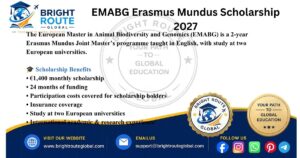
EMABG Erasmus Mundus Scholarship 2027
Apply for the EMABG Erasmus Mundus Master 2027 with €1,400/month...
Read More
Helmut Veith Stipend 2026 at Vienna, Austria
Helmut Veith Stipend 2026: €7,000 Scholarship at TU Wien Apply...
Read More
Czech Government Scholarship 2027/28
Czech Government Scholarship 2027/28 for Developing Countries Scholarship Overview Learn...
Read More
Open Doors Russian Scholarship 2026–27
Open Doors Russian Scholarship 2026–27 Scholarship Overview Apply for the...
Read More
Universiti Malaya Bright Scholarship 2026/27
Universiti Malaya Bright Scholarship 2026/27 Apply for the UM Bright...
Read More
University of Manitoba Scholarships & Admissions 2027
University of Manitoba International Admissions & Scholarships 2027 Explore University...
Read More