Commonwealth Scholarships 2027/28 in the UK | Fully Funded Opportunities
Explore Commonwealth Scholarships 2027/28, including eligibility, benefits, application process, UK study options, visa requirements and FAQs.
The Commonwealth Scholarships 2027/28 offer prestigious study and professional development opportunities for talented applicants from eligible Commonwealth countries. The programmes are administered by the Commonwealth Scholarship Commission (CSC) in the UK and primarily funded by the UK Foreign, Commonwealth & Development Office (FCDO).
The Commonwealth Scholarship programme supports students, researchers, academics and professionals who can use their education and skills to contribute to development in their home countries.
For postgraduate applicants, the Commonwealth Master’s Scholarship is one of the most attractive opportunities. It supports eligible candidates who would otherwise be unable to afford postgraduate study in the UK.
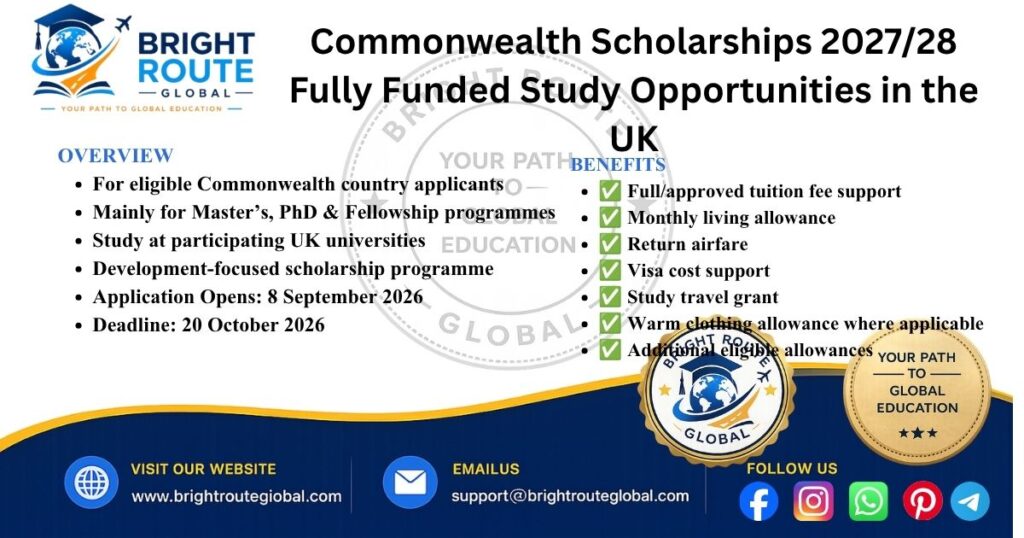
For the 2027/28 cycle, Commonwealth Master’s Scholarship applications are scheduled to open on 8 September 2026 and close on 20 October 2026 at 16:00 BST. Successful candidates are expected to begin their studies in September or October 2027.
Scholarship Overview
The Commonwealth Scholarships are a group of programmes rather than one single award. Depending on the year, opportunities can include Master’s Scholarships, PhD Scholarships, Shared Scholarships, Fellowships and other specialised programmes.
The programme combines academic excellence with development impact. Applicants are expected to explain how their proposed study can help address development challenges in their home countries.
At a Glance
| Information | Details |
|---|---|
| Scholarship | Commonwealth Master’s Scholarship 2027/28 |
| Organiser | Commonwealth Scholarship Commission |
| Funding | UK Foreign, Commonwealth & Development Office |
| Study Country | United Kingdom |
| Degree | One-year taught Master’s |
| Eligible Applicants | Citizens of eligible Commonwealth countries |
| Bangladesh | Eligible for applicable programmes |
| Application Opens | 8 September 2026 |
| Deadline | 20 October 2026, 16:00 BST |
| Study Begins | September/October 2027 |
| Application System | CSC Central |
| Application Fee | No CSC application fee |
| Host Institutions | Participating UK universities |
The CSC’s development priorities include science and technology, health systems, innovation and entrepreneurship, peace and governance, resilience and crisis response, and access, inclusion and opportunity.
University Overview
Commonwealth Scholars study at participating UK universities rather than at one specific institution.
Applicants should select universities based on the relevance and quality of their proposed course rather than relying only on overall rankings. Course modules, faculty expertise, research opportunities, location, accommodation costs and career prospects should all be considered.
For Master’s applicants, the chosen programme should clearly connect with their previous education and future career plans.
For example, an applicant with experience in education could consider programmes related to educational leadership, education policy or digital education and explain how the knowledge gained could address a specific educational challenge in their home country.
Applicants should also check university admission requirements separately because meeting CSC eligibility does not automatically mean that the applicant meets the university’s admission requirements.
Why Study at a UK University?
Studying in the UK through a Commonwealth Scholarship offers several advantages.
Internationally recognised education: UK universities offer specialised Master’s programmes across science, engineering, business, health, education, technology and social sciences.
Research opportunities: Students can access academic experts, research centres, libraries, laboratories and international research networks.
International exposure: Studying with students from different countries can develop communication, collaboration and global professional skills.
Career development: A UK qualification can strengthen professional knowledge and provide access to international academic and professional networks.
Development impact: Commonwealth Scholarships are specifically designed to help talented people develop skills that can contribute to sustainable development in their home countries.
Commonwealth alumni network: The programme has a large international alumni community, creating opportunities for future collaboration and professional networking.
Degree Levels
The CSC offers different scholarship and fellowship programmes, although availability varies by academic year.
Master’s
The Commonwealth Master’s Scholarship supports full-time taught Master’s study in the UK for eligible candidates from low- and middle-income Commonwealth countries.
PhD
Commonwealth PhD opportunities support doctoral study and research for eligible applicants under specific CSC programmes.
Split-site PhD
Commonwealth Split-site Scholarships support eligible PhD candidates registered at a university in an eligible Commonwealth country who undertake part of their research at a UK university. Availability can vary by year.
Professional and Academic Fellowships
Commonwealth Fellowships provide professional development opportunities for eligible mid-career professionals and academic staff, depending on the specific fellowship programme.
Applicants should always check the latest CSC announcement because not every programme is open during every academic year.
Available Fields of Study
Commonwealth Scholarships cover many academic areas depending on the specific programme and approved courses.
Popular areas include:
- Engineering and Technology
- Computer Science and Digital Technology
- Public Health and Health Systems
- Environmental Studies and Climate Change
- Agriculture and Food Security
- Education
- Economics and Development
- Public Policy and Governance
- Business and Entrepreneurship
- Social Sciences
- Peace and Security
Applicants should choose a field that fits both their academic background and their future development objectives.
Scholarship Benefits
The Commonwealth Master’s Scholarship provides substantial financial support for eligible Scholars.
Benefits under the published scholarship conditions can include:
- Approved tuition fees
- Monthly living allowance
- Return airfare
- Visa-related support
- Study travel grant
- Warm clothing allowance where applicable
- Additional eligible allowances under specific circumstances
The current published monthly living allowance is £1,452, increasing to £1,781 for Scholars studying at universities in the London metropolitan area.
The exact benefits and conditions should always be checked against the official scholarship information for the relevant academic year.
Hidden Costs
Even a fully funded scholarship does not necessarily mean that applicants will have no personal expenses.
| Potential Cost | What Applicants Should Consider |
| English-language test | May be required by the university |
| Document translation | Needed for documents not in an accepted language |
| Certification | Some documents may require certification |
| University application costs | Depends on the institution |
| Accommodation deposit | Common for private housing |
| Initial accommodation | May be needed before permanent housing |
| Local transportation | Particularly during arrival |
| Personal expenses | Clothing, toiletries and daily needs |
| Study materials | Books or specialist course materials |
| Initial setup | Bedding, kitchen items and other essentials |
Applicants should keep some personal funds available for their initial arrival in the UK, even when they have secured a scholarship.
Eligibility Criteria
Requirements vary by programme. For the Commonwealth Master’s Scholarship, applicants should generally:
- Be a citizen of or hold refugee status in an eligible Commonwealth country, or be a British Protected Person.
- Be permanently resident in an eligible Commonwealth country.
- Be available to begin academic study in September/October 2027.
- Hold a first degree equivalent to at least a UK upper-second-class standard, or meet the alternative qualification conditions.
- Demonstrate that they could not otherwise afford to study in the UK.
- Meet the admission requirements of the selected university and course.
- Submit all required supporting documents.
- Meet any additional conditions set by the relevant nominating agency.
Applicants should remember that the nominating agency may have additional requirements and an earlier deadline.
Required Documents
Applicants should begin preparing documents before the application opens.
| ✓ | Document | Purpose |
| ☐ | Academic certificates | Evidence of qualifications |
| ☐ | Academic transcripts | Complete academic records |
| ☐ | Passport/ID | Identity and nationality |
| ☐ | CV/Resume | Academic and professional background |
| ☐ | Reference letters | Academic/professional recommendations |
| ☐ | Personal statement | Motivation and background |
| ☐ | Study plan | Proposed course and academic objectives |
| ☐ | Development Impact statement | Expected contribution after study |
| ☐ | Employment information | Relevant professional experience |
| ☐ | Leadership/volunteering details | Evidence of wider engagement |
| ☐ | Publications/prizes | Where applicable |
| ☐ | English-language evidence | If required by the university |
| ☐ | Additional documents | Programme or nominator requirements |
Supporting documents must be submitted according to the CSC’s application instructions. Applicants should not wait until the final day to obtain references or official transcripts.
Step-by-Step Application Process
The Commonwealth Master’s application requires careful preparation because the scholarship application and university admission process are related but separate.
| Step | What to Do | Practical Guidance |
| 1 | Check eligibility | Confirm nationality, academic qualifications and other requirements. |
| 2 | Research courses | Find Master’s programmes related to your academic and career goals. |
| 3 | Choose universities | Compare course content, location, costs and academic strengths. |
| 4 | Select preferences | List up to three suitable university/course choices as required. |
| 5 | Check admission requirements | Review university-specific academic and English requirements. |
| 6 | Apply for admission | Start the university application process as early as possible. |
| 7 | Identify your nominator | Find the relevant national nominating agency or approved organisation. |
| 8 | Check nominator deadline | The nominator may close applications before the CSC deadline. |
| 9 | Prepare documents | Collect transcripts, certificates, CV and references. |
| 10 | Write your statements | Prepare the study plan, personal statement and development-impact responses. |
| 11 | Complete CSC Central | Fill in the official online scholarship application. |
| 12 | Upload documents | Check file formats and make sure nothing is missing. |
| 13 | Review application | Ensure your course, background and development goals are consistent. |
| 14 | Submit | Submit before both the nominator and CSC deadlines. |
| 15 | Wait for selection | Nominations are assessed before final CSC selection. |
| 16 | Complete admission | Meet any outstanding university admission conditions. |
| 17 | Prepare for travel | Complete visa, accommodation and travel arrangements. |
Development Impact Statement
The Development Impact statement is particularly important.
Applicants should clearly explain:
Development problem → Existing experience → Skills gap → UK course → Planned action → Expected outcomes → Beneficiaries → Measurement
Avoid vague statements such as “I want to improve my country.”
Instead, identify a real challenge, explain your relevant experience, show what knowledge you need and describe how you will use that knowledge after graduation.
Application Timeline
For the 2027/28 Commonwealth Master’s Scholarship:
| Stage | Timeline |
| Application opens | 8 September 2026 |
| Application deadline | 20 October 2026, 16:00 BST |
| Nominator assessment | After submission |
| CSC selection | Following nomination and assessment |
| Expected study period | September/October 2027 |
Nominating agencies may set an earlier deadline, so applicants should check their country’s specific instructions before starting the application.
Selection Criteria
The CSC assesses Commonwealth Master’s applications mainly according to:
- Candidate merit
- Quality of the study plan
- Potential development impact
A strong academic record is valuable, but applicants also need to demonstrate why the selected course is important and how the knowledge will be used after graduation.
The strongest applications create a clear connection between:
Academic background → UK course → Development challenge → Career plan → Future impact
Accommodation & Living Costs
Accommodation is usually one of the largest expenses for students in the UK.
Common options include university halls, shared private accommodation and private rental housing.
The CSC currently lists a monthly living allowance of £1,452, or £1,781 for London metropolitan universities.
Students should budget for:
- Accommodation
- Food
- Transportation
- Utilities
- Mobile/internet
- Study materials
- Personal expenses
- Initial arrival costs
London generally has higher accommodation and daily living costs than many smaller UK university cities.
Part-time Jobs
Commonwealth Scholars should not depend on part-time employment to finance their studies.
The CSC’s scholarship conditions state that Scholars must not undertake paid employment during the award without prior CSC approval.
Before accepting any job, Scholars should check the scholarship conditions, Student visa restrictions and university regulations.
Student Visa Process
After receiving the necessary university and scholarship documentation, eligible international students generally follow this process:
University admission → CAS → Visa application → Identity/biometric requirements → Visa decision → Travel to the UK
Common documents may include:
- Valid passport
- CAS
- Scholarship/financial sponsorship evidence
- Academic documents where required
- TB test certificate where applicable
- ATAS certificate where applicable
- Other UKVI-required documents
UK immigration requirements can change, so applicants should always check the latest information on GOV.UK before applying.
Tips from Previous Applicants
- Start preparing several months early.
- Research the course, not just the university ranking.
- Make your development plan specific.
- Use real examples of your achievements.
- Ask referees well in advance.
- Keep your study and career plans consistent.
- Submit before the final day.
Common Mistakes
- Ignoring the nominating agency’s deadline
- Choosing an unrelated Master’s course
- Writing a generic personal statement
- Failing to explain measurable development impact
- Uploading incomplete documents
- Leaving references until the last minute
- Assuming nomination guarantees final selection
Frequently Asked Questions
1. Can Bangladeshi students apply?
Yes. Bangladesh is an eligible Commonwealth country for applicable Commonwealth scholarship programmes, subject to the specific programme requirements.
2. Can I apply directly to the CSC?
For the Commonwealth Master’s Scholarship, applicants must apply through an approved nominating agency or organisation in addition to completing the CSC application.
3. How many universities can I choose?
Commonwealth Master’s applicants can list up to three university/course choices.
4. Do I need IELTS?
The CSC itself does not require IELTS, but your selected UK university may require proof of English proficiency.
5. Is work experience compulsory?
No. Work experience is not generally a compulsory requirement for the Commonwealth Master’s Scholarship, although relevant experience can strengthen an application.
6. Does the scholarship cover tuition?
Yes. Approved tuition fees are covered under the Commonwealth Master’s Scholarship conditions.
7. How much is the monthly stipend?
The current published rate is £1,452 per month, increasing to £1,781 for eligible Scholars studying at London metropolitan universities.
8. Can I work part-time?
Paid employment requires prior approval under the CSC scholarship conditions.
9. Can I apply for an MBA?
The Commonwealth Master’s Scholarship does not fund MBA programmes.
10. Can I study a research Master’s?
The Commonwealth Master’s Scholarship supports one-year taught Master’s programmes rather than research Master’s programmes.
11. Is there an age limit?
The CSC states that there is no general age limit for its applications, although applicants should check programme-specific requirements.
12. Does the scholarship cover airfare?
Approved return airfare is included under the Commonwealth Master’s Scholarship conditions.
13. Does the scholarship cover visa costs?
The CSC provides support for eligible visa costs under the scholarship conditions.
14. Is there an application fee?
The CSC does not charge applicants an application fee for its online scholarship application.
15. When should I start preparing?
Ideally, begin several months before applications open. University admission, references, transcripts and personal statements can take considerable time to prepare.
Conclusion
The Commonwealth Scholarships 2027/28 offer an excellent opportunity for eligible Commonwealth applicants to pursue advanced education and professional development in the UK.
For Master’s applicants, academic results are only one part of the application. A competitive application should demonstrate a clear connection between your academic background, selected UK course, development challenge and future career plans.
Applicants from Bangladesh and other eligible Commonwealth countries should start preparing early by researching courses, checking university requirements, identifying the correct nominating agency and collecting documents.
The 2027/28 Commonwealth Master’s Scholarship application is scheduled to open on 8 September 2026, with the CSC deadline on 20 October 2026 at 16:00 BST.
Check your eligibility, choose your course carefully and begin preparing your application early.
University of Southern Denmark Scholarships : How to Apply
University of Southern Denmark Scholarships 2027: Eligibility, Benefits and How...
Read More
Aalto University Scholarships 2027 Full Details
Aalto University Scholarships 2027: Eligibility, Tuition Fees and How to...
Read More
UN Volunteers Opportunities 2026–2027: How to Apply
UN Volunteers Opportunities 2026–2027: Eligibility, Benefits and Application Process Explore...
Read More
MESPOM Erasmus Mundus Scholarship 2027–2029
MESPOM Erasmus Mundus Scholarship 2027–2029: Fully Funded Master’s in Europe...
Read More
Maastricht University Netherlands 2027 Scholarships
Maastricht University Netherlands 2027: Admissions, Scholarships and Study Guide University...
Read More
Czech Government Scholarship 2027/28
Czech Government Scholarship 2027/28 for Developing Countries Scholarship Overview Learn...
Read More
Open Doors Russian Scholarship 2026–27
Open Doors Russian Scholarship 2026–27 Scholarship Overview Apply for the...
Read More
EMABG Erasmus Mundus Scholarship 2027
Apply for the EMABG Erasmus Mundus Master 2027 with €1,400/month...
Read More
Australian Catholic University (ACU) Scholarships
Australian Catholic University (ACU) Admissions 2027: Courses, Scholarships and How...
Read More
University of Southern Denmark Scholarships : How to Apply
University of Southern Denmark Scholarships 2027: Eligibility, Benefits and How...
Read More
Aalto University Scholarships 2027 Full Details
Aalto University Scholarships 2027: Eligibility, Tuition Fees and How to...
Read More
UBD Graduate Research Scholarship 2027: PhD Funding
UBD Graduate Research Scholarship 2027: Fully Funded PhD in Brunei...
Read More
UN Volunteers Opportunities 2026–2027: How to Apply
UN Volunteers Opportunities 2026–2027: Eligibility, Benefits and Application Process Explore...
Read More
MESPOM Erasmus Mundus Scholarship 2027–2029
MESPOM Erasmus Mundus Scholarship 2027–2029: Fully Funded Master’s in Europe...
Read More
Maastricht University Netherlands 2027 Scholarships
Maastricht University Netherlands 2027: Admissions, Scholarships and Study Guide University...
Read More
Czech Government Scholarship 2027/28
Czech Government Scholarship 2027/28 for Developing Countries Scholarship Overview Learn...
Read More