ADB–Japan Scholarship Program 2027 | Fully Funded Master’s Scholarships in Asia & the Pacific
Explore ADB–Japan Scholarship 2027 for eligible students. Learn about full funding, eligibility, universities, benefits, and application steps.
The Asian Development Bank–Japan Scholarship Program (ADB–JSP) is a prestigious fully funded scholarship opportunity for talented students from eligible developing member countries of the Asian Development Bank (ADB). The program provides opportunities to pursue Master’s-level graduate studies at selected academic institutions across the Asia-Pacific region, including leading universities in Japan.
Established in April 1988 with funding from the Government of Japan, the ADB–JSP was created to strengthen human resource development and support the economic and social development of ADB member countries. Each year, the program offers around 130 graduate scholarships, although the number can vary by year and program arrangements.
The scholarship is particularly attractive for students from developing countries who want to gain advanced knowledge in areas such as economics, business, management, science, technology, development studies, law, public policy, environmental studies, engineering, health, and other development-related disciplines.
Unlike scholarships where students apply directly to the funding organization, the ADB–JSP application process is linked to the participating university. Applicants must first seek admission to an approved Master’s programme at a Designated Institution and indicate that they wish to be considered for the ADB–JSP scholarship. There is no separate application to ADB.
This guide explains the ADB–Japan Scholarship Program, including its benefits, eligible fields, participating institutions, eligibility requirements, documents, and important application considerations.
Scholarship Overview
| Category | Details |
|---|---|
| Scholarship | ADB–Japan Scholarship Program (ADB–JSP) |
| Funding Partner | Government of Japan |
| Administered By | Asian Development Bank |
| Degree Level | Master’s / Graduate Study |
| Scholarship Type | Fully Funded |
| Target Applicants | Eligible Nationals of ADB Borrowing Member Countries |
| Study Region | Asia & Pacific |
| Participating Institutions | Designated Academic Institutions |
| Study Duration | Normally 1 year, extendable to a second year |
| Application Method | Through the Selected Designated Institution |
| Work Experience | At least 2 years of full-time professional experience |
| Age Requirement | Normally not more than 35 years |
| Return Requirement | Scholars must return to their home country after completing the program |
The scholarship is intended for applicants who can use their advanced education to contribute to the socioeconomic development of their home countries.
What Is the ADB–Japan Scholarship Program?
The ADB–Japan Scholarship Program is a graduate scholarship initiative jointly supported by the Asian Development Bank and the Government of Japan.
Since its establishment in 1988, the program has provided qualified citizens of developing ADB member countries with opportunities to undertake postgraduate education in selected institutions throughout Asia and the Pacific.
The program focuses on developing professionals who can contribute to economic growth, poverty reduction, technological advancement, environmental sustainability, and social development after returning to their home countries.
Scholarship recipients study alongside students from different countries and gain exposure to international academic and professional environments.
According to ADB, the program currently supports studies at 27 selected educational institutions across Asia and the Pacific, including 17 institutions in Japan.
Why Choose the ADB–JSP Scholarship?
The ADB–JSP is particularly valuable for students who want to combine a high-quality Master’s degree with practical knowledge relevant to the development challenges of their countries.
Fully Funded Study Opportunity
The scholarship provides comprehensive financial support that generally includes:
- Full tuition fees
- Monthly subsistence and housing allowance
- Books and instructional materials
- Medical insurance
- Travel expenses
- Possible thesis or research preparation support
Additional support may be available in special circumstances for preparatory language courses, computer literacy courses, or similar academic preparation.
Study at Selected Leading Institutions
ADB–JSP scholars study at designated academic institutions throughout Asia and the Pacific. These include universities in Japan and other countries in the region.
This gives students the opportunity to select a programme that matches their academic background and professional goals while studying in a high-quality international environment.
Development-Focused Education
The program places strong emphasis on fields that can contribute to the economic and social development of participating countries.
Students can develop advanced expertise that can later be applied in government, private-sector organizations, development agencies, universities, research institutions, and international organizations.
International Exposure
Studying with students and academics from different countries helps scholars develop:
- International professional networks
- Cross-cultural communication skills
- Research experience
- Leadership abilities
- Understanding of regional development challenges
Scholarship Benefits
The ADB–JSP provides one of the more comprehensive funding packages available for Master’s study in the Asia-Pacific region.
| Scholarship Benefit | Coverage |
| Tuition Fees | Fully Covered |
| Monthly Subsistence Allowance | Provided |
| Housing Allowance | Included in Subsistence Support |
| Books & Instructional Materials | Provided |
| Medical Insurance | Covered |
| Travel Expenses | Covered |
| Thesis Preparation | Special Grant May Be Available |
| Preparatory Language Courses | May Be Covered in Special Circumstances |
| Computer Literacy Courses | May Be Covered in Special Circumstances |
The exact implementation of benefits can vary according to the participating institution and scholarship arrangements.
Who Can Apply?
The ADB–JSP is primarily designed for nationals of ADB borrowing member countries who meet the scholarship’s eligibility requirements and have been admitted to an approved Master’s course at a designated institution.
Applicants should understand that admission to a university and selection for the scholarship are related but separate decisions. Only candidates who have been admitted and endorsed by a designated institution can be considered for the ADB scholarship.
Eligible Fields of Study
The ADB–JSP supports academic fields that are relevant to development and the economic and social advancement of ADB member countries.
Science and Technology
Possible fields include:
- Agriculture
- Biological Sciences
- Computer Science
- Energy
- Engineering
- Environmental Science
- Forestry
- Genetics
- Health Sciences
Economics, Business and Management
Students may pursue areas such as:
- Accounting
- Business Administration
- Business Management
- Commerce
- E-Business
- Entrepreneurship
- Economics
- Finance
- International Cooperation
- Social Sciences
Development Studies
Relevant areas include:
- Asia Pacific Studies
- Development Management
- Development Studies
Law and Public Policy
Possible fields include:
- International Business Law
- International Environmental Law
- Policy Studies
- Political Science
- Public Administration
- Public Policy
The availability of a specific field depends on the Master’s programmes offered by the participating designated institutions.
Participating Institutions
The ADB–JSP operates through a network of designated academic institutions across Asia and the Pacific.
The participating institutions include universities in:
- Japan
- Australia
- New Zealand
- Hong Kong, China
- Thailand
- Other eligible locations within the Asia-Pacific region
ADB currently states that the program has 27 selected educational institutions, including 17 in Japan. Applicants should review the latest official list of designated institutions and check whether their preferred university and Master’s course participate in the program.
General Eligibility Requirements
Applicants must satisfy the scholarship requirements as well as the admission requirements of their chosen university.
According to ADB’s current general requirements, applicants should:
- Be a national of an ADB borrowing member country and a Japanese ODA scholarship-eligible country.
- Not hold dual citizenship of a developed country.
- Have gained admission to an approved Master’s course at a designated institution.
- Hold a Bachelor’s degree or equivalent with a superior academic record.
- Have at least two years of full-time professional work experience acquired after completing a university degree.
- Have sufficient oral and written English proficiency to pursue graduate studies.
- Normally be 35 years old or younger at the time of application, unless an exceptional waiver applies.
- Be in good health.
- Agree to return to their home country and work there for at least two years after completing the scholarship-supported studies.
- Meet the additional requirements established by the selected institution.
Important Work Experience Requirement
One of the most important eligibility conditions is professional experience.
Applicants generally need at least two years of full-time professional work experience acquired after obtaining their university degree.
This means the ADB–JSP is primarily designed for professionals rather than students who have just completed their Bachelor’s degree without relevant post-graduation work experience.
Applicants should carefully document their employment history because the selected institution may request evidence of professional experience.
Age Requirement
The standard ADB–JSP requirement is that applicants should not be more than 35 years old at the time of application.
However, ADB notes that an age waiver may be possible in exceptional cases when there is an expressed endorsement from the Government of Japan. Applicants should not assume that an exception applies to them unless it is specifically confirmed.
Return-to-Home-Country Requirement
ADB–JSP scholars are expected to return to their home country after completing their studies.
The program requires scholars to agree to return and work in their home country for at least two years after completing their studies.
This condition reflects the central objective of the scholarship: developing skilled professionals who can transfer their knowledge and contribute to socioeconomic development in their own countries.
Required Documents
The exact document checklist depends on the designated institution and Master’s programme. Applicants should therefore follow the university-specific instructions carefully.
Commonly requested documents may include:
| Document | Purpose |
| Scholarship/Application Form | Official Scholarship Application |
| University Application Form | Admission Application |
| Bachelor’s Certificate | Proof of Academic Qualification |
| Academic Transcripts | Academic Performance Assessment |
| Passport | Identity & Nationality Verification |
| CV/Resume | Academic & Professional Background |
| Employment Certificates | Proof of Work Experience |
| English Proficiency Evidence | Language Requirement |
| Recommendation Letters | Academic/Professional Assessment |
| Study/Research Plan | Academic Goals |
| Income/Social Information | Scholarship Assessment |
ADB’s application procedure specifically states that applicants should submit their latest income tax return or certification of annual/monthly salary, where available, as well as certification of family income.
Important Application Rule
One of the most important things applicants should understand is that you do not submit a separate scholarship application directly to ADB.
Instead, applicants should:
- Select a designated academic institution.
- Choose an eligible Master’s programme.
- Apply for admission to that institution.
- Indicate that they wish to be considered for the ADB–JSP.
- Submit the required university and scholarship documents to the institution.
- Wait for the institution to screen and rank applicants.
- The institution then submits its recommended candidates to ADB for final consideration.
ADB explicitly states that only candidates who have been offered admission and endorsed by the academic institution will be considered for the scholarship.
Application Preparation Tips
Before applying, prospective applicants should:
- Identify eligible ADB–JSP institutions.
- Find a Master’s programme matching their academic background.
- Confirm that the selected course is supported by the scholarship.
- Check the university’s admission requirements.
- Prepare academic transcripts and certificates.
- Collect proof of professional experience.
- Prepare evidence of English proficiency where required.
- Request recommendation letters early.
- Prepare financial and family-income documents where required.
- Review the university’s deadline carefully.
Applicants are encouraged to submit their scholarship applications to the institution at least six months before the planned commencement of studies, according to ADB’s published application procedure.
Important Things Applicants Should Know
The ADB–JSP has several conditions that applicants should understand before applying.
It Is a Master’s Scholarship
The ADB–JSP is designed primarily for approved graduate/Master’s programmes. Applicants should check the individual institution’s programme information before assuming a particular degree is eligible.
Scholarship Selection Is Competitive
Meeting the minimum eligibility requirements does not guarantee a scholarship. The designated institution screens and ranks applicants according to its own criteria while considering ADB’s requirements.
University Admission Is Not Scholarship Confirmation
Being admitted to a designated university does not automatically mean that you have received the ADB–JSP scholarship.
Family Expenses Are Not Covered
ADB states that the scholarship does not cover expenses for the scholar’s family/dependents.
Additional Personal Expenses May Not Be Covered
The scholarship does not generally cover additional travel during the study programme, extracurricular courses or training, certain field trips, workshops, seminars, internships, supplementary educational materials, or educational equipment such as computers.

Why ADB–JSP Can Be a Strong Opportunity for Developing-Country Professionals
For professionals from eligible developing countries, the ADB–JSP offers an unusual combination of:
Fully funded education + international exposure + professional development + development-focused Master’s training + return-home career impact.
The program is particularly suitable for candidates whose career goals are connected to areas such as economic development, public administration, infrastructure, environmental sustainability, technology, finance, business, health, education, and public policy.
The key is to choose a Master’s programme that has a clear connection with your professional background and the development needs of your home country.
Step Application Process
| Step | What You Need to Do |
|---|---|
| Step 1: Check Your Eligibility | Confirm that you are a citizen of an eligible ADB borrowing member country and meet the academic, professional, age, English-language, and other scholarship requirements. |
| Step 2: Select a Participating Institution | Review the official list of ADB–JSP designated institutions and identify universities offering Master’s programmes that match your background and career goals. |
| Step 3: Select an Approved Master’s Programme | Check the specific fields and programmes supported by your selected institution. Not every Master’s course at a participating university is eligible for ADB–JSP funding. |
| Step 4: Check University Admission Requirements | Review the university’s academic qualifications, English-language requirements, application fee, recommendation requirements, deadlines, and any programme-specific conditions. |
| Step 5: Prepare Your Academic Documents | Collect your Bachelor’s certificate, transcripts, passport, CV, English-language evidence, recommendation letters, and other documents required by the university. |
| Step 6: Prepare Financial Documents | Prepare your latest income-tax return or annual/monthly salary certification where available, along with certification of family income as requested by ADB’s application procedure. |
| Step 7: Prepare the ADB–JSP Information Sheet | Complete the ADB–JSP scholarship information/application form accurately and provide details about your academic background, professional experience, family financial situation, and proposed study. |
| Step 8: Apply to the University | Submit your admission application and clearly indicate that you want to be considered for the ADB–JSP scholarship. The application and supporting documents should be sent to the participating institution, not separately to ADB. |
| Step 9: Submit Early | ADB recommends submitting scholarship applications at least six months before the planned start of studies. However, university-specific deadlines vary, so applicants must check the selected institution’s current deadline. |
| Step 10: University Screening | The designated institution reviews applications, evaluates candidates according to its own criteria and ADB requirements, and may contact applicants for additional information. |
| Step 11: ADB Selection & Approval | The university submits its ranked candidates to ADB. ADB reviews the recommendations and recommends awardees to the Executive Director of Japan for formal approval. |
| Step 12: Receive the Final Decision | After approval, ADB informs the institution, and the university communicates the scholarship result to applicants. Successful scholars complete the scholarship acceptance arrangements and prepare for their studies. |
ADB confirms that only candidates who have received admission and have been endorsed by a participating institution are considered for the scholarship.
How to Select the Right University
Choosing the correct university is one of the most important parts of an ADB–JSP application because the scholarship is available only through participating institutions and approved programmes.
Before applying, compare:
- Master’s programme curriculum
- Research opportunities
- University admission requirements
- English-language requirements
- Application deadline
- Scholarship availability
- Programme duration
- Location and living costs
- Your previous academic background
- Your professional experience
- Connection between the degree and your future career
The official ADB list currently includes 27 designated institutions across the Asia-Pacific region, including 17 in Japan.
Participating Countries & Institutions
ADB–JSP opportunities are available through designated institutions in several countries and locations across the Asia-Pacific region.
Examples include institutions in:
🇯🇵 Japan
🇭🇰 Hong Kong, China
🇮🇳 India
🇵🇭 Philippines
🇹🇭 Thailand
🇸🇬 Singapore
🇺🇸 United States — East-West Center, University of Hawaiʻi
The participating institution list and approved programmes should always be checked before applying because eligibility is programme-specific.
How Candidates Are Selected
The selection process involves both the designated academic institution and ADB.
Stage 1: University Screening
The university first checks:
- Academic qualifications
- Professional experience
- Programme suitability
- English proficiency
- Application quality
- Financial circumstances
- Other university-specific criteria
The institution then ranks eligible candidates and sends its recommendations to ADB.
Stage 2: ADB Review
ADB reviews the institution’s recommendations against its scholarship selection criteria.
ADB’s stated selection considerations include:
- Candidate qualifications
- Ranking provided by the designated institution
- Gender diversity, including preference for women candidates
- Financial need
- Nationality diversity
- Leadership and development potential
- Professional interest in development
- Relevance of the proposed field of study
- Alignment with development priorities
Applicants whose academic and professional background connects strongly with development-related work can therefore be particularly competitive.
How to Make Your Application More Competitive
1. Connect Your Degree to Your Career
Do not select a Master’s programme simply because it is prestigious.
Explain how the programme will help you solve a specific professional or development challenge in your country.
For example:
Professional Experience → Master’s Degree → New Skills → Home-Country Impact
This creates a much stronger scholarship narrative.
2. Demonstrate Professional Impact
Instead of simply writing:
“I have worked in an organization for three years.”
Explain what you accomplished during those three years.
For example:
3. Choose a Relevant Field
ADB–JSP places emphasis on development-related fields. ADB identifies areas including economics, management, health, education, agriculture, environment, natural resource management, science and technology, and other development-related fields.
4. Explain Your Future Contribution
Your application should answer an important question:
“How will your Master’s degree contribute to the development of your home country?”
This is particularly important because ADB–JSP scholars are required to return to their home country after completing their studies and work there for at least two years.
Financial Documentation
Financial documentation is an important part of the ADB–JSP application.
According to ADB’s application procedure, applicants should provide:
- Latest income-tax return, where available
- Annual salary certification or monthly salary certification
- Certification of family income/parental income
Applicants should provide accurate information and ensure that the documents correspond with the information stated in their application.
Scholarship Duration
The ADB–JSP scholarship is normally awarded for one year, with the possibility of extension into a second year if required for the Master’s programme and the scholar maintains satisfactory academic performance.
The maximum scholarship period for a Master’s programme is two years.
What the Scholarship Does Not Cover
Although the ADB–JSP is comprehensive, applicants should understand its limitations.
ADB states that the scholarship does not cover:
- Expenses for family members or dependents
- Extra-curricular courses or training
- Additional personal travel during the study period
- Certain field trips
- Workshops and seminars
- Internships
- Supplementary educational materials beyond the scholarship provisions
- Educational equipment such as computers
Therefore, applicants should maintain some personal financial planning even when receiving the scholarship.
Student Visa & Pre-Departure Preparation
After receiving the scholarship and university admission, international students must complete the immigration requirements of their host country.
For students going to Japan, this normally involves:
- Receiving the necessary university documentation.
- Completing the required immigration process.
- Obtaining the appropriate student visa.
- Arranging accommodation.
- Preparing travel documents.
- Arranging international travel.
- Completing university enrollment procedures after arrival.
Visa requirements can differ depending on the host country, so applicants should follow the instructions provided by their university and the relevant immigration authorities.
Common Application Mistakes
Avoid these mistakes when applying for the ADB–JSP:
❌ Applying Directly to ADB
This is one of the most common misunderstandings. The application must be submitted through the participating academic institution.
❌ Choosing an Ineligible Programme
A university may participate in ADB–JSP while some of its Master’s programmes are not supported.
❌ Applying Too Late
Because ADB recommends submitting applications at least six months before the intended study start, waiting until the final weeks can create serious problems.
❌ Weak Career Connection
Your selected degree should make sense based on your previous education and professional experience.
❌ Ignoring Financial Documents
Incomplete income and family-income documentation can affect application processing.
❌ Assuming Admission Means Scholarship Selection
Getting admitted to a participating university does not automatically mean that you have received ADB–JSP funding.
Frequently Asked Questions (FAQs)
1. Is ADB–JSP fully funded?
Yes. The programme provides full tuition, monthly subsistence and housing support, books and instructional materials, medical insurance, and travel expenses, subject to the programme’s terms.
2. Can Bangladeshi students apply?
Yes. Bangladesh is listed among the eligible countries for the ADB–JSP. Applicants must also meet all other scholarship and university requirements.
3. Can fresh graduates apply?
Generally, no. Applicants need at least two years of full-time professional work experience acquired after completing a university degree.
4. Can I apply directly to ADB?
No. You must apply through a designated academic institution offering an eligible programme.
5. Can I apply to more than one university?
Yes. ADB’s FAQ states that applicants may apply to more than one participating institution simultaneously, but they should mention this in the application form.
6. Can I study outside Japan?
Yes. Despite its name, ADB–JSP operates across the Asia-Pacific region and includes designated institutions outside Japan.
7. Can I take a second Master’s degree?
ADB states that the programme will, in principle, not support applicants pursuing a second Master’s degree.
8. Does ADB–JSP cover undergraduate programmes?
No. The programme supports eligible graduate-level studies rather than undergraduate education.
9. Does the scholarship cover my spouse or children?
No. Family and dependent expenses are not covered.
10. How long can the scholarship last?
The award is normally for one year and may be extended for a second year if appropriate. The maximum duration for a Master’s programme is two years.
Conclusion
The ADB–Japan Scholarship Program 2027 is an excellent opportunity for experienced professionals from eligible developing countries who want to pursue a Master’s degree in a development-related field.
Its biggest advantages are the full tuition coverage, monthly subsistence and housing allowance, medical insurance, travel support, international academic environment, and access to leading universities across Asia and the Pacific.
However, the application requires strategic preparation. The most important step is choosing the right participating university and approved Master’s programme. Your academic background, professional experience, proposed field of study, and future development goals should form a coherent story.
For applicants from Bangladesh and other eligible countries, the best strategy is to begin preparing well before the university’s deadline, carefully document professional experience and financial information, and submit a strong application directly to the selected participating institution.
UBD Graduate Research Scholarship 2027: PhD Funding
UBD Graduate Research Scholarship 2027: Fully Funded PhD in Brunei...
Read More
Open Doors Russian Scholarship 2026–27
Open Doors Russian Scholarship 2026–27 Scholarship Overview Apply for the...
Read More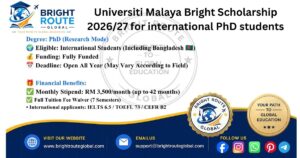
Universiti Malaya Bright Scholarship 2026/27
Universiti Malaya Bright Scholarship 2026/27 Apply for the UM Bright...
Read More
Open Doors Russian Scholarship 2026 | Study in Russia
Open Doors Russian Scholarship 2026: Study in Russia Apply for...
Read More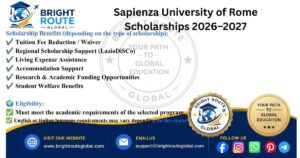
Sapienza University of Rome Scholarships 2026–27
Sapienza University of Rome Scholarships 2026–2027 Explore Sapienza University of...
Read More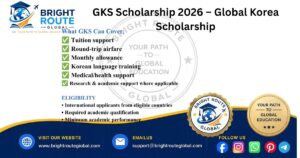
GKS Scholarship 2026: Global Korea Scholarship
Global Korea Scholarship 2026 (GKS) – Fully Funded Scholarship in...
Read More
Schwarzman Scholars 2028–29: Fully Funded
Schwarzman Scholars 2028–29: Fully Funded Master’s in China Explore Schwarzman...
Read More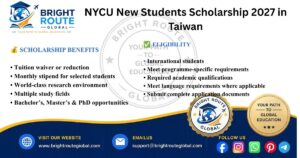
NYCU New Students Scholarship 2027 in Taiwan
NYCU New Students Scholarship Spring 2027 in Taiwan Apply for...
Read More