University of Helsinki Open University 2026 | Study Flexible Courses in Finland
Explore University of Helsinki Open University 2026 courses, fees, eligibility, registration, and flexible study options for international learners.
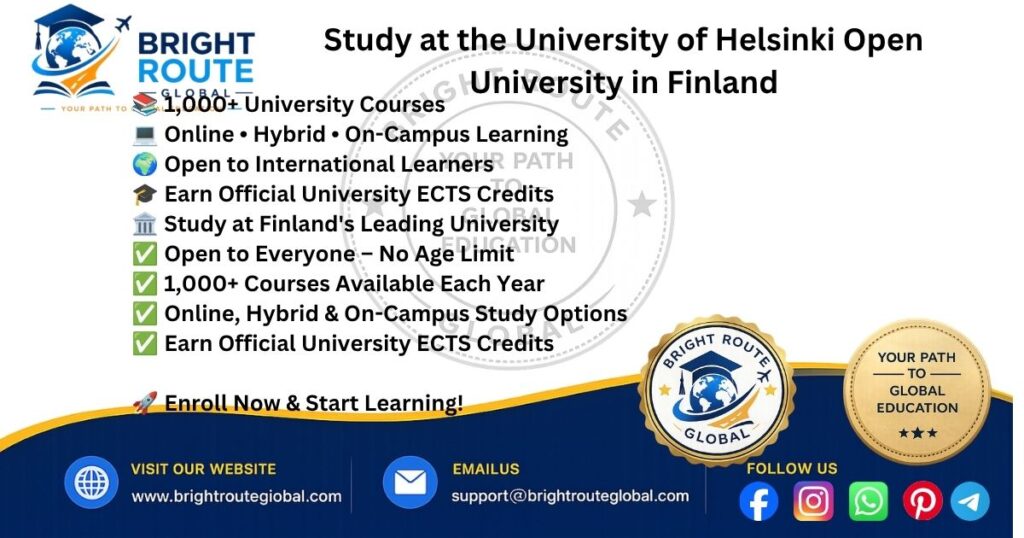
The University of Helsinki Open University offers one of the most flexible learning opportunities in Europe. Unlike traditional degree programmes, Open University studies are available to everyone, regardless of age, nationality, or previous educational background. Whether you want to gain new skills, prepare for degree studies, explore a new academic field, or advance your career, the University of Helsinki provides more than 1,000 courses annually in a wide range of disciplines.
Open University courses are offered throughout the year in various formats, including online learning, on-campus teaching, and hybrid classes. Students can choose individual courses or larger study modules that match their personal and professional goals. While Open University studies do not directly award a bachelor’s or master’s degree, many courses correspond to the University’s degree programmes and may later support admission through specific study pathways where applicable.
This guide explains everything international students need to know about the University of Helsinki Open University, including available study fields, course fees, eligibility, application process, and why Finland is one of the world’s best destinations for higher education.
Scholarship & Programme Overview
| Category | Details |
|---|---|
| Institution | University of Helsinki |
| Programme | Open University Studies |
| Country | Finland |
| Study Type | Non-degree / Continuing Education |
| Study Mode | Online, On-campus & Hybrid |
| Eligible Applicants | Open to Everyone (including international learners) |
| Courses Offered | 1,000+ annually |
| Language of Instruction | Finnish, Swedish & Selected Courses in English |
| Application Mode | Online |
| Degree Awarded | No (credits may support future degree pathways where applicable) |
About the University of Helsinki
Founded in 1640, the University of Helsinki is Finland’s oldest and largest university and consistently ranks among the leading universities in Europe. It is internationally recognized for excellence in research, innovation, sustainability, and high-quality teaching.
The university serves more than 30,000 students and thousands of researchers across eleven faculties. Its graduates work in academia, government, healthcare, business, technology, and international organizations worldwide.
Some of the university’s strengths include:
- World-class research facilities
- Internationally recognized faculty
- Modern learning environments
- Strong emphasis on innovation
- Global academic partnerships
- Excellent graduate employability
- Extensive digital learning resources
The University of Helsinki is particularly respected in agriculture, environmental sciences, medicine, education, data science, life sciences, social sciences, and humanities.
Why Choose the Open University?
The Open University is ideal for learners who want flexibility without committing immediately to a full degree programme.
Learn Without Traditional Admission
Unlike regular university programmes, most Open University courses do not require competitive entrance examinations. Students register directly for available courses, making higher education more accessible.
Flexible Study Options
Students can choose from:
- Fully online courses
- Classroom teaching
- Hybrid learning
- Evening courses
- Weekend classes
- Self-paced learning in selected subjects
This flexibility allows working professionals, international learners, and lifelong learners to study according to their schedules.
Study from a Top European University
Completing courses from the University of Helsinki allows learners to experience the teaching quality and academic standards of one of Northern Europe’s most respected universities.
Earn University Credits
Although Open University studies do not result in a degree by themselves, students earn officially recognized university credits (ECTS) for successfully completed courses, which may later be useful depending on future academic pathways and institutional policies.
Why Study in Finland?
Finland is consistently ranked among the world’s best countries for education, innovation, safety, and quality of life.
Globally Respected Education System
Finnish universities emphasize independent learning, critical thinking, and practical application rather than rote memorization.
Innovative Teaching Methods
Students benefit from:
- Small class sizes
- Interactive learning
- Research-based education
- Modern technology
- Student-centered teaching
Safe Living Environment
Finland offers:
- Low crime rates
- Excellent public transportation
- High-quality healthcare
- Clean cities
- Sustainable living
Excellent Work-Life Balance
Students enjoy:
- Modern campuses
- Extensive libraries
- Sports facilities
- Student organizations
- International communities
Study Levels Available
The Open University provides courses corresponding to both bachelor’s and master’s level studies.
| Study Level | Description |
|---|---|
| Bachelor’s Level Courses | Suitable for beginners and learners exploring a new field. |
| Master’s Level Courses | Intended for students with previous studies or relevant background, depending on the course. |
| Individual Courses | Stand-alone university courses. |
| Study Modules | Collections of related courses within a subject area. |
Course-specific prerequisites vary, particularly for advanced studies.
Available Fields of Study
The University of Helsinki Open University offers courses across dozens of academic disciplines.
Business and Economics
Students can explore:
- Business Management
- Economics
- Entrepreneurship
- Marketing
- Finance
These courses help learners strengthen analytical and decision-making skills relevant to today’s global economy.
Computer Science and Data Science
Popular areas include:
- Programming
- Artificial Intelligence
- Data Analysis
- Information Systems
- Software Development
Many courses combine theoretical knowledge with practical assignments.
Education
The Open University provides courses in:
- Educational Sciences
- Teacher Development
- Learning Psychology
- Curriculum Studies
- Adult Education
These courses are valuable for teachers, trainers, and education professionals.
Environmental and Natural Sciences
Students interested in sustainability can study:
- Environmental Science
- Biology
- Geography
- Climate Change
- Ecology
Finland’s leadership in sustainability makes these programmes especially attractive.
Social Sciences
Available subjects include:
- Psychology
- Sociology
- Political Science
- Social Policy
- International Relations
These disciplines help students understand contemporary social challenges and policy development.
Humanities
Learners can choose courses in:
- History
- Philosophy
- Literature
- Languages
- Cultural Studies
- Linguistics
These programmes develop communication, critical thinking, and intercultural competence.
Health and Life Sciences
Selected Open University courses are available in areas such as:
- Public Health
- Nutrition
- Biomedical Sciences
- Health Promotion
These are particularly suitable for continuing professional development.
Course Fees and Benefits
Unlike degree programmes, Open University studies are generally fee-based. The course fee is typically €15 or €45 per ECTS credit, depending on the course, with payment made during online registration.
Key Benefits
| Benefit | Details |
|---|---|
| Flexible Learning | Study online, on campus, or in hybrid format. |
| Open Admission | Most courses have no competitive entrance examination. |
| University Credits | Earn official ECTS credits upon successful completion. |
| Wide Course Selection | More than 1,000 courses available annually. |
| Career Development | Upskill or reskill with university-level education. |
| Pathway Opportunities | Certain studies may support later applications to degree programmes, subject to programme requirements. |
Hidden Costs
Although Open University courses are affordable, students should budget for additional expenses.
| Expense | Estimated Cost |
|---|---|
| Course Fees | €15–45 per ECTS credit |
| Learning Materials | Varies by course |
| Internet & Technology | Personal expense |
| Travel (if attending campus) | Depends on location |
| Accommodation (for in-person studies) | If applicable |
| Personal Study Supplies | Books, stationery, software |
Eligibility Criteria
One of the biggest advantages of the Open University is its accessibility.
General eligibility includes:
- Open to learners of all nationalities.
- No upper age limit.
- Most bachelor’s-level courses require no previous university education.
- Some advanced or master’s-level courses require prior knowledge or completed studies in the field.
- Applicants must meet any course-specific prerequisites where applicable.
Required Documents
Registration for Open University studies is usually much simpler than applying for a degree programme.
| Document | Required |
|---|---|
| Online Registration | ✔ |
| Valid Identification | ✔ |
| Previous Academic Records | Only if required for advanced courses |
| Proof of Prerequisites | If applicable |
| Payment of Course Fee | ✔ |
Unlike degree admissions, applicants generally do not need a motivation letter, recommendation letters, or research proposal for most Open University courses.
Step-by-Step Registration Process
Registering for the University of Helsinki Open University is straightforward. Unlike traditional degree programmes, most Open University courses do not require entrance examinations or lengthy admission procedures. Students simply register for individual courses during the published registration period, pay the course fee, and complete identity verification where required. Course places are often allocated on a first-come, first-served basis, so early registration is recommended.
Registration Process
| Step | Action |
|---|---|
| 1 | Browse the Open University course catalogue. |
| 2 | Select a course or study module that matches your interests. |
| 3 | Review the course description, prerequisites, and registration dates. |
| 4 | Register online when the registration period opens. |
| 5 | Pay the course fee online during registration. |
| 6 | Complete identity verification and confirm your study place if required. |
| 7 | Activate your University of Helsinki user account. |
| 8 | Access Moodle or other digital learning platforms before the course begins. |
| 9 | Attend classes and complete coursework. |
| 10 | Earn ECTS credits upon successful completion. |
Registration Timeline
Unlike traditional university admissions, Open University courses are offered throughout the year. Registration periods differ depending on the course.
| Stage | Timeline |
|---|---|
| Course Catalogue Published | Throughout the year |
| Registration Opens | According to each course |
| Registration Closes | Before course begins or when places are filled |
| Course Fee Payment | During registration |
| Course Commencement | Multiple intakes annually |
| Completion & Credits | After successfully finishing the course |
Because popular courses can fill quickly, applicants should check the course catalogue regularly and register as soon as enrolment opens.
How to Choose the Right Course
With more than 1,000 courses available each year, choosing the right one can seem overwhelming.
Before registering, consider the following:
Your Career Goals
Ask yourself:
- Do you want to develop professional skills?
- Are you preparing for future university studies?
- Do you want to explore a new subject?
- Are you learning for personal interest?
Course Prerequisites
While many beginner-level courses have no prerequisites, advanced courses may require previous university studies or subject knowledge.
Teaching Format
Choose the learning format that best suits your schedule.
Available options include:
- Online learning
- Hybrid learning
- Campus-based teaching
- Independent study
- Evening classes
- Weekend courses
Workload
Review:
- Number of ECTS credits
- Weekly study hours
- Assessment methods
- Assignment deadlines
Selecting a manageable workload helps maintain a healthy study-life balance.
Accommodation & Living Costs
Students taking online courses from outside Finland generally do not need accommodation. However, learners attending campus-based studies in Helsinki should plan for housing and living expenses.
Accommodation Options
| Accommodation Type | Estimated Monthly Cost (€) |
|---|---|
| Student Housing | 300–600 |
| Shared Apartment | 450–800 |
| Private Apartment | 700–1,300 |
Estimated Monthly Living Expenses
| Expense | Estimated Cost (€) |
|---|---|
| Accommodation | 300–1,300 |
| Food & Groceries | 250–400 |
| Transportation | 40–70 |
| Internet & Mobile | 25–45 |
| Personal Expenses | 100–250 |
| Study Materials | Varies by course |
Finland has a relatively high cost of living compared with many countries, but students benefit from excellent public services, efficient transportation, and a high quality of life.
Part-Time Work Opportunities
Students who later enroll in a degree programme in Finland may be eligible to work part-time under the conditions of their residence permit.
Common student jobs include:
- Research Assistant
- Library Assistant
- Café or Restaurant Staff
- Customer Service Representative
- Retail Assistant
- English Tutor
- IT Support
- Software Developer
- Digital Marketing Assistant
- Freelance Graphic Designer
Learning Finnish can improve employment opportunities, although many international companies also recruit English-speaking professionals.
Student Visa Information
Open University studies do not automatically qualify a student for a Finnish residence permit or student visa. Whether you need a visa or residence permit depends on your nationality, where you live, the duration of your stay, and whether you are enrolling in non-degree studies from abroad or attending courses in Finland. Always check the latest requirements with the relevant Finnish authorities before making travel plans.
If you later gain admission to a full degree programme, you will normally need:
- Valid Passport
- Official Admission Letter
- Proof of Financial Resources
- Health Insurance (where required)
- Accommodation Details
- Residence Permit Application
- Passport Photographs
Tips from Previous Learners
Students who have completed Open University courses often recommend:
- Register as soon as enrolment opens.
- Read the course description carefully before enrolling.
- Check whether prerequisites apply.
- Plan your study schedule in advance.
- Participate actively in online discussions.
- Submit assignments before deadlines.
- Make full use of digital learning resources.
- Keep copies of your completed course certificates and transcripts.
Common Mistakes to Avoid
Avoid these common errors:
- Registering after the deadline.
- Ignoring course prerequisites.
- Underestimating the study workload.
- Missing assignment deadlines.
- Failing to activate your university account.
- Waiting until the last minute to pay course fees.
- Choosing too many courses simultaneously.
Frequently Asked Questions (FAQs)
1. Is the Open University free?
No. Most courses require a fee of approximately €15–45 per ECTS credit, although some MOOCs may be free.
2. Can international students register?
Yes. The Open University welcomes learners from around the world.
3. Do I need IELTS?
Most Open University courses do not require a formal English language test, but you should ensure you have sufficient language proficiency for the course you choose.
4. Will I receive a university degree?
No. Open University studies provide university credits rather than a bachelor’s or master’s degree.
5. Can Open University credits be used later?
In some cases, completed credits may support admission through specific Open University pathways or be recognized according to university policies.
6. Can I study online?
Yes. Many courses are delivered fully online.
7. Are there age restrictions?
No. Open University studies are open to learners of all ages.
8. Can I work while taking Open University courses?
Online learners studying from their home country may continue working according to local regulations. Studying at the Open University alone does not automatically provide work rights in Finland.
9. How many courses can I take?
There is no universal limit, but students should choose a workload they can realistically complete.
10. Are certificates provided?
Students who successfully complete courses receive official records of completed university credits.
Conclusion
The University of Helsinki Open University provides an outstanding opportunity for lifelong learners, professionals, and international students to study at one of Europe’s leading universities without applying for a full degree programme. With more than 1,000 courses, flexible online and hybrid learning options, and affordable course fees, it is an excellent choice for anyone looking to gain new knowledge, develop professional skills, or prepare for future university studies.
Whether your goal is career advancement, personal development, or exploring a new academic field, the University of Helsinki Open University offers flexible, high-quality education backed by one of Finland’s most prestigious institutions.
University of Southern Denmark Scholarships : How to Apply
University of Southern Denmark Scholarships 2027: Eligibility, Benefits and How...
Read More
Aalto University Scholarships 2027 Full Details
Aalto University Scholarships 2027: Eligibility, Tuition Fees and How to...
Read More
UN Volunteers Opportunities 2026–2027: How to Apply
UN Volunteers Opportunities 2026–2027: Eligibility, Benefits and Application Process Explore...
Read More
MESPOM Erasmus Mundus Scholarship 2027–2029
MESPOM Erasmus Mundus Scholarship 2027–2029: Fully Funded Master’s in Europe...
Read More