KAUST Graduate Admissions 2027: Fully Funded Master’s & PhD in Saudi Arabia
Apply to KAUST 2027 for fully funded Master’s and PhD programs. Check stipend, eligibility, IELTS, documents, benefits and deadlines.
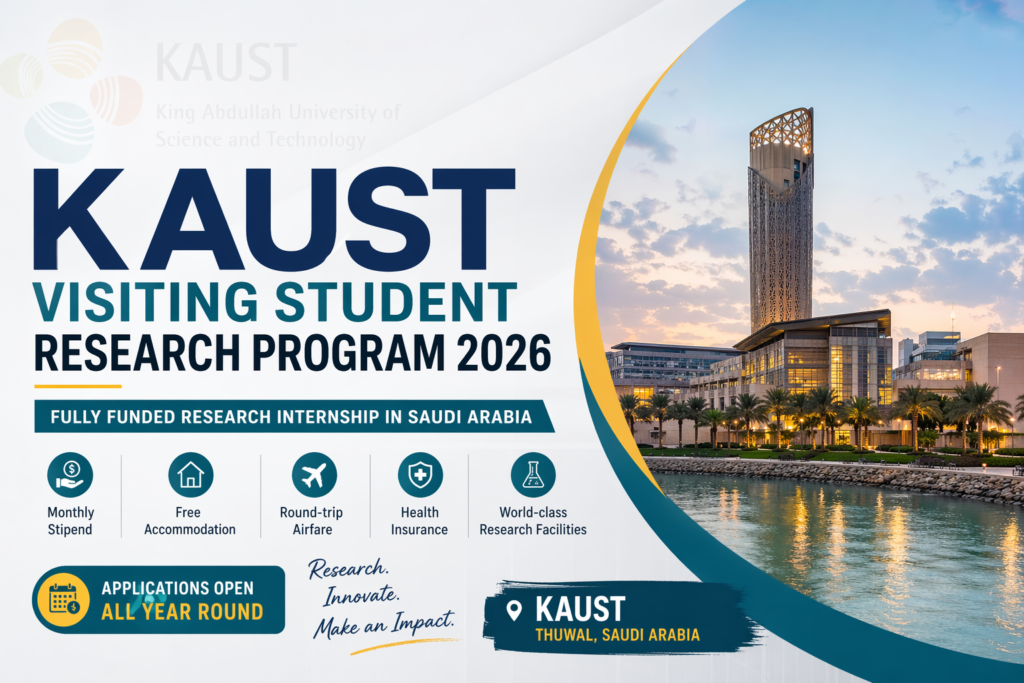
King Abdullah University of Science and Technology (KAUST) in Saudi Arabia offers fully funded graduate study opportunities for talented students from around the world. Through the KAUST Fellowship, admitted Master’s and PhD students can receive full tuition support, a monthly stipend, accommodation, health coverage and relocation assistance.
KAUST is a research-focused university with graduate programmes across 17 STEM disciplines. Its admissions website currently states that applications for 2027 entry opened in mid-August 2026, following the closure of the 2026 cycle.
Unlike many international scholarships, the KAUST Fellowship is generally connected to admission: all admitted students are evaluated for KAUST Fellowship support, making the university particularly attractive for applicants looking for a fully funded Master’s or PhD opportunity.
Scholarship Overview
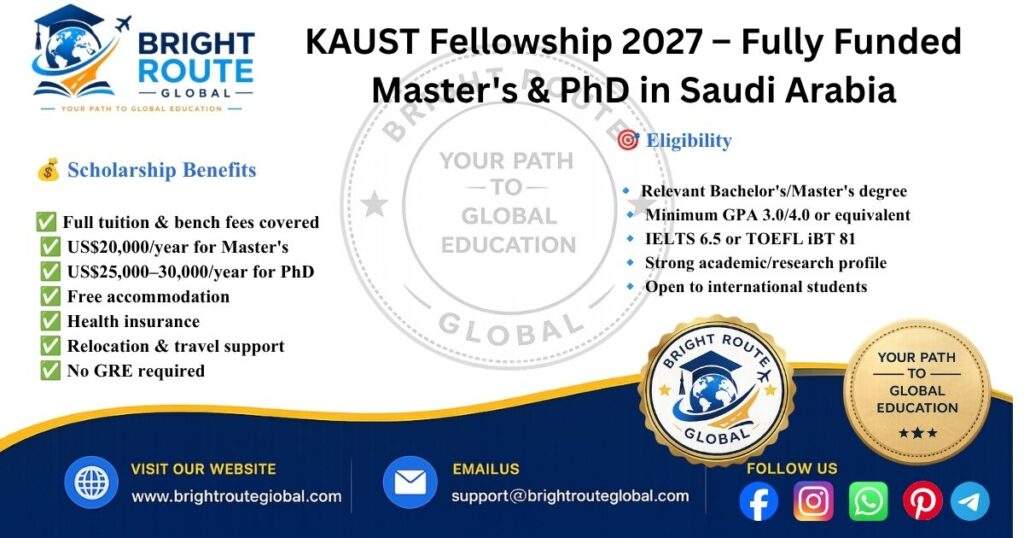
The KAUST Fellowship supports graduate students throughout their studies. The university describes the fellowship as covering tuition and bench fees, a monthly stipend, accommodation, health insurance and relocation support.
At a Glance
| Feature | Details |
|---|---|
| University | King Abdullah University of Science and Technology (KAUST) |
| Location | Thuwal, Saudi Arabia |
| Study Level | Master’s, PhD, MS/PhD |
| Academic Areas | STEM and related technology disciplines |
| Funding | KAUST Fellowship |
| Tuition | Fully covered |
| Monthly Stipend | Approx. US$20,000/year for MS; US$25,000–30,000/year for PhD |
| Housing | Included |
| Health Insurance | Included for students and eligible dependents living on campus |
| Relocation Support | Included |
| English Requirement | IELTS 6.5 or TOEFL iBT 81 minimum |
| GRE | Not required |
| Minimum GPA | 3.0/4.0 or equivalent |
| 2027 Entry | Applications opened mid-August 2026 |
| Application Fee | No application fee stated by KAUST |
| Official Application | KAUST Admissions |
The current KAUST funding page estimates the total fellowship value at approximately US$70,000–80,000 per year, depending on the student’s situation.
University Overview
King Abdullah University of Science and Technology (KAUST) is a graduate research university located in Thuwal, Saudi Arabia, on the Red Sea coast.
The university focuses heavily on scientific research, advanced technology, innovation and interdisciplinary collaboration. KAUST’s current admissions website reports 180+ world-class faculty, students from 120+ nationalities, and a highly international campus community.
Students have access to advanced laboratories, research facilities and specialised equipment. KAUST also highlights research areas addressing challenges such as water and food security, energy, health and artificial intelligence.
Why Study at KAUST?
Fully Funded Graduate Education
The KAUST Fellowship covers major educational and living expenses, allowing students to focus on research without the financial burden normally associated with graduate study abroad.
World-Class Research Facilities
Students work in an environment equipped with advanced laboratories, research infrastructure and specialised technologies.
International Community
KAUST hosts students and researchers from more than 100 countries, creating a strongly international academic environment.
Research-Focused Education
Both Master’s and PhD programmes emphasise research, with students working closely with faculty and participating in projects designed to address real-world scientific and technological problems.
Career Opportunities
KAUST graduates have progressed into careers across academia, industry, research laboratories, government and technology companies. The university highlights alumni working with organisations including Google, Tesla and Saudi Aramco.
Degree Levels
Master’s Degree
KAUST’s MS programmes are research-intensive and can be completed through either a 1.5-year non-thesis track or a 2-year thesis track, depending on the programme.
The Master’s programme is designed for students who want to strengthen their technical knowledge, enter industry or continue toward a PhD.
MS/PhD Pathway
Students who have recently completed a Bachelor’s degree and are committed to a research career can apply for the MS/PhD pathway.
This route allows students to progress from a Master’s into a PhD without submitting a new PhD application, provided they satisfy the required progression conditions. The current programme information lists an expected duration of approximately 5.5–6 years.
PhD
KAUST’s PhD programme is designed for students pursuing advanced research careers in academia, industry or research institutions.
The standard PhD programme is research intensive and is generally structured around approximately four years for students entering with a Master’s degree.
Available Fields of Study
KAUST offers graduate study across 17 STEM-related subjects. Popular areas include:
- Computer Science
- Artificial Intelligence & Data Science
- Electrical & Computer Engineering
- Applied Mathematics & Computational Science
- Applied Physics
- Chemical Engineering
- Chemistry
- Bioengineering
- Bioscience
- Environmental Science & Engineering
- Marine Science
- Plant Science
- Earth Science & Engineering
- Material Science & Engineering
- Mechanical Engineering
- Energy Resources & Petroleum Engineering
- Statistics
- Technology Innovation & Entrepreneurship
The exact degree and intake availability can vary by programme. Applicants should therefore check the current programme directory before preparing an application.
Scholarship Benefits
The KAUST Fellowship is one of the strongest features of studying at the university.
Full Tuition & Bench Fee Coverage
The current funding information states that the fellowship covers tuition and bench fees valued at up to US$35,000 per year.
Monthly Stipend
The current annual stipend ranges are:
- MS: approximately US$20,000 per year
- PhD: approximately US$25,000–30,000 per year
The exact amount depends on qualifications and academic progress.
Accommodation
Base accommodation is included. Single students receive shared accommodation, while married students receive two-bed accommodation under the standard arrangement. Housing upgrades may be available for an additional fee.
Health Insurance
Health insurance is provided for students and eligible dependents living on campus.
Relocation Assistance
KAUST provides relocation support covering eligible visa, relocation and travel costs. The university states that this assistance applies to the student’s initial move to KAUST and return home upon graduation.
Hidden Costs
Although KAUST is fully funded for admitted students receiving the fellowship, applicants should still understand potential additional expenses.
| Expense | What to Know |
|---|---|
| Tuition | Covered by KAUST Fellowship |
| Bench Fees | Covered |
| Base Accommodation | Included |
| Health Insurance | Included for eligible students/dependents |
| Relocation | Supported |
| Housing Upgrade | Additional fee may apply |
| Dependent Housing | Additional charges may apply |
| Dependent Medical Coverage | Charges may apply |
| Personal Expenses | Student responsibility |
| Entertainment & Leisure | Student responsibility |
| Additional Travel | May be student’s responsibility |
| Personal Electronics | Student responsibility |
| Optional Services | May incur additional charges |
The university specifically notes that charges may apply to dependent housing and medical/dental coverage, while housing upgrades can also involve additional fees.
Eligibility Criteria
KAUST looks for academically strong applicants with clear research interests and the potential to contribute to the scientific community. The admissions process takes a holistic approach rather than relying solely on grades.
Master’s Applicants
Applicants need:
- A Bachelor’s degree in a subject relevant to the programme.
- A degree from a recognised higher education institution.
- At least 18 years of age when entering KAUST.
- A competitive GPA.
- Proof of English proficiency.
- Strong academic and research potential.
The minimum permitted GPA is 3.0/4.0 or equivalent, although KAUST notes that admitted students typically have considerably higher GPAs: around 90% of admitted applicants have a GPA above 3.3 and 75% above 3.5.
PhD Applicants
Applicants need:
- A relevant Master’s degree from a recognised institution.
- Strong academic preparation.
- Research potential.
- English proficiency.
- A clear research interest matching the programme.
KAUST notes that professional Master’s degrees are not automatically considered equivalent to academic/research Master’s degrees for PhD admission.
Required Documents
| ✓ | Document | Requirement |
|---|---|---|
| ☐ | Academic Transcript | Official transcript from every institution attended |
| ☐ | Degree Certificate | Bachelor’s/Master’s certificate as applicable |
| ☐ | CV | Updated academic/professional CV |
| ☐ | Statement of Purpose | Explain academic interests, goals and motivation |
| ☐ | English Test | IELTS/TOEFL or accepted alternative |
| ☐ | Recommendation Letters | 3 letters |
| ☐ | Referee Details | Contact information for three referees |
| ☐ | Passport/ID | Clear copy showing personal details |
| ☐ | Certified Translation | Required for documents not in English where applicable |
| ☐ | GRE | Not required |
KAUST requires official transcripts from every institution previously attended, including the grading scale.
Three recommendation letters are required. KAUST recommends choosing professors or academic advisers familiar with the applicant’s academic or research work.
Step-by-Step Application Process
| Step | What to Do | Practical Guidance |
|---|---|---|
| Check programme | Choose an eligible MS, MS/PhD or PhD programme | Confirm that your Bachelor’s/Master’s background matches |
| Check GPA | Compare your GPA with KAUST expectations | Meeting 3.0 does not guarantee admission |
| Review English requirement | Check IELTS/TOEFL requirements | Aim above the minimum where possible |
| Research faculty | Explore professors and research groups | Identify areas matching your interests |
| Prepare CV | Create an academic/research-focused CV | Include projects, publications, internships and technical skills |
| Write Statement of Purpose | Explain your research interests and career goals | Make it specific to KAUST |
| Request recommendations | Contact three referees early | Choose professors who know your academic/research ability |
| Collect transcripts | Obtain official records from every university attended | Include grading scale |
| Prepare passport/ID | Upload a clear copy | Make sure all information is visible |
| Take English test | Submit official IELTS/TOEFL results | KAUST encourages applicants to include valid results |
| Create application | Register through KAUST Admissions | Complete all sections carefully |
| Upload documents | Submit required files | Check file quality and completeness |
| Submit application | Apply before the relevant deadline | Early submission is recommended |
| Application review | KAUST evaluates your academic and personal profile | Evaluation is holistic |
| Interview, if invited | Respond promptly | Prepare to discuss research interests and goals |
| Admission decision | Await the university decision | Strong applicants may receive offers |
| Fellowship assessment | Admitted students are evaluated for funding | Fellowship benefits apply to eligible admitted students |
| Onboarding | Submit final documents | Official final transcript may be required before arrival |
| Travel to KAUST | Complete relocation process | KAUST provides eligible relocation assistance |
KAUST strongly recommends applying early because admission is highly competitive.
Application Timeline
KAUST’s current website states that 2026 applications are closed and applications for 2027 entry opened in mid-August 2026.
The university has not published a single final 2027 deadline on the currently available admissions pages in the same way as the previous cycle. Therefore, applicants should monitor the official Admissions Timeline and their chosen programme page rather than relying on outdated deadlines.
| Stage | Current Information |
|---|---|
| 2027 applications | Opened mid-August 2026 |
| Application period | Check current programme timeline |
| MS | Fall entry |
| PhD | Spring and Fall entry depending on programme |
| Decision | Depends on application cycle and completeness |
| Enrollment | According to the relevant 2027 intake |
The previous Fall 2026 cycle closed on 7 May 2026 for international students and 14 May 2026 for Saudi students, but applicants should not assume these dates will remain the same for 2027.
Selection Criteria
KAUST uses a holistic admissions process.
The university considers:
- Academic performance
- GPA and academic trajectory
- Relevant academic preparation
- Research experience
- Research interests
- Statement of purpose
- Recommendation letters
- English proficiency
- Potential contribution to the scientific community
- Fit with KAUST’s research environment
A high GPA is valuable, but KAUST specifically states that academic scores are not the only measure of potential.
Accommodation & Living Costs
One major advantage of KAUST is that accommodation is incorporated into the fellowship.
Base housing is provided under the fellowship, although the standard arrangement depends on family status. Single students receive shared accommodation, while married students receive two-bed accommodation. Students can request housing upgrades subject to additional fees.
The KAUST campus is designed as a residential community, with housing, laboratories, recreation and other facilities located within the university environment.
Because the fellowship also provides a substantial monthly stipend, students generally have much lower out-of-pocket educational costs than international students studying in many other countries.
Part-time Jobs
KAUST’s funding model is designed to allow students to concentrate on their academic work and research.
Because students receive a substantial fellowship stipend, part-time employment should not be treated as the primary method of financing study.
Students should also check KAUST regulations and Saudi employment/residence rules before undertaking any paid work outside their academic responsibilities.
Student Visa Process
International students admitted to KAUST will need to complete the university’s immigration and relocation process.
A typical sequence is:
Admission → Fellowship/Financial Confirmation → Visa Processing → Travel Arrangements → Arrival at KAUST → Residence/Onboarding
KAUST’s fellowship includes eligible visa, relocation and travel support, particularly for the student’s initial move to KAUST.
Students should keep their:
- Passport
- Admission documents
- Fellowship information
- Academic certificates
- Medical/health documents
- Passport photographs
- Other immigration documents
ready for the onboarding process.
Tips from Previous Applicants
- Apply as early as possible because KAUST is highly competitive.
- Choose a programme that genuinely matches your academic background.
- Research KAUST faculty before submitting your application.
- Make your Statement of Purpose research-focused.
- Choose recommendation writers who know your research or academic ability.
- Don’t rely only on the minimum GPA; aim for a competitive academic profile.
- Include valid English test results if possible, even though the application can sometimes be submitted before the result is available.
KAUST specifically notes that including valid English results at application stage can strengthen an applicant’s overall profile.
Common Mistakes
- Applying to a programme unrelated to your academic background
- Treating the minimum 3.0 GPA as a competitive target
- Writing a generic Statement of Purpose
- Choosing weak or unrelated recommenders
- Uploading incomplete transcripts
- Assuming an MOI certificate will replace IELTS/TOEFL
- Waiting until the final days to submit the application
KAUST explicitly states that Medium of Instruction certificates are not accepted as proof of English proficiency.
Frequently Asked Questions
1. Is KAUST fully funded?
Yes. Admitted eligible graduate students receive the KAUST Fellowship, which covers tuition and bench fees, housing, health insurance and relocation support, together with a monthly stipend.
2. How much is the KAUST stipend?
The current funding page lists approximately US$20,000 per year for Master’s students and US$25,000–30,000 per year for PhD students, depending on qualifications and academic progress.
3. Does KAUST charge tuition fees?
The fellowship covers tuition and bench fees for eligible admitted students. The university values this tuition/bench coverage at up to approximately US$35,000 per year.
4. What is the minimum GPA for KAUST?
The minimum permitted GPA is 3.0/4.0 or equivalent, but KAUST reports that most admitted students have substantially higher GPAs.
5. What IELTS score does KAUST require?
The minimum IELTS requirement is 6.5.
6. What TOEFL score is required?
KAUST requires a minimum TOEFL iBT score of 81.
7. Is GRE required?
No. KAUST does not require the GRE. However, the university states that it strongly encourages students to take the GRE General Test, and a strong quantitative score can enhance an application.
8. Can I apply for a Master’s directly after Bachelor’s?
Yes. Applicants with a relevant Bachelor’s degree can apply for KAUST Master’s programmes. Students committed to research can also consider the MS/PhD pathway where available.
9. Can I apply for a PhD after Bachelor’s?
KAUST’s standard PhD entry requirement is a relevant Master’s degree. Applicants with a Bachelor’s degree may instead consider an MS/PhD pathway where available.
10. Does KAUST accept an MOI certificate?
No. KAUST explicitly states that Medium of Instruction certificates are not accepted as proof of English proficiency.
11. How many recommendation letters are required?
You need three recommendation letters, submitted directly through the application by the recommenders.
12. Is accommodation free?
Base accommodation is included in the KAUST Fellowship. However, housing upgrades and certain dependent-related housing arrangements may involve additional fees.
13. Do I need work experience?
Generally, KAUST graduate admission is academically focused and does not list a general work-experience requirement. Research experience can nevertheless strengthen your application.
14. How many subjects does KAUST offer?
KAUST’s current admissions website states that its graduate programmes span 17 subjects/disciplines.
15. When did applications for 2027 entry open?
KAUST states that applications for 2027 entry opened in mid-August 2026. Applicants should check the official timeline for the exact deadline applicable to their programme and intake.
Conclusion
The King Abdullah University of Science and Technology (KAUST) is one of the most attractive destinations for students seeking a fully funded STEM Master’s or PhD in an international research environment.
The KAUST Fellowship can cover full tuition and bench fees, accommodation, health insurance and relocation, while providing a substantial annual stipend. The current fellowship is valued at approximately US$70,000–80,000 per year, depending on the student’s circumstances.
However, KAUST is highly competitive. Meeting the minimum GPA or English requirement does not guarantee admission. Applicants should focus on building a strong academic profile, gaining research experience where possible, preparing a compelling Statement of Purpose and selecting recommenders who can provide meaningful evidence of their academic and research abilities.
For students planning to apply for 2027 entry, the application cycle is now open. Start by selecting your programme, researching faculty and preparing your documents rather than waiting until the deadline.
UBD Graduate Research Scholarship 2027: PhD Funding
UBD Graduate Research Scholarship 2027: Fully Funded PhD in Brunei...
Read More
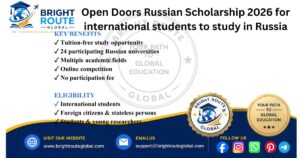
Open Doors Russian Scholarship 2026–27
Open Doors Russian Scholarship 2026–27 Scholarship Overview Apply for the...
Read More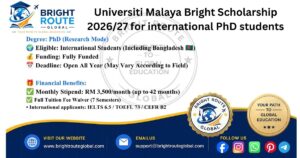
Universiti Malaya Bright Scholarship 2026/27
Universiti Malaya Bright Scholarship 2026/27 Apply for the UM Bright...
Read More
Open Doors Russian Scholarship 2026 | Study in Russia
Open Doors Russian Scholarship 2026: Study in Russia Apply for...
Read More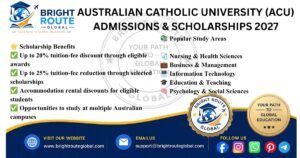
Australian Catholic University (ACU) Scholarships
Australian Catholic University (ACU) Admissions 2027: Courses, Scholarships and How...
Read More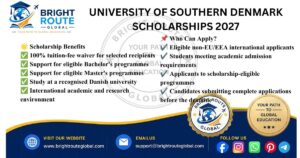
University of Southern Denmark Scholarships : How to Apply
University of Southern Denmark Scholarships 2027: Eligibility, Benefits and How...
Read More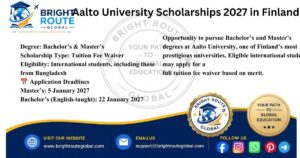
Aalto University Scholarships 2027 Full Details
Aalto University Scholarships 2027: Eligibility, Tuition Fees and How to...
Read More
UBD Graduate Research Scholarship 2027: PhD Funding
UBD Graduate Research Scholarship 2027: Fully Funded PhD in Brunei...
Read More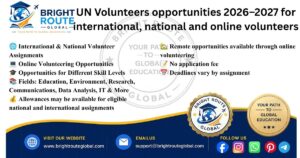
UN Volunteers Opportunities 2026–2027: How to Apply
UN Volunteers Opportunities 2026–2027: Eligibility, Benefits and Application Process Explore...
Read More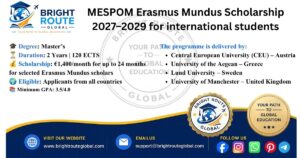
MESPOM Erasmus Mundus Scholarship 2027–2029
MESPOM Erasmus Mundus Scholarship 2027–2029: Fully Funded Master’s in Europe...
Read More
Maastricht University Netherlands 2027 Scholarships
Maastricht University Netherlands 2027: Admissions, Scholarships and Study Guide University...
Read More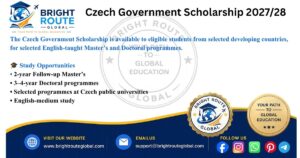
Czech Government Scholarship 2027/28
Czech Government Scholarship 2027/28 for Developing Countries Scholarship Overview Learn...
Read More