Belarusian State Technological University (BSTU), Belarus: Study & Admission Guide
Explore BSTU admission, programmes, eligibility, documents, tuition, accommodation and visa guidance for international students in Belarus.
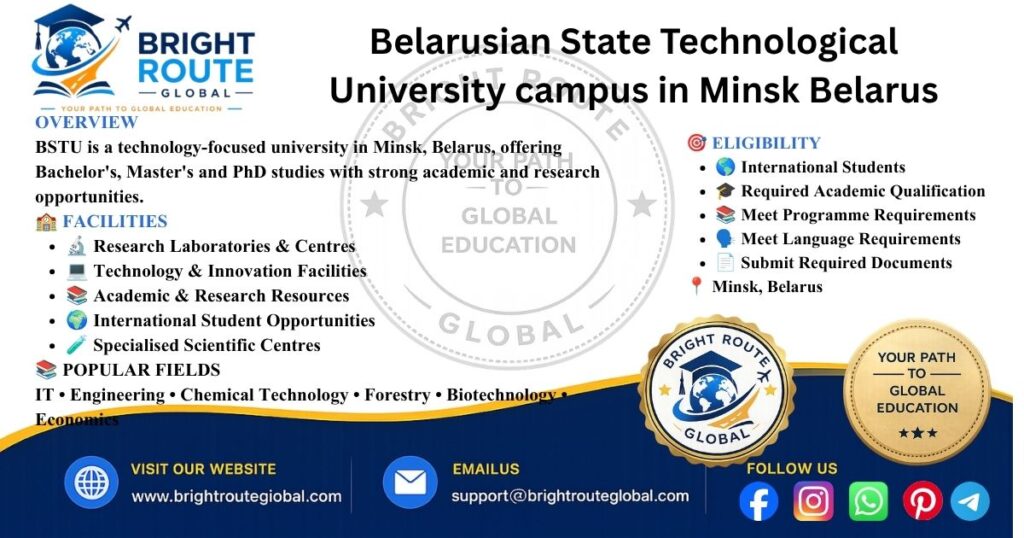
The Belarusian State Technological University (BSTU) is a specialised higher-education and research institution in Minsk, Belarus, with a strong academic focus on technology, engineering, forestry, chemical sciences, information technology, economics, design and related disciplines.
The university offers undergraduate, Master’s and PhD studies, maintains dedicated research units and laboratories, and has an international student and cooperation programme.
Scholarship Overview
BSTU is primarily a university admission opportunity rather than a single scholarship programme. International students can explore degree programmes and financial-support opportunities according to their nationality, programme and admission status.
The university’s official website provides dedicated sections for international applicants, undergraduate studies, Master’s studies and PhD studies.
At a Glance
| Feature | Details |
|---|---|
| University | Belarusian State Technological University |
| Abbreviation | BSTU |
| Country | Belarus |
| Location | Minsk |
| Study Levels | Bachelor’s, Master’s & PhD |
| Main Focus | Technology, Engineering, Forestry, IT, Chemistry & Business |
| International Students | Yes |
| Research | Laboratories, research schools & centres |
| Application | International Applicant system |
| Official Website | belstu.by/en/ |
University Overview
The Belarusian State Technological University is based at 13A Sverdlova Street, Minsk. Its academic structure includes specialised faculties covering forestry, forest engineering, materials science, chemical technology, information technology, economics and media communications.
BSTU also maintains research infrastructure that includes research units, laboratories, centres, research schools and scientific journals. Its website highlights areas such as technology transfer, physical and chemical investigation methods and innovation.
The university also has affiliated colleges, including institutions connected with forestry, building materials, polytechnic education and technology.
Country Overview
Belarus is an Eastern European country with Minsk as its capital and largest city. For international students, the country offers higher-education options across engineering, technology, science, economics and other fields.
Students considering Belarus should research the current visa rules, tuition-payment arrangements, banking facilities, accommodation, health insurance and travel conditions before making a final decision.
Why Study at BSTU?
Strong Technology Focus
BSTU’s academic structure is particularly suitable for students interested in technology, engineering, chemical sciences, forestry and related applied disciplines.
Information Technology
The Information Technology Faculty includes departments covering information systems and technologies, software engineering, physics, engineering drawing and higher mathematics.
Engineering & Industrial Studies
The university offers specialised departments related to mechanical engineering, chemical production, automation, electrical engineering and materials science.
Forestry & Environmental Studies
BSTU has dedicated academic departments in silviculture, forest inventory, forest protection, landscape design, forest plantations, tourism, nature management and hunting.
Research Opportunities
The university maintains research schools, laboratories, research centres and other scientific infrastructure, making it relevant for students interested in research and innovation.
Degree Levels
Bachelor’s / Undergraduate Studies
BSTU offers undergraduate study across its faculties and specialised academic departments.
Master’s Studies
Students who already hold an appropriate Bachelor’s or equivalent qualification can explore Master’s-level programmes offered by the university.
PhD Studies
BSTU also provides doctoral-level study for students interested in advanced academic research.
The exact programme duration, admission requirements and language of instruction depend on the chosen programme.
Available Fields of Study
BSTU’s academic areas include:
- Information Technology & Software Engineering
- Chemical Technology & Engineering
- Forestry & Forest Engineering
- Woodworking & Materials Science
- Biotechnology & Chemistry
- Economics, Marketing & Management
- Printing & Media Communications
- Landscape Design
- Industrial Ecology
- Automation & Electrical Engineering
These fields reflect the university’s current faculty and departmental structure.
Scholarship Benefits
The official BSTU website provides information about education and international admission but does not present the university as offering one universal, fully funded scholarship for every international applicant.
Therefore, students should distinguish between admission to BSTU and scholarship/financial support.
Depending on the applicant’s circumstances, potential support may include:
- Government-funded study places where applicable
- University or academic scholarships
- International exchange opportunities
- Other institutional funding
- Possible accommodation support
Applicants should verify the exact funding conditions for their nationality and programme before assuming that tuition or living expenses will be covered.
Hidden Costs
| Potential Cost | What to Consider |
|---|---|
| Tuition fees | Vary according to programme and study level |
| Accommodation | Dormitory or private housing |
| Food | Monthly living expenses |
| Visa costs | Depending on nationality |
| Residence registration | Administrative requirements may apply |
| Health insurance | Check current requirements |
| Airfare | Travel to Belarus |
| Books & materials | Programme dependent |
| Transportation | Daily travel within Minsk |
| Translation | Foreign documents may need translation |
| Document certification | Depending on admission requirements |
| Personal expenses | Phone, clothing and other needs |
Students should create a complete budget rather than considering tuition alone.
Eligibility Criteria
Requirements vary according to the degree and programme. International applicants should generally:
- Hold the required previous academic qualification.
- Meet the academic requirements of the selected programme.
- Provide valid academic and identity documents.
- Meet applicable language requirements.
- Complete the international admission procedure.
- Fulfil any programme-specific examination or assessment requirements.
Applicants should always check the current requirements for their particular programme.
Required Documents
| ✓ | Document | Purpose |
|---|---|---|
| ☐ | Valid Passport | Identity and nationality |
| ☐ | Academic Certificate/Diploma | Proof of previous education |
| ☐ | Academic Transcript | Academic record |
| ☐ | Passport Photos | Application and identification |
| ☐ | Birth Certificate | Where required |
| ☐ | Language Certificate | If required |
| ☐ | Medical Documents | Where required |
| ☐ | Health Insurance Documents | According to current requirements |
| ☐ | CV | Particularly relevant for postgraduate applicants |
| ☐ | Motivation Letter | If required by the programme |
| ☐ | Recommendation Letters | Programme dependent |
| ☐ | Certified/Translated Documents | If required for foreign qualifications |
| ☐ | Additional Supporting Documents | According to programme requirements |
The final checklist should be taken from the current BSTU international-admission instructions.
Step-by-Step Application Process
| Step | Action | Practical Guidance |
|---|---|---|
| Choose a programme | Select your preferred field | Compare curriculum, duration and language |
| Check eligibility | Review academic requirements | Make sure your qualification is acceptable |
| Check language | Confirm teaching language | Do not assume every programme is English-taught |
| Check tuition | Review the current fee | Include accommodation and living expenses |
| Prepare documents | Collect certificates and transcripts | Start translations early |
| Create applicant account | Use the international applicant system | Enter information exactly as shown on your passport |
| Submit application | Follow the official procedure | Use official university channels |
| Upload documents | Provide the requested files | Check format and completeness |
| Entrance assessment | Complete examinations/interviews if required | Requirements vary by programme |
| Wait for decision | Monitor university communication | Respond promptly to requests |
| Receive admission documents | Obtain the necessary documents for enrolment/visa | Check all personal details |
| Arrange accommodation | Apply for available university housing | Confirm availability before travel |
| Prepare visa | Complete applicable immigration requirements | Check current rules for your nationality |
| Travel to Belarus | Enter with required documents | Keep admission and immigration documents accessible |
| Complete registration | Finish university enrolment | Follow BSTU’s instructions after arrival |
BSTU provides a dedicated International Applicant section and a separate personal-account system for international applicants.
Application Timeline
There is no single universal deadline applicable to every BSTU programme and applicant category.
A practical preparation schedule is:
| Period | Recommended Action |
|---|---|
| 6–12 months before study | Research programmes and tuition |
| 4–8 months before | Prepare academic documents |
| 3–6 months before | Begin application process |
| After admission | Complete university formalities |
| Before travel | Arrange visa, accommodation and insurance |
| After arrival | Complete registration and enrolment |
Applicants should verify the exact deadline with BSTU’s current international admission system.
Selection Criteria
Admission may depend on:
- Academic qualifications
- Previous academic results
- Programme-specific requirements
- Entrance examinations where applicable
- Language proficiency
- Availability of study places
- Completeness and authenticity of documents
For Master’s and PhD applicants, previous academic background and research interests may be particularly relevant.
Accommodation & Living Costs
Students should plan separately for accommodation and daily expenses.
University accommodation may be available, but applicants should confirm:
- Whether a dormitory place is guaranteed
- Accommodation fees
- What facilities are included
- Distance from the relevant faculty
- Registration procedures
- Availability for international students
Private accommodation can provide more flexibility but may cost more.
A realistic student budget should include accommodation, food, transportation, internet/mobile services, study materials and personal expenses.
Part-time Jobs
Students should not depend on part-time employment as their primary source of funding.
Before working, international students should verify the current Belarusian regulations applicable to their immigration status and any university restrictions.
Students should ensure that they have enough funding for tuition and living expenses before travelling.
Student Visa Process
Visa requirements depend on nationality and the current immigration rules.
A typical sequence is:
Admission → University Documents → Visa Application → Travel → Arrival → Registration
Applicants should check the current requirements with the appropriate Belarusian authorities and BSTU before making travel arrangements.
Possible documents can include:
- Passport
- University admission/invitation documentation
- Visa application
- Photographs
- Medical/insurance documents
- Accommodation information
- Other documents requested by authorities
Students should avoid relying on outdated visa information because immigration requirements can change.
Tips from Previous Applicants
- Start preparing documents early.
- Confirm the language of your chosen programme.
- Check the exact tuition fee before applying.
- Keep digital and physical copies of your documents.
- Verify translation and certification requirements.
- Apply through official BSTU channels.
- Confirm accommodation before travelling.
Common Mistakes
- Assuming every programme is taught in English
- Applying without checking programme-specific requirements
- Submitting incomplete academic documents
- Ignoring translation/certification requirements
- Underestimating living expenses
- Relying on unofficial agents for important information
- Booking travel before admission and immigration arrangements are confirmed
Frequently Asked Questions
1. What is BSTU?
BSTU stands for Belarusian State Technological University, a higher-education and research institution in Minsk, Belarus.
2. Where is BSTU located?
BSTU is located at 13A Sverdlova Street, Minsk, Belarus.
3. Does BSTU accept international students?
Yes. The university maintains dedicated international admission and international cooperation facilities.
4. What can I study at BSTU?
Major areas include IT, engineering, chemical technology, forestry, biotechnology, economics, management, media communications and materials science.
5. Does BSTU offer Bachelor’s programmes?
Yes. The university provides undergraduate studies across its faculties.
6. Can international students apply for Master’s programmes?
Yes. BSTU has a dedicated Master’s Studies section, although requirements vary by programme.
7. Does BSTU offer PhD programmes?
Yes. The university provides PhD-level study and research opportunities.
8. Are BSTU programmes taught in English?
The language of instruction depends on the programme. Applicants should verify the language before applying.
9. Does BSTU offer scholarships?
Financial-support opportunities may exist depending on the student’s status and programme, but applicants should not assume that admission automatically includes a full scholarship.
10. How much does it cost to study at BSTU?
Tuition varies according to the programme and degree level. Applicants should check the current official fee information.
11. Does BSTU provide accommodation?
Students should contact the university or international admission office to confirm current dormitory availability, costs and allocation procedures.
12. What documents do international applicants need?
Typical documents include a passport, academic certificates, transcripts, photographs and programme-specific supporting documents.
13. How do I apply to BSTU?
International applicants should use BSTU’s official international applicant system and follow the current instructions for their chosen programme.
14. Can I work while studying at BSTU?
This depends on current Belarusian immigration regulations and the student’s status. Applicants should confirm the applicable rules before accepting employment.
15. Is BSTU suitable for technology and engineering students?
Yes. Technology and engineering are central areas of BSTU’s academic structure, with dedicated faculties and departments in chemical technology, information technology, forest engineering, materials science, automation and mechanical engineering.
Conclusion
The Belarusian State Technological University is an interesting option for international students seeking specialised education in technology, engineering, IT, forestry, chemistry, biotechnology, economics and related disciplines.
Its dedicated faculties, research infrastructure and international applicant system make it particularly relevant for students interested in applied and technical education.
Before applying, students should carefully compare their chosen programme’s language of instruction, tuition fees, admission requirements, accommodation options and visa requirements.
If BSTU matches your academic goals, begin by selecting your programme, preparing your academic documents and checking the latest international admission information through the university’s official website.
University of Southern Denmark Scholarships : How to Apply
University of Southern Denmark Scholarships 2027: Eligibility, Benefits and How...
Read More

Aalto University Scholarships 2027 Full Details
Aalto University Scholarships 2027: Eligibility, Tuition Fees and How to...
Read More
UN Volunteers Opportunities 2026–2027: How to Apply
UN Volunteers Opportunities 2026–2027: Eligibility, Benefits and Application Process Explore...
Read More
MESPOM Erasmus Mundus Scholarship 2027–2029
MESPOM Erasmus Mundus Scholarship 2027–2029: Fully Funded Master’s in Europe...
Read More
Australian Catholic University (ACU) Scholarships
Australian Catholic University (ACU) Admissions 2027: Courses, Scholarships and How...
Read More
University of Southern Denmark Scholarships : How to Apply
University of Southern Denmark Scholarships 2027: Eligibility, Benefits and How...
Read More
Aalto University Scholarships 2027 Full Details
Aalto University Scholarships 2027: Eligibility, Tuition Fees and How to...
Read More
UBD Graduate Research Scholarship 2027: PhD Funding
UBD Graduate Research Scholarship 2027: Fully Funded PhD in Brunei...
Read More