ARES Scholarships in Belgium 2027–2028: Fully Funded Study & Training Opportunity
Explore ARES Scholarships 2027–2028 in Belgium, including benefits, eligibility, documents, application process, eligible countries and FAQs.
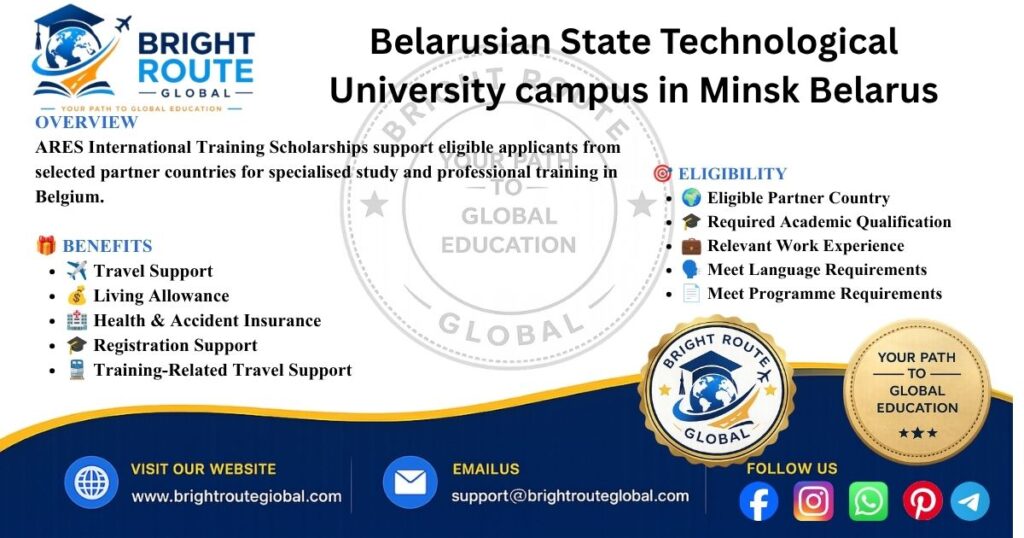
The ARES International Training Scholarships offer students and professionals from selected partner countries the opportunity to undertake advanced higher education or short-term professional training in Belgium.
The programme is administered by the Académie de Recherche et d’Enseignement Supérieur (ARES) and supports development-focused education within higher education institutions of the Wallonia-Brussels Federation. The current ARES application system includes the 2027–2028 International Training Scholarships and lists eligible applicants from selected partner countries.
Unlike conventional scholarships that may be open to applicants worldwide, ARES scholarships have a specific country list and professional-experience requirements. Applicants should therefore check their eligibility before spending time preparing an application.
Important: The current 2027–2028 application forms shown by ARES are closed to new submissions. Applicants interested in a future call should monitor the official ARES website for the next opening.
Scholarship Overview
ARES scholarships are designed to strengthen the knowledge and professional capacity of people from partner countries and contribute to development in their home countries.
The programme has traditionally included specialised Bachelor’s programmes, specialised Master’s programmes and continuing education/training courses. Previous official ARES calls specified that applicants could apply for only one programme and did not need to obtain admission separately from a French-speaking Belgian higher-education institution before applying for the ARES grant.
At a Glance
| Feature | Details |
|---|---|
| Scholarship Provider | ARES – Académie de Recherche et d’Enseignement Supérieur |
| Host Country | Belgium |
| Study Region | Wallonia-Brussels Federation |
| Academic Year | 2027–2028 |
| Study Types | Specialised Bachelor’s, Specialised Master’s & International Training |
| Target Group | Professionals and graduates from selected partner countries |
| Funding | Travel, living support, insurance and other eligible costs |
| Programme Length | Depends on the selected programme |
| Application | Online through the ARES system |
| Application Fee | Free |
| Selection | Competitive |
| Official Website | ARES |
ARES explicitly states in its previous official call that applying for an ARES scholarship is free and that it does not charge applicants at any stage of the application or selection process.
University Overview
ARES is not a single university. It is the Academy for Research and Higher Education of the Wallonia-Brussels Federation, and its scholarship programmes support study and training at participating higher-education institutions in French-speaking Belgium.
This means applicants should focus not only on the scholarship itself but also on the specific programme and host institution attached to the ARES call.
Depending on the year, the available programmes can cover areas related to public health, development, economics, environment, agriculture, human rights, transport, logistics, data science and other development-oriented subjects.
The exact programme list should always be taken from the latest ARES call because programmes can change from one academic year to another. The official ARES 2027–2028 application system currently confirms that a new International Training scholarship call exists.
Country Overview
Belgium is a Western European country known for its internationally connected cities, multilingual environment and strong higher-education system.
The Wallonia-Brussels Federation is the French-speaking community of Belgium and includes several universities and higher-education institutions.
For international students and professionals, studying in Belgium can provide exposure to European academic networks, research institutions, international organisations and development-focused projects.
However, applicants should remember that the ARES scholarship is specifically targeted toward applicants from selected partner countries, rather than being a general scholarship for all international students.
Why Choose an ARES Scholarship?
Fully Supported International Study
ARES scholarships are designed to remove many of the major financial barriers associated with studying or training in Belgium.
Professional Development
The programme is particularly relevant to professionals who want to strengthen their expertise and apply new knowledge in their home countries.
Development Focus
ARES connects higher education with international development cooperation, making the scholarship particularly relevant to applicants working in sectors that contribute to social and economic development.
International Exposure
Selected participants gain experience in Belgium while studying alongside people from different professional and cultural backgrounds.
Practical Training
The programme is not limited to traditional academic education. ARES also supports continuing education and specialised training programmes.
Degree Levels
Specialised Bachelor’s
ARES has offered specialised Bachelor’s-level opportunities equivalent to the first cycle of Belgian higher education. Previous official calls required a qualification comparable to a Belgian first-cycle degree of 180 ECTS credits.
Specialised Master’s
Specialised Master’s programmes are intended for applicants who already possess an advanced academic qualification.
Previous ARES calls required a qualification comparable to a Belgian second-cycle degree of 300 ECTS credits for specialised Master’s and continuing education applicants.
Continuing Education & Training
ARES also supports shorter professional-development programmes. Depending on the call, these can range from several weeks to several months.
The exact duration and programme format should be checked in the current call.
Available Fields of Study
ARES programmes are generally focused on areas connected to development and professional capacity building.
Popular areas have included:
- Public Health
- International Development
- Economics & Microfinance
- Environment & Sustainable Development
- Water, Energy & Food
- Human Rights
- Transport & Logistics
- Data Science
- Digital Education
- Agriculture
- Pharmaceutical Quality
- Geographic Information Systems
The list is not permanent. ARES changes the available programmes between calls, so applicants should select from the programmes listed in the relevant year’s official call rather than relying on an old programme list.
Scholarship Benefits
ARES scholarships can provide substantial financial support.
For specialised Bachelor’s and Master’s scholarships, the previous official ARES financing framework included:
- Economy-class international travel
- Living allowance
- Arrival and return-related allowance
- Registration-related support
- Health and accident insurance
- Eligible travel expenses related to inter-university training
The 2025–2026 official ARES documentation specified economy-class travel on an IATA airline, with a maximum of one return trip per academic year, along with a monthly subsistence package and insurance paid directly by ARES.
For continuing education programmes, the financing structure differs according to the duration of the training. Previous ARES rules included international travel, a subsistence allowance, insurance and eligible travel expenses.
Important: Financial amounts can change between calls. Applicants should use the latest official ARES call for the exact 2027–2028 amounts and conditions.
Hidden Costs
Even a highly funded scholarship does not necessarily mean that applicants will have no expenses before or during their journey.
| Potential Cost | What to Consider |
|---|---|
| Passport | Applicant’s responsibility |
| Document translation | May be required |
| Document certification | Depends on country/document |
| Local transportation | Before departure and after arrival |
| Initial personal expenses | Useful before first allowance |
| Airport travel | Home-country transportation may vary |
| Extra baggage | Usually not automatically covered |
| Personal purchases | Not normally scholarship-funded |
| Accommodation extras | Depends on programme arrangements |
| Banking/transfer costs | May apply depending on circumstances |
| Emergency expenses | Recommended to maintain a reserve |
Applicants should therefore keep a small emergency fund even when the scholarship provides substantial financial support.
Eligibility Criteria
ARES eligibility is one of the most important parts of the application.
Previous official ARES calls required applicants to:
- Be a national of an eligible partner country.
- Live and work in one of the eligible partner countries.
- Hold the appropriate academic qualification.
- Have relevant professional experience.
- Demonstrate adequate knowledge of the programme’s language.
- Apply for only one programme.
For specialised Bachelor’s applicants, the previous official criteria required at least two years of relevant professional experience after completion of Bac+3. For specialised Master’s and continuing education applicants, at least two years of relevant professional experience after Bac+5 was required.
The previous call also stated that the relevant academic qualification generally had to have been obtained no more than 20 years before the beginning of the training, with certain adjustments for childbirth/adoption.
The 2027–2028 ARES eligibility screening currently lists countries including Benin, Bolivia, Burkina Faso, Burundi, Cambodia, Cameroon, Cuba, Ecuador, Ethiopia, Haiti, Indonesia, Kenya, Madagascar, Mali, Morocco, Mozambique, Nepal, Niger, Peru, Philippines, Rwanda, Senegal, South Africa, Tanzania, Tunisia, Uganda, Vietnam and Zimbabwe, among others.
Bangladesh is not listed among the countries shown in the current ARES 2027–2028 eligibility screening. Therefore, Bangladeshi applicants should not assume they are eligible for the current ARES International Training Scholarship.
Required Documents
The exact document list depends on the selected programme, but previous official ARES calls required documents such as:
| ✓ | Document | Purpose |
|---|---|---|
| ☐ | Passport/Nationality Document | Proof of identity and nationality |
| ☐ | Academic Diploma | Proof of required qualification |
| ☐ | Academic Transcripts | Academic record |
| ☐ | Proof of Residence | Confirms residence in an eligible country |
| ☐ | Proof of Employment/Professional Experience | Demonstrates required work experience |
| ☐ | Academic Recommendation | Supports academic profile |
| ☐ | Professional Recommendation | Supports professional experience |
| ☐ | Motivation/Application Information | Explains suitability |
| ☐ | Pre-project | Required for certain programmes |
| ☐ | Language Evidence | Where required |
| ☐ | Other Programme Documents | According to the selected course |
Previous official ARES documentation specifically listed two recommendation letters, certified diploma copies, certified transcripts, proof of occupancy for the previous five years, nationality proof and a pre-project for certain courses.
Step-by-Step Application Process
The application is competitive, so applicants should treat the process as more than simply filling out an online form.
| Step | Action | Practical Guidance |
|---|---|---|
| Choose an eligible country | Check whether your country appears in the ARES list | This should be your first eligibility check |
| Choose one programme | Review available International Training programmes | You can apply for only one programme under the previous rules |
| Check academic eligibility | Compare your degree with the required Belgian-equivalent level | Check programme-specific requirements |
| Check professional experience | Confirm the required years and field | Experience should be relevant |
| Check language requirements | Review the programme’s teaching language | ARES requires appropriate language ability |
| Prepare academic documents | Collect diplomas and transcripts | Certified copies may be required |
| Prepare employment evidence | Gather employment certificates and related proof | Make sure dates and duties are clear |
| Prepare recommendation letters | Obtain academic/professional references | Choose referees who know your work |
| Prepare programme-specific documents | Write the required pre-project or other documents | Follow the course instructions |
| Create an ARES/GIRAF account | Access the official application system | Use accurate personal information |
| Complete the application | Fill in each section carefully | Save your work as you progress |
| Upload documents | Attach the required files | Check file quality and completeness |
| Review everything | Check dates, names and attachments | Errors can weaken or invalidate an application |
| Submit before the deadline | Complete the final submission | Do not wait until the final hours |
| Monitor your application | Follow official communications | Check email and platform notifications |
| Wait for selection | ARES evaluates applications | Selection is competitive |
| Complete post-selection procedures | Follow instructions if selected | Prepare travel and study arrangements |
Previous ARES application instructions used the GIRAF platform and stated that applications had to be completed online. ARES also warned applicants that the scholarship application itself is free.
Application Timeline
The timeline changes from one call to another.
For the current 2027–2028 cycle, ARES has already published an online eligibility/application system for International Training Scholarships, but the currently indexed submission form is closed to new submissions.
Applicants preparing for a future call should generally plan as follows:
| Period | Recommended Action |
|---|---|
| Several months before the call | Research eligible programmes |
| Before applications open | Prepare diplomas and transcripts |
| Before applications open | Collect employment evidence |
| Before applications open | Request recommendation letters |
| Application period | Complete online form |
| Before deadline | Upload and verify documents |
| After submission | Monitor email/platform |
| After selection | Complete visa and travel arrangements |
Because ARES deadlines can be short, preparing documents before the application portal opens can make a major difference.
Selection Criteria
Meeting the eligibility requirements does not guarantee selection.
ARES has previously stated that satisfying the admissibility criteria does not automatically guarantee selection or admission to the programme.
The selection process may consider factors such as:
- Academic background
- Professional experience
- Relevance of the applicant’s profile
- Motivation
- Development impact
- Quality of the application
- Programme-specific requirements
- Potential contribution to the applicant’s home country
Applicants should therefore demonstrate a clear connection between their education, professional experience, chosen programme and future development goals.
Accommodation & Living Costs
Selected scholarship recipients should receive financial support according to the applicable ARES financing framework, but applicants should still understand the Belgian cost of living.
Major expenses include:
- Accommodation
- Food
- Local transportation
- Mobile and internet services
- Study materials
- Personal expenses
The amount of the living allowance and other benefits depends on the scholarship category and current call.
Applicants should also understand that Belgium can be relatively expensive compared with many developing countries. A good financial plan is therefore important even when receiving a scholarship.
Part-time Jobs
ARES scholarship recipients should not build their financial plan around part-time employment.
The scholarship is designed to provide financial support during the academic or training period, and programme requirements can be intensive.
Before undertaking any paid work, scholarship recipients should check:
- Belgian immigration regulations
- Their residence status
- Scholarship conditions
- Programme requirements
- Applicable working-hour restrictions
The safest approach is to consider employment supplementary rather than essential funding.
Student Visa Process
Applicants selected for a programme in Belgium may need to obtain the appropriate visa and residence authorisation.
A practical sequence is:
ARES Selection → University/Programme Documentation → Visa Application → Travel → Arrival in Belgium → Registration
Depending on nationality and programme duration, applicants may need documents such as:
- Valid passport
- Scholarship/selection documentation
- Admission or programme documents
- Proof of financial support
- Health/insurance documentation
- Visa application forms
- Other documents requested by Belgian authorities
Visa requirements can change, so selected applicants should follow the instructions provided by the Belgian authorities and ARES rather than relying on old scholarship blogs.
Tips from Previous Applicants
- Check the eligible-country list before doing anything else.
- Start preparing documents several months in advance.
- Make sure your professional experience is clearly documented.
- Choose a programme closely related to your career.
- Read the programme-specific requirements carefully.
- Apply only through the official ARES system.
- Never pay anyone claiming to guarantee ARES selection.
ARES explicitly states that its scholarship application is free and warns about people or companies falsely claiming to act on its behalf and requesting payment.
Common Mistakes
- Applying when your country is not eligible
- Ignoring the professional-experience requirement
- Choosing a programme unrelated to your academic or professional background
- Applying for more than one programme
- Uploading uncertified or incomplete documents
- Submitting weak recommendation letters
- Waiting until the deadline to complete the application
Frequently Asked Questions
1. What is the ARES Scholarship?
ARES scholarships support international students and professionals from selected partner countries who wish to undertake eligible advanced study or training programmes in Belgium.
2. Is ARES a university?
No. ARES is the Academy for Research and Higher Education of the Wallonia-Brussels Federation. It coordinates higher-education-related activities and scholarship programmes.
3. Is the ARES Scholarship fully funded?
ARES provides substantial financial support. Depending on the programme, benefits can include international travel, living support, insurance and other eligible expenses. The exact package varies by scholarship type and call.
4. Can Bangladeshi students apply?
For the current 2027–2028 International Training eligibility screening, Bangladesh is not among the listed eligible countries. Applicants should always check the latest official country list before applying.
5. What countries are eligible?
ARES uses a defined partner-country list. The current 2027–2028 system lists countries across Africa, Asia and Latin America, including Benin, Nepal, Vietnam, Indonesia, Morocco, Peru, Rwanda, Senegal, Tanzania and others.
6. What academic levels are supported?
ARES International Training Scholarships have included specialised Bachelor’s, specialised Master’s and continuing education programmes.
7. Do I need work experience?
Yes, relevant professional experience is an important eligibility condition. Previous official calls required at least two years of relevant experience after the relevant degree level.
8. Can I apply for several ARES programmes?
Previous official rules required applicants to apply for only one course.
9. Do I need admission to a Belgian university before applying?
Previous ARES rules stated that applicants did not need to obtain prior admission to a French-speaking Belgian higher-education institution before applying for the ARES grant.
10. Does ARES charge an application fee?
No. ARES states that applying for its scholarship is free and that it does not charge fees during the application or selection process.
11. Does ARES pay for airfare?
Previous official scholarship rules included economy-class international travel, generally limited to one return trip per academic year for specialised Bachelor’s and Master’s scholarships.
12. Does ARES provide a monthly allowance?
Yes, scholarship financing includes a subsistence allowance. The amount depends on the scholarship category and current call.
13. Does ARES cover insurance?
Previous official financing rules state that insurance costs are paid directly by ARES.
14. How do I apply?
Applicants should use the official ARES online application system when the relevant call is open.
15. Is selection guaranteed if I meet the requirements?
No. ARES explicitly states that satisfying the admissibility requirements does not guarantee selection.
Conclusion
The ARES International Training Scholarship is a highly competitive opportunity for graduates and professionals from selected partner countries who want to strengthen their academic and professional expertise in Belgium.
Its biggest advantage is the combination of academic training and substantial financial support, including travel, living support and insurance under the applicable scholarship framework.
However, ARES is not a general scholarship open to every international student. The eligible-country list, academic qualification, professional experience and programme requirements are critical. For the current 2027–2028 cycle, the official eligibility system lists a defined group of partner countries, and the current application form is already closed to new submissions.
If you are from an eligible country, the best strategy is to prepare well before the next application window: identify a suitable programme, document your professional experience, prepare certified academic records and develop a strong application that demonstrates how the training will contribute to your career and your home country’s development.
Always verify the latest ARES call before applying because eligible countries, programmes, benefits, deadlines and requirements may change.
University of Southern Denmark Scholarships : How to Apply
University of Southern Denmark Scholarships 2027: Eligibility, Benefits and How...
Read More

Aalto University Scholarships 2027 Full Details
Aalto University Scholarships 2027: Eligibility, Tuition Fees and How to...
Read More
UN Volunteers Opportunities 2026–2027: How to Apply
UN Volunteers Opportunities 2026–2027: Eligibility, Benefits and Application Process Explore...
Read More
MESPOM Erasmus Mundus Scholarship 2027–2029
MESPOM Erasmus Mundus Scholarship 2027–2029: Fully Funded Master’s in Europe...
Read More
Australian Catholic University (ACU) Scholarships
Australian Catholic University (ACU) Admissions 2027: Courses, Scholarships and How...
Read More
University of Southern Denmark Scholarships : How to Apply
University of Southern Denmark Scholarships 2027: Eligibility, Benefits and How...
Read More
Aalto University Scholarships 2027 Full Details
Aalto University Scholarships 2027: Eligibility, Tuition Fees and How to...
Read More
UBD Graduate Research Scholarship 2027: PhD Funding
UBD Graduate Research Scholarship 2027: Fully Funded PhD in Brunei...
Read More