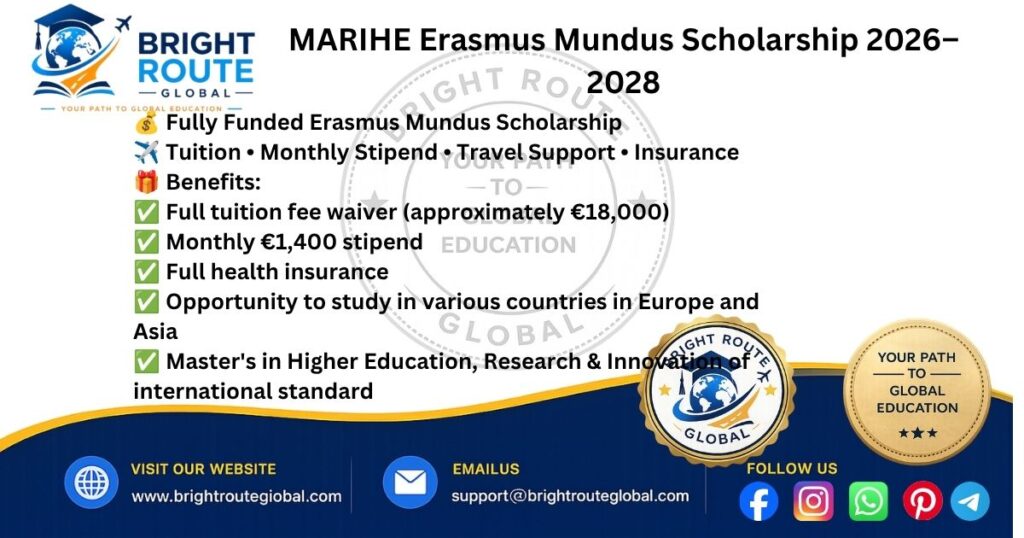
MARIHE Erasmus Mundus Scholarship 2026–2028
Apply for the MARIHEScholarship 2026–2028 to study Higher Education Management in Europe with tuition coverage, a monthly stipend, and travel support.
If you aspire to build a career in higher education leadership, university administration, educational policy, or international education management, the Master in Research and Innovation in Higher Education (MARIHE) is one of the most prestigious opportunities available. Supported by the Erasmus Mundus Joint Master’s (EMJM) programme, MARIHE brings together leading European universities to deliver a multidisciplinary master’s degree focused on the future of higher education.
Unlike traditional master’s programmes offered by a single university, MARIHE provides a unique international learning experience where students study in multiple European countries, engage with diverse higher education systems, and collaborate with classmates from around the world. Graduates receive a joint or multiple degree recognized across Europe and beyond, making them highly competitive for careers in universities, government agencies, international organizations, NGOs, and education-focused companies.
The programme combines academic excellence with practical experience through mobility, research projects, internships, and close interaction with experts in higher education policy and innovation. For ambitious students seeking a global perspective on educational leadership, MARIHE offers a transformative academic journey.
Scholarship Overview
| Category | Details |
|---|---|
| Scholarship Name | MARIHE Erasmus Mundus Scholarship 2026–2028 |
| Programme | Master in Research and Innovation in Higher Education (MARIHE) |
| Scholarship Type | Fully Funded (for selected Erasmus Mundus scholarship recipients) |
| Degree Level | Joint Master’s Degree |
| Programme Duration | 2 Years (120 ECTS) |
| Study Locations | Multiple European Countries |
| Language of Instruction | English |
| Funding | Erasmus Mundus Joint Master’s Scholarship |
| Application Mode | Online |
| Eligible Applicants | International Students |
What is the MARIHE Programme?
MARIHE is an internationally recognized master’s programme specializing in higher education management, governance, research, innovation, and policy development. It was designed to prepare future professionals who can address the rapidly changing challenges faced by universities and higher education institutions worldwide.
The programme focuses on understanding how higher education systems operate, how universities are managed, how policies influence educational development, and how innovation can improve teaching, research, and institutional performance.
Students learn through lectures, seminars, workshops, research projects, case studies, and practical assignments led by internationally respected academics and professionals.
One of MARIHE’s greatest strengths is its multicultural environment. Each cohort includes students from numerous countries, creating opportunities to exchange ideas, understand different educational systems, and develop international professional networks that continue long after graduation.
Why Choose the MARIHE Programme?
MARIHE stands out from conventional master’s degrees because it combines academic knowledge with international mobility and practical experience.
Key advantages include:
- Study in multiple European countries during one degree.
- Learn from internationally recognized professors and researchers.
- Gain insight into different higher education systems.
- Build a strong international professional network.
- Earn a prestigious Erasmus Mundus joint master’s degree.
- Improve leadership and policy analysis skills.
- Participate in research and innovation projects.
- Prepare for careers in international organizations, ministries, universities, and educational consulting.
- Develop intercultural communication and teamwork skills.
- Enhance employability in the global education sector.
The programme is particularly valuable for students who want to influence educational policy, improve university management, or contribute to the modernization of higher education systems.
Host Universities
MARIHE is delivered through a consortium of respected European universities. Each institution contributes its expertise in higher education studies, management, economics, policy, and research.
Some of the participating universities include:
- Danube University Krems (Austria)
- University for Continuing Education Krems (Austria)
- Tampere University (Finland)
- Eötvös Loránd University (Hungary)
- Osnabrück University of Applied Sciences (Germany)
Depending on the intake and study pathway, students may also have opportunities to study or conduct research with additional academic and institutional partners.
Studying at multiple universities allows students to experience different academic cultures, teaching methods, and administrative systems while broadening their professional perspectives.
Host Countries
One of MARIHE’s defining features is its international mobility. Instead of remaining in one country for two years, students move between partner institutions across Europe.
The programme typically includes study periods in:
| Country | Highlights |
|---|---|
| Austria | Innovation, university governance, and research excellence |
| Finland | World-renowned education system and digital learning |
| Hungary | Rich academic traditions and international student community |
| Germany | Practical learning, research collaboration, and industry connections |
This mobility helps students understand how different countries organize higher education and equips them with comparative knowledge that is highly valued by employers.
Why Study in Europe?
Europe remains one of the world’s leading destinations for higher education due to its academic quality, cultural diversity, and global recognition.
Benefits of studying in Europe include:
Internationally Recognized Degrees
European universities are known for maintaining high academic standards and producing graduates who are competitive in the international job market.
Multicultural Environment
Students interact with peers from different cultural, linguistic, and professional backgrounds, strengthening their global communication skills.
Research Opportunities
European universities actively participate in international research projects, providing students with access to advanced research facilities and experienced supervisors.
Travel Opportunities
The programme’s mobility structure allows students to experience several European countries, broadening both academic and personal perspectives.
Career Development
Graduates benefit from strong alumni networks, employer recognition, internships, and career services that support professional growth.
Degree Structure
The MARIHE programme is a two-year, full-time master’s degree consisting of 120 ECTS credits.
The curriculum integrates theoretical knowledge with practical application and emphasizes interdisciplinary learning.
Students complete:
- Core courses
- Elective modules
- Research methodology
- Comparative higher education studies
- Innovation and policy analysis
- International mobility semesters
- Master’s thesis
The programme encourages students to critically examine global trends affecting higher education while developing practical solutions to real-world challenges.
Programme Mobility Structure
One of the most exciting aspects of MARIHE is its mobility pathway.
Instead of studying at a single institution, students move between partner universities according to the programme structure.
This international experience enables students to:
- Experience different teaching methods.
- Compare national higher education systems.
- Develop intercultural competence.
- Build an international academic network.
- Learn from specialists across Europe.
- Enhance adaptability and leadership skills.
Employers increasingly value graduates with international study experience because they demonstrate flexibility, communication skills, and global awareness.
Who Should Apply?
The MARIHE programme is an excellent choice for individuals who are passionate about improving education and shaping the future of universities.
It is particularly suitable for:
- Recent graduates interested in education policy
- University administrators seeking advanced qualifications
- Government professionals working in higher education
- Researchers in education and public policy
- NGO professionals focused on educational development
- International education consultants
- Professionals working in quality assurance and accreditation
- Future leaders of universities and educational institutions
Whether your goal is to work in academia, public administration, international organizations, or educational consulting, MARIHE provides the knowledge, skills, and international experience needed to succeed.
Scholarship Benefits
One of the biggest advantages of the MARIHE Erasmus Mundus Scholarship is its comprehensive financial support. Students selected for the Erasmus Mundus scholarship receive funding that allows them to focus on their studies, research, and international mobility without worrying about major financial burdens.
Apart from the financial assistance, students also benefit from studying at several prestigious European universities, gaining international exposure, and becoming part of a global alumni network.
Scholarship Benefits at a Glance
| Benefit | Coverage | Why It Matters |
|---|---|---|
| Tuition Fee | Full tuition fee waiver | Students do not need to pay tuition to the partner universities. |
| Monthly Living Allowance | Monthly stipend throughout the study period | Helps cover food, transportation, study materials, and daily expenses. |
| Travel Support | Contribution toward international travel | Reduces the cost of traveling between home country and Europe, as well as mobility between partner universities (subject to programme rules). |
| Installation Support | Initial settlement allowance | Helps students manage initial expenses after arriving in Europe. |
| Health Insurance | Comprehensive insurance coverage | Protects students throughout the programme and mobility periods. |
| Mobility Experience | Study in multiple European countries | Develops intercultural competence and international professional networks. |
| Joint Master’s Degree | Internationally recognized qualification | Increases employability worldwide. |
| Academic Networking | Access to experts and researchers | Enables collaboration with academics and professionals across Europe. |
| Career Development | International exposure and practical learning | Strengthens future career opportunities in higher education and policy sectors. |
Scholarship Benefits Explained
Full Tuition Fee Coverage
Tuition fees for international master’s programmes in Europe can be substantial. Erasmus Mundus scholarship recipients are exempt from paying these tuition fees, allowing them to pursue a world-class education without this financial burden.
Monthly Living Allowance
The scholarship includes a monthly stipend intended to help students manage their everyday living expenses. While careful budgeting is still important, this support significantly reduces financial stress during the programme.
Travel Contribution
Because MARIHE includes mobility across multiple countries, travel costs can become expensive. The scholarship provides travel support according to Erasmus Mundus regulations, making international study more accessible.
Installation Allowance
Moving to another continent often involves initial expenses such as accommodation deposits, transportation, household essentials, and administrative fees. Installation support helps students settle more comfortably.
Insurance Coverage
Students receive health insurance during the programme, providing peace of mind while studying and traveling within Europe.
International Learning Environment
Students learn alongside classmates from different continents, creating lifelong friendships and professional connections while gaining valuable cross-cultural experience.
Hidden Costs You Should Budget For
Although the Erasmus Mundus Scholarship is generous, applicants should still prepare for certain personal expenses that may not be fully covered.
Planning ahead will help ensure a smoother transition to life in Europe.
| Expense | Estimated Cost | Notes |
|---|---|---|
| Passport Application/Renewal | Varies by country | Required before applying for a visa. |
| Student Visa Fee | Depends on embassy requirements | May differ based on nationality. |
| Residence Permit | Country-specific | Required after arrival in some host countries. |
| Flight Tickets | Varies by departure country | Scholarship travel support may not cover all costs. |
| Accommodation Deposit | One month’s rent in many cases | Usually refundable at the end of the tenancy. |
| Personal Shopping | Clothing, electronics, toiletries | Not covered by the scholarship. |
| Additional Meals | Depends on lifestyle | Students should budget for groceries and dining. |
| Local Transportation | Depends on city | Student discounts are often available. |
| Study Materials | Books, software, printing | Costs vary by semester. |
| Leisure and Travel | Optional | Personal expense for tourism and entertainment. |
Budgeting Tips
To manage your finances effectively:
- Prepare an emergency fund before departure.
- Compare accommodation options early.
- Use student discounts whenever possible.
- Cook meals at home to reduce food expenses.
- Purchase second-hand textbooks if available.
- Track monthly spending using budgeting apps.
Eligibility Criteria
Applicants must satisfy both the MARIHE programme requirements and the Erasmus Mundus admission criteria.
Although exact requirements may change slightly each admission cycle, the following conditions generally apply.
Academic Qualification
Applicants should hold a recognized bachelor’s degree (or equivalent) before the programme begins.
Degrees from various academic disciplines are accepted, provided applicants demonstrate an interest in higher education management and related fields.
English Language Proficiency
Since the programme is taught entirely in English, applicants must provide valid proof of English proficiency according to the programme’s accepted language qualifications.
Accepted tests typically include IELTS, TOEFL, Cambridge English, or other approved qualifications listed in the official admission requirements.
Academic Excellence
Strong academic performance increases competitiveness.
Selection committees evaluate:
- Academic transcripts
- Grade point average
- Relevant coursework
- Academic achievements
Motivation
Applicants should clearly explain:
- Why they want to join MARIHE
- Their interest in higher education
- Career objectives
- Leadership potential
- Contribution to international education
International Perspective
The programme values applicants who demonstrate:
- Intercultural awareness
- International experience
- Community engagement
- Leadership abilities
- Research interests
Required Application Documents
The MARIHE application process is document-intensive. Preparing these materials well before the deadline greatly improves your chances of submitting a strong application.
Required Documents Overview
| Document | Required | Purpose |
|---|---|---|
| Online Application Form | ✔ | Official application submission |
| Passport | ✔ | Identity verification |
| Bachelor’s Degree Certificate | ✔ | Proof of academic qualification |
| Official Academic Transcript | ✔ | Academic performance evaluation |
| Curriculum Vitae (CV) | ✔ | Academic and professional background |
| Motivation Letter | ✔ | Demonstrates suitability for the programme |
| English Language Certificate | ✔ | Proof of English proficiency |
| Two Recommendation Letters | ✔ | Academic or professional references |
| Proof of Residence/Citizenship (if applicable) | As required | Scholarship eligibility verification |
| Additional Supporting Documents | If requested | Programme-specific requirements |
Understanding Each Document
1. Online Application Form
Complete every section carefully. Ensure that your personal information, educational background, and programme choices are accurate.
2. Passport
Your passport should remain valid throughout the application process and preferably extend beyond your planned arrival in Europe.
3. Degree Certificate
Applicants who have not yet graduated may usually submit proof of expected graduation according to the programme guidelines.
4. Academic Transcript
Official transcripts should clearly list:
- Courses completed
- Grades received
- Credit hours
- Degree classification (if applicable)
5. Curriculum Vitae (CV)
Your CV should include:
- Educational background
- Work experience
- Research experience
- Volunteer activities
- Leadership roles
- Awards and achievements
- Conferences
- Publications (if any)
- Language skills
- Technical skills
A well-structured Europass-style CV is often recommended for European programmes.
6. Motivation Letter
This is one of the most important parts of your application.
Your motivation letter should answer questions such as:
- Why MARIHE?
- Why higher education management?
- What are your career goals?
- What makes you a strong candidate?
- How will the programme benefit your future?
- How will you contribute to your home country’s higher education sector?
Avoid generic statements or copied templates. Admissions committees value authenticity, clarity, and specific examples.
7. English Language Certificate
Ensure your language test is valid and meets the minimum score required by the programme. Expired test results are generally not accepted.
8. Recommendation Letters
Choose referees who know your academic or professional abilities well.
Strong recommendation letters should discuss:
- Academic performance
- Research potential
- Leadership
- Communication skills
- Professionalism
- Suitability for graduate study
Two-Round Application Process
The MARIHE programme follows a structured admission process. During the initial application round, applicants submit all required documents through the online application portal.
Candidates shortlisted after the document evaluation may be invited to participate in the second stage, which can include additional assessments such as a recorded video statement or interview, depending on the admission cycle and programme requirements. Applicants should carefully follow the official instructions provided after submitting their application.
Application Preparation Tips
To maximize your chances of success:
- Start preparing documents several months before the deadline.
- Request recommendation letters early.
- Review your motivation letter multiple times.
- Scan all documents clearly and in the required format.
- Name files according to the programme’s instructions.
- Double-check every uploaded document before submission.
- Submit your application well before the deadline to avoid technical issues.
A complete, accurate, and professionally prepared application reflects your commitment and attention to detail—qualities that admissions committees highly value.
Step-by-Step Application Process
Applying for the MARIHE Erasmus Mundus Scholarship requires careful preparation, as the programme is highly competitive. Applicants should begin gathering documents several months before the application deadline and follow the official instructions carefully.
The application process is completed online, and all required documents must be uploaded before the deadline. Incomplete or late applications are generally not considered.
Application Process Overview
| Step | Action | Details |
|---|---|---|
| Step 1 | Research the Programme | Review the curriculum, mobility scheme, eligibility requirements, and scholarship information. |
| Step 2 | Check Eligibility | Confirm that you meet the academic and English language requirements. |
| Step 3 | Prepare Documents | Collect transcripts, degree certificates, passport, CV, motivation letter, recommendation letters, and language certificate. |
| Step 4 | Create an Online Account | Register through the official MARIHE online application portal. |
| Step 5 | Complete the Application Form | Fill in your personal, academic, and professional information accurately. |
| Step 6 | Upload Required Documents | Ensure all files are clear, complete, and in the required format. |
| Step 7 | Submit Before the Deadline | Review every section carefully before final submission. |
| Step 8 | Wait for Evaluation | Applications undergo academic and administrative review. |
| Step 9 | Participate in the Second Round | Shortlisted applicants may be invited to submit additional materials or participate in an interview/video assessment, depending on the admission cycle. |
| Step 10 | Receive Admission Decision | Successful applicants receive admission and scholarship notifications. |
Tips for Completing the Online Application
- Use an active email address that you check regularly.
- Save your application frequently while completing the form.
- Upload high-quality PDF files whenever possible.
- Ensure names on all documents match your passport.
- Double-check dates, grades, and personal information before submitting.
- Keep a copy of all submitted documents for future reference.
Application Timeline
Although exact dates may vary each year, the MARIHE admission process generally follows a similar schedule.
| Stage | Expected Timeline |
|---|---|
| Applications Open | October–November |
| Application Deadline | January |
| Administrative Review | January–February |
| Academic Evaluation | February–March |
| Second-Round Assessment (if applicable) | March |
| Admission Results | April–May |
| Scholarship Confirmation | May–June |
| Visa Application | June–August |
| Programme Begins | September |
Applicants should regularly check the official programme website for updated deadlines and announcements, as timelines may change from one admission cycle to another.
How Applications Are Evaluated
Admission to MARIHE is highly competitive because the programme attracts applicants from around the world.
The admissions committee evaluates applications holistically rather than relying on a single factor.
Main Evaluation Criteria
| Criterion | Importance |
|---|---|
| Academic Performance | Very High |
| Motivation Letter | Very High |
| English Language Proficiency | High |
| Recommendation Letters | High |
| Relevant Academic Background | High |
| Professional Experience (if applicable) | Moderate |
| International Experience | Moderate |
| Leadership & Community Involvement | Moderate |
| Completeness of Application | Essential |
Strong applicants typically demonstrate not only excellent academic records but also a clear commitment to improving higher education systems and contributing to society.
What Makes a Strong Applicant?
Successful candidates often share several characteristics:
Strong Academic Foundation
Applicants should show consistent academic performance throughout their previous studies.
Clear Career Goals
The admissions committee values applicants who can clearly explain how the MARIHE programme aligns with their long-term professional ambitions.
Genuine Interest in Higher Education
Candidates should demonstrate an understanding of current challenges in higher education, such as internationalization, digital transformation, quality assurance, governance, and innovation.
Leadership Potential
Leadership can be demonstrated through:
- Student organizations
- Volunteer work
- Community projects
- Professional responsibilities
- Research activities
International Mindset
Because MARIHE is an international programme, applicants who appreciate cultural diversity and global collaboration are particularly well suited.
Accommodation
Accommodation arrangements vary depending on the university and country where students are studying during each semester.
Many students choose university-recommended housing, while others rent private apartments.
University Accommodation
Advantages include:
- Affordable rental costs
- Close proximity to campus
- Easy access to university facilities
- Opportunity to meet international students
- Student-friendly environment
Private Accommodation
Some students prefer renting private apartments because they offer:
- Greater privacy
- Flexible living arrangements
- Independent lifestyle
- More space for study
Finding Accommodation
Useful strategies include:
- Apply early for university housing.
- Join official student social media groups.
- Compare rental prices across neighborhoods.
- Read rental agreements carefully before signing.
- Budget for security deposits and utility costs.
Estimated Monthly Living Costs
Living expenses vary depending on the country, city, and personal lifestyle. Students should prepare a realistic budget before arriving in Europe.
Estimated Monthly Expenses
| Expense | Estimated Cost (€) |
|---|---|
| Accommodation | 350–700 |
| Food & Groceries | 200–350 |
| Local Transportation | 20–60 |
| Internet & Mobile | 20–40 |
| Study Materials | 20–60 |
| Health & Personal Care | 30–80 |
| Leisure & Entertainment | 80–200 |
| Miscellaneous | 50–100 |
Students living in larger cities may have higher expenses than those in smaller university towns. Planning and budgeting are essential to make the most of the scholarship support.
Cost-Saving Tips
International students can reduce expenses by:
- Using student discounts on transportation and museums.
- Cooking meals at home instead of eating out frequently.
- Sharing accommodation with classmates when appropriate.
- Purchasing second-hand textbooks.
- Taking advantage of university libraries and digital resources.
- Planning travel in advance to secure lower fares.
Part-Time Work Opportunities
Many European countries allow international students to work part-time while studying, subject to national immigration regulations and visa conditions.
Part-time employment can help students gain practical experience, improve language skills, and supplement their income.
Popular Student Jobs
- University administrative assistant
- Library assistant
- Research assistant
- Teaching assistant
- Customer service representative
- Café or restaurant staff
- Retail assistant
- English language tutor
- Translation services
- Freelance writing or graphic design
- Digital marketing
- IT support and software development
Students should always ensure that employment does not interfere with their academic responsibilities and that they comply with local work regulations.
Internship Opportunities
One of MARIHE’s strengths is its emphasis on practical learning.
Depending on the curriculum and study pathway, students may have opportunities to:
- Work with universities and higher education institutions.
- Participate in educational research projects.
- Engage with international organizations.
- Contribute to policy analysis and quality assurance initiatives.
- Develop professional networks through conferences and workshops.
These experiences enhance graduates’ employability and provide valuable real-world insights into higher education management.
Student Visa Process
After receiving the official admission letter and scholarship confirmation, successful applicants should begin the student visa application process as early as possible.
Visa procedures vary depending on the country where students begin their studies and their nationality.
Common Visa Requirements
| Document | Purpose |
|---|---|
| Valid Passport | Identity verification |
| Admission Letter | Confirms acceptance into the programme |
| Scholarship Confirmation | Demonstrates financial support |
| Visa Application Form | Official visa request |
| Passport Photographs | Identity documentation |
| Health Insurance Proof | Required by immigration authorities |
| Accommodation Information | Confirms intended residence |
| Academic Documents | Supporting educational qualifications |
| Additional Documents | As required by the relevant embassy or consulate |
Visa Application Tips
- Apply immediately after receiving admission documents.
- Check embassy appointment availability well in advance.
- Prepare certified translations if required.
- Keep printed and digital copies of all documents.
- Verify passport validity before submitting your application.
- Follow the specific visa requirements of the country where your first semester will take place.
Processing times vary by country, so early preparation is strongly recommended.
Tips from Previous Applicants
Every year, the MARIHE programme attracts highly qualified applicants from around the world. While academic excellence is important, successful candidates often emphasize that careful preparation, authenticity, and attention to detail made the biggest difference in their applications.
Here are some practical tips inspired by the experiences of previous applicants and Erasmus Mundus scholars.
1. Start Preparing Early
One of the most common recommendations is to begin preparing your application several months before the deadline. This gives you enough time to:
- Request recommendation letters.
- Renew your passport if necessary.
- Take an English language proficiency test.
- Review and improve your motivation letter.
- Gather official academic documents.
Last-minute applications often contain avoidable mistakes.
2. Research the Programme Thoroughly
Admissions committees appreciate applicants who clearly understand the programme.
Before writing your motivation letter, learn about:
- The curriculum
- Mobility structure
- Partner universities
- Career opportunities
- Research focus
- Programme objectives
A well-informed application demonstrates genuine interest and commitment.
3. Write an Original Motivation Letter
Avoid copying templates from the internet.
Instead, explain:
- Why you are interested in higher education management.
- What experiences inspired your career goals.
- Why MARIHE is the right programme for you.
- How you plan to apply your knowledge after graduation?
A personal and authentic motivation letter is often much more persuasive than one filled with generic statements.
4. Choose Strong Referees
Recommendation letters should come from people who genuinely know your academic or professional abilities.
Good referees include:
- University professors
- Research supervisors
- Department heads
- Employers
- Project coordinators
Provide your referees with sufficient time to prepare thoughtful recommendations.
5. Pay Attention to Every Detail
Simple mistakes can negatively affect your application.
Always verify:
- Correct spelling of your name
- Accurate dates
- Proper document titles
- Clear scanned copies
- Complete uploads
- Required signatures
Small details reflect professionalism.
6. Demonstrate Leadership and Initiative
The programme values applicants who have contributed beyond the classroom.
Examples include:
- Student organizations
- Community service
- Volunteer work
- Research projects
- Conferences
- Professional training
- Educational initiatives
These experiences strengthen your application.
7. Prepare Financially
Even fully funded scholarships may not cover every personal expense.
Save money for:
- Visa fees
- Flight tickets (if partially covered)
- Accommodation deposits
- Initial living expenses
- Emergency situations
Good financial planning makes the transition much easier.
Common Mistakes to Avoid
Many otherwise qualified applicants lose opportunities because of avoidable errors.
Frequent Mistakes
❌ Submitting incomplete applications
❌ Uploading blurred or unreadable documents
❌ Using copied motivation letters
❌ Missing the application deadline
❌ Ignoring document formatting requirements
❌ Selecting referees who barely know you
❌ Providing inconsistent academic information
❌ Uploading expired English language certificates
❌ Waiting until the final day to submit
❌ Failing to monitor email after submitting the application
Avoiding these mistakes can significantly improve the quality of your application.
Career Opportunities After Graduation
The MARIHE programme prepares graduates for leadership and specialist roles in higher education and related sectors.
Graduates commonly pursue careers in:
- Universities and colleges
- Ministries of Education
- International organizations
- UNESCO-related projects
- Erasmus+ programme administration
- Educational NGOs
- Quality assurance agencies
- Research institutes
- Policy think tanks
- International student services
- Higher education consulting
- Academic project management
The programme’s international perspective and multidisciplinary curriculum make graduates highly competitive in both public and private sectors.
Frequently Asked Questions (FAQs)
1. Is the MARIHE programme fully funded?
Selected Erasmus Mundus scholarship recipients receive comprehensive financial support, including tuition coverage and other benefits according to the scholarship rules.
2. Is IELTS mandatory?
Applicants must demonstrate English language proficiency. Accepted tests and minimum score requirements are specified in the official admission guidelines.
3. Can students from any academic background apply?
Yes. Applicants from various disciplines may apply if they meet the admission requirements and demonstrate a strong interest in higher education management.
4. How long is the programme?
The programme lasts two years (120 ECTS credits).
5. Is the degree internationally recognized?
Yes. MARIHE is an internationally recognized Erasmus Mundus Joint Master’s programme.
6. Will I study in more than one country?
Yes. International mobility is one of the programme’s defining features.
7. Can I apply before completing my bachelor’s degree?
Applicants who are in the final year of their bachelor’s programme may be eligible, provided they satisfy the programme’s graduation requirements before enrollment.
8. Is work experience required?
No. However, relevant professional or volunteer experience may strengthen your application.
9. How competitive is the scholarship?
The Erasmus Mundus Scholarship is highly competitive because it attracts excellent applicants from around the world.
10. Are recommendation letters mandatory?
Yes. Applicants are generally required to submit recommendation letters as part of the application.
11. Can I apply without a passport?
A valid passport is generally required for identification and future visa processing. Applicants should review the official application instructions for any exceptions.
12. Do I need to submit original documents?
Applications are usually submitted online using digital copies. Original documents may be requested later for verification.
13. Can I work while studying?
Many European countries allow international students to work part-time, subject to visa conditions and national regulations.
14. What language is used for teaching?
The MARIHE programme is taught entirely in English.
15. Does the programme include internships?
Depending on the study pathway and curriculum, students may participate in internships, research projects, or other practical learning activities.
16. Can I stay in Europe after graduation?
Graduates should follow the post-study residence and employment regulations of the country where they wish to work, as these vary by nation.
17. What makes a strong application?
A competitive application typically includes:
- Strong academic performance
- A well-written motivation letter
- Quality recommendation letters
- Clear career goals
- Complete and accurate documentation
18. Where can I find official updates?
Always rely on the official MARIHE website for the latest admission requirements, deadlines, and scholarship information.
Final Thoughts
The MARIHE Erasmus Mundus Scholarship 2026–2028 is much more than a fully funded master’s programme—it’s an opportunity to become part of a global community committed to improving higher education. Through its international mobility, interdisciplinary curriculum, and collaboration among leading European universities, MARIHE equips students with the knowledge, skills, and global perspective needed to shape the future of education.
If you are passionate about educational leadership, policy development, research, or university management, this programme offers an outstanding platform to build a successful international career.
Because admission is highly competitive, preparation is essential. Start gathering your documents early, invest time in writing a compelling motivation letter, request strong recommendation letters, and carefully follow the official application guidelines.
With thorough preparation and a genuine commitment to advancing higher education, you can significantly improve your chances of joining one of Europe’s most respected Erasmus Mundus Joint Master’s programmes.
Stay connected with Bright Route Global for the latest scholarship opportunities, study abroad guides, visa updates, and expert application tips to help you achieve your international education goals.
University of Southern Denmark Scholarships : How to Apply
University of Southern Denmark Scholarships 2027: Eligibility, Benefits and How...
Read More
Aalto University Scholarships 2027 Full Details
Aalto University Scholarships 2027: Eligibility, Tuition Fees and How to...
Read More
UN Volunteers Opportunities 2026–2027: How to Apply
UN Volunteers Opportunities 2026–2027: Eligibility, Benefits and Application Process Explore...
Read More
MESPOM Erasmus Mundus Scholarship 2027–2029
MESPOM Erasmus Mundus Scholarship 2027–2029: Fully Funded Master’s in Europe...
Read More