Global Korea Scholarship 2026 (GKS) – Fully Funded Scholarship in South Korea
Explore the GKS Scholarship 2026 for international students, including benefits, eligibility, documents, application tracks and study opportunities in Korea.
The Global Korea Scholarship (GKS) 2026, funded by the Government of South Korea and administered through the National Institute for International Education (NIIED), provides international students with opportunities to pursue higher education at universities in South Korea.
GKS supports degree programmes at undergraduate and graduate levels and combines financial support with Korean language training and academic study. The official Study in Korea portal describes GKS as a Korean government scholarship programme designed to attract talented international students and build international networks.
For 2026, separate application guidelines were issued for undergraduate programmes (GKS-U) and graduate programmes (GKS-G). The 2026 graduate programme planned to invite 2,000 international students, while the undergraduate programme included approximately 280 students across associate and bachelor’s degree programmes.
Important: The 2026 application cycles have already been announced and processed according to their respective schedules. Applicants planning for a future GKS intake should use the latest official GKS notice rather than relying on old deadlines.
Scholarship Overview
| Feature | Details |
|---|---|
| Scholarship | Global Korea Scholarship (GKS) |
| Country | South Korea |
| Funded by | Government of the Republic of Korea |
| Administered by | National Institute for International Education (NIIED) |
| Study levels | Associate, Bachelor’s, Master’s and Doctoral programmes |
| Application routes | Embassy Track and University Track |
| Main study language | Korean and/or English depending on programme |
| Korean language training | Generally included for applicable degree programmes |
| Tuition support | Provided under GKS |
| Airfare | Provided according to programme rules |
| Monthly allowance | Provided according to the applicable GKS guidelines |
| Universities | Designated Korean universities |
| Official platform | Study in Korea |
The exact quota, benefits, eligibility conditions and application schedule depend on the specific GKS programme and year.
What Is the Global Korea Scholarship?
The Global Korea Scholarship, commonly known as GKS, is one of South Korea’s major government-funded scholarship programmes for international students.
The programme is intended to provide international students with opportunities to study at Korean universities while developing academic and cultural connections between Korea and other countries.
GKS degree programmes can include Korean language training followed by a degree programme. The official Study in Korea portal lists associate, bachelor’s, master’s and doctoral pathways, with the duration depending on the degree.
Why Study in South Korea Through GKS?
Government-funded scholarship
GKS is funded by the Korean government and administered through NIIED, giving selected students access to a structured scholarship programme.
Wide range of universities
The programme works with designated universities across South Korea. Applicants must select institutions and departments from the universities included in the relevant GKS University Information file.
Multiple degree levels
Depending on the specific annual programme, students can apply for associate, bachelor’s, master’s or doctoral studies.
Korean language opportunity
Applicable GKS degree programmes include Korean language training before the degree programme, subject to the programme’s rules and exemptions.
International academic environment
GKS brings students from different countries together in Korean universities, creating opportunities for international academic and cultural exchange.
GKS Scholarship Benefits
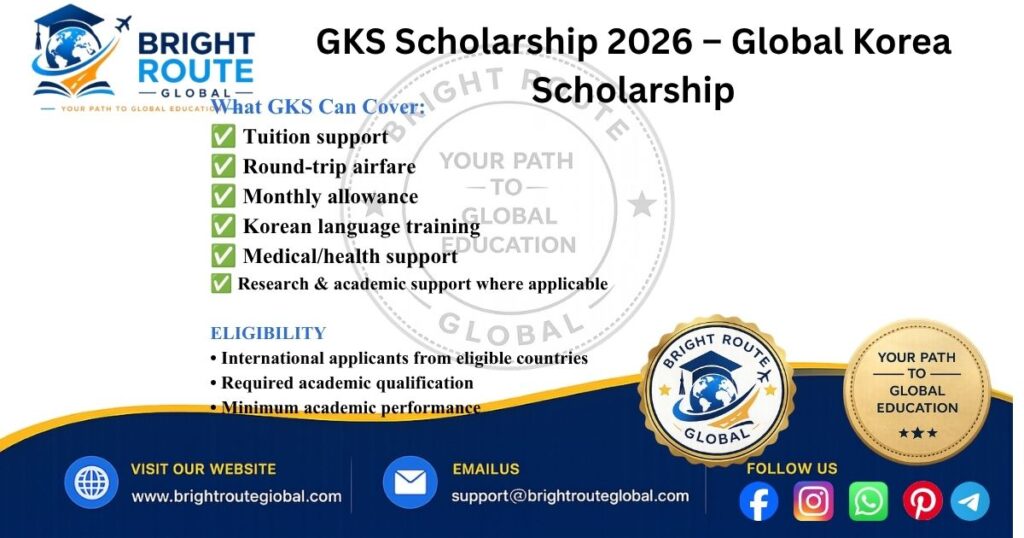
The exact benefit structure can vary by degree level and the applicable year’s guidelines. Major GKS benefits include:
- Round-trip airfare
- Tuition support
- Korean language training expenses
- Monthly allowances
- Settlement support
- Medical or health-related insurance support
- Research support for eligible graduate students
- Support related to thesis printing and academic activities where applicable
- Korean language proficiency-related benefits where applicable
The official Study in Korea portal confirms airfare, Korean language training fees, tuition and monthly allowances as core GKS benefits.
Applicants should check the current year’s guidelines for the exact amounts and conditions rather than assuming that every GKS applicant receives identical benefits.
GKS Undergraduate Scholarship 2026
The 2026 GKS Undergraduate programme (GKS-U) covered associate and bachelor’s degree programmes.
The official 2026 announcement stated that approximately 280 students would be invited for undergraduate-level study.
The programme structure can include:
- One year of Korean language training
- Associate degree study
- Bachelor’s degree study
The total scholarship period depends on the selected degree programme.
Undergraduate Eligibility
The general GKS requirements include conditions related to nationality, education, age and academic performance.
For the 2026 undergraduate programme, applicants generally needed to:
- Hold citizenship of a designated eligible country
- Have parents who did not hold Korean citizenship
- Meet the applicable age requirement
- Have completed or be expected to complete the required previous education
- Meet the minimum academic-performance requirement
- Satisfy the health and other conditions specified in the official guidelines
The official GKS information states that undergraduate applicants must meet academic requirements such as a cumulative score of 80% or higher, placement within the top 20% of their class, or an applicable CGPA threshold.
GKS Graduate Scholarship 2026
The 2026 GKS Graduate programme (GKS-G) was announced separately for international students seeking master’s and doctoral degrees.
For 2026, the Korean government planned to invite 2,000 international students through GKS for graduate degrees.
Applicants could apply through either:
- Embassy Track
- University Track
The appropriate route depends on the applicant’s circumstances and the specific university/programme requirements.
Embassy Track vs University Track
Understanding the two application routes is important before preparing a GKS application.
| Feature | Embassy Track | University Track |
|---|---|---|
| Application authority | Korean Embassy/Consulate | Designated Korean university |
| Application route | Through the applicable embassy process/Study in Korea system | Directly to designated university |
| University choices | Depends on programme and year | Generally one designated university for the relevant application |
| First selection | Embassy | University |
| Further selection | NIIED and relevant institutions | NIIED and relevant institutions |
The official Study in Korea portal states that degree applicants submit through a Korean embassy in their country of citizenship or directly to a designated GKS university, depending on the track.
Available Fields of Study
GKS supports a broad range of academic disciplines through participating universities.
Depending on the university and programme, students may find opportunities in areas such as:
- Engineering
- Computer Science and Information Technology
- Natural Sciences
- Business and Economics
- Social Sciences
- Humanities
- Arts
- Life Sciences
- Medicine and health-related fields
- Korean studies
- Other specialised academic disciplines
Not every university offers every field. Applicants must check the official University Information file for the specific GKS intake before selecting a programme.
Eligibility Criteria
GKS eligibility differs according to the degree level and annual guidelines, but applicants generally need to satisfy requirements concerning:
- Citizenship
- Parents’ citizenship
- Academic qualification
- Academic performance
- Age
- Health
- Previous scholarship history
- University and programme requirements
Applicants should not assume that meeting the general GKS requirements guarantees eligibility for a particular university or department.
Individual Korean universities may impose additional admission conditions.
Required Documents
The exact document list varies between GKS-U, GKS-G, Embassy Track, University Track and individual universities.
Common documents may include:
| Document | Requirement |
|---|---|
| GKS application form | ✓ |
| Personal statement | ✓ |
| Study plan | ✓ |
| Academic transcripts | ✓ |
| Graduation certificate | ✓ |
| Proof of citizenship | ✓ |
| Recommendation letter | Depending on programme |
| Personal medical assessment | ✓ |
| Passport/identity document | As required |
| Language test certificate | Where applicable |
| Additional university documents | If required |
| Research proposal | Applicable graduate/research applicants |
The 2026 undergraduate guidelines specifically included the application form, personal statement, study plan, personal medical assessment, recommendation materials, graduation documentation, academic transcript and citizenship documentation among the required materials.
For graduate applicants, the official 2026 GKS-G guidelines should be followed because requirements can differ from undergraduate applications.
English and Korean Language Scores
Language proficiency can be relevant to GKS selection and university admission.
Applicants may encounter requirements or evaluation criteria involving tests such as:
- TOPIK
- TOEFL iBT
- IELTS
The specific language requirements depend on the GKS programme and university.
A language certificate may also strengthen an application where scores are considered during selection, but applicants should not assume that a particular score automatically guarantees selection.
Step-by-Step Application Process
Because GKS has different tracks and degree levels, applicants should follow the process specified in the relevant annual guideline.
| Step | What to Do |
|---|---|
| 1 | Check the latest GKS announcement on Study in Korea |
| 2 | Confirm your degree-level eligibility |
| 3 | Choose Embassy Track or University Track where applicable |
| 4 | Review eligible universities and departments |
| 5 | Prepare academic and personal documents |
| 6 | Complete the GKS application |
| 7 | Upload or submit documents according to the applicable procedure |
| 8 | Submit any additional university documents if required |
| 9 | Complete the first-round selection |
| 10 | Wait for subsequent NIIED/final selection |
| 11 | Follow admission and visa instructions if selected |
For the 2026 graduate programme, the official announcement instructed applicants to apply either through a Korean Embassy in their country of citizenship or directly to a designated university.
Application Timeline
GKS schedules are not identical for undergraduate and graduate programmes.
For the 2026 undergraduate programme, the official notice was published on September 5, 2025, with applicants instructed to consult the application guidelines for the specific deadlines, documents and procedures.
For the 2026 graduate programme, the official notice was published in February 2026, with the application process taking place according to the GKS-G schedule and track-specific instructions.
The official Study in Korea scholarship page describes the general undergraduate selection cycle as beginning with an announcement around September, followed by application, screening and final results later in the year.
Important: Future GKS applicants should wait for the official announcement for their target intake because dates, quotas and procedures can change each year.
Selection Process
GKS selection normally involves several stages.
First-round screening
Applicants are initially screened by the relevant embassy or university, depending on their application track.
Second-round review
Successful candidates proceed to the NIIED stage according to the applicable programme guidelines.
Final selection
Final candidates are selected according to the GKS evaluation process and programme rules.
Academic performance, study plans, personal statements, recommendations, language ability and other factors may be considered depending on the programme.
Hidden Costs to Consider
Although GKS provides substantial financial support, applicants should still plan for expenses that may not be fully covered or may arise before scholarship payments begin.
| Possible Expense | What to Consider |
|---|---|
| Passport | Obtain or renew before applying |
| Document certification | Some documents may require notarisation, apostille or authentication |
| Translation | Documents may need certified translations |
| Language tests | IELTS, TOEFL or TOPIK costs may apply |
| Travel before scholarship payment | Initial personal funds may be necessary |
| Visa-related expenses | Check current Korean visa requirements |
| Personal expenses | Not every personal cost is necessarily covered |
| Extra academic expenses | Programme-specific costs may arise |
| University-specific documents | Additional submission costs may apply |
Always check the latest GKS guidelines before assuming a particular expense will be reimbursed.
Accommodation and Living in South Korea
GKS scholars receive financial support under the applicable scholarship rules, while accommodation arrangements can vary by university.
Many Korean universities operate student dormitories, but housing availability, room types and fees differ.
Applicants should check the accommodation information of their selected university before travelling to Korea.
Tips for Applicants
- Start preparing academic and identity documents well before the application opens.
- Read the official GKS guideline from beginning to end.
- Check the University Information file before selecting a university.
- Verify whether your preferred department accepts GKS applicants.
- Keep your personal statement focused on your academic and career goals.
- Make your study plan specific to Korea and your chosen field.
- Check the embassy or university’s additional document requirements.
- Never rely on an old GKS deadline for a new intake.
Common Mistakes to Avoid
- Applying to a university or department that is not included in the current GKS University Information file.
- Confusing Embassy Track with University Track.
- Using outdated application forms.
- Missing country-specific embassy instructions.
- Submitting incomplete academic or citizenship documents.
- Assuming every university has the same admission requirements.
- Waiting until the deadline to arrange document certification or translation.
Frequently Asked Questions
1. What is the Global Korea Scholarship?
GKS is a scholarship programme funded by the Government of South Korea and administered through NIIED for international students seeking degree-level study in Korea.
2. Is GKS fully funded?
GKS provides substantial government-funded support, including tuition, airfare, Korean language training and allowances under the applicable programme rules. The exact benefits depend on the degree programme and current guidelines.
3. Can international students apply for GKS?
Yes. GKS is specifically designed for eligible international students from participating countries.
4. Can I apply for a Bachelor’s degree through GKS?
Yes. GKS-U supports eligible associate and bachelor’s degree applicants.
5. Can I apply for a Master’s degree?
Yes. GKS-G includes master’s programmes for eligible international applicants.
6. Can I apply for a PhD?
Yes. Doctoral programmes are included under GKS graduate scholarships, subject to the current eligibility and university requirements.
7. What are the two main GKS application tracks?
The two main routes are the Embassy Track and University Track.
8. Do I need to know Korean before applying?
Not necessarily. GKS can include Korean language training, and programme-specific language requirements should be checked in the current guidelines.
9. Can I choose any Korean university?
No. Applicants must select from universities and departments designated for the applicable GKS programme and intake.
10. Does GKS cover tuition fees?
Yes, tuition support is one of the core GKS benefits, subject to the applicable scholarship rules.
11. Does GKS provide airfare?
Airfare is included among the main GKS scholarship benefits under the official programme information.
12. Does GKS provide a monthly stipend?
Yes. Monthly allowances are included in the GKS benefit structure, with the amount determined by the applicable programme guidelines.
13. Can I apply through both Embassy and University Track?
Applicants must follow the restrictions in the current GKS guidelines. Do not submit duplicate applications where the guidelines prohibit them.
14. Where can I find the official GKS application guidelines?
The official guidelines are published through the Study in Korea GKS notice section.
15. Are GKS deadlines the same every year?
No. Application dates, quotas and procedures can change. Applicants should use the official announcement for the specific intake they are targeting.
Conclusion
The Global Korea Scholarship (GKS) provides international students with an opportunity to pursue higher education in South Korea with substantial financial support from the Korean government.
The programme covers different academic levels, including undergraduate, master’s and doctoral studies, and can include tuition, airfare, Korean language training and living-related allowances.
However, GKS is a competitive programme with detailed eligibility rules and different application routes. Applicants should carefully check the latest annual guideline, eligible universities, department requirements, document rules and application schedule before submitting an application.
For the 2026 intake, official undergraduate and graduate announcements were published separately. Students preparing for a future intake should monitor the official Study in Korea GKS notices for the next application cycle rather than using outdated 2026 deadlines.
Open Doors Russian Scholarship 2026–27
Open Doors Russian Scholarship 2026–27 Scholarship Overview Apply for the...
Read More
Universiti Malaya Bright Scholarship 2026/27
Universiti Malaya Bright Scholarship 2026/27 Apply for the UM Bright...
Read More
Open Doors Russian Scholarship 2026 | Study in Russia
Open Doors Russian Scholarship 2026: Study in Russia Apply for...
Read More
Sapienza University of Rome Scholarships 2026–27
Sapienza University of Rome Scholarships 2026–2027 Explore Sapienza University of...
Read More
Czech Government Scholarship 2027/28
Czech Government Scholarship 2027/28 for Developing Countries Scholarship Overview Learn...
Read More
Open Doors Russian Scholarship 2026–27
Open Doors Russian Scholarship 2026–27 Scholarship Overview Apply for the...
Read More
Universiti Malaya Bright Scholarship 2026/27
Universiti Malaya Bright Scholarship 2026/27 Apply for the UM Bright...
Read More
University of Manitoba Scholarships & Admissions 2027
University of Manitoba International Admissions & Scholarships 2027 Explore University...
Read More