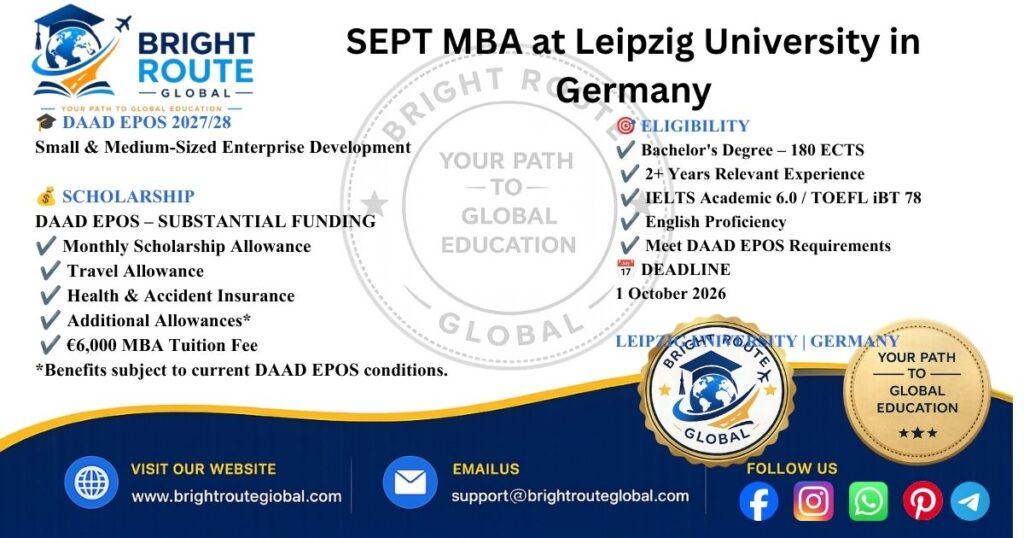
SEPT MBA in Small and Medium-Sized Enterprise Development, Germany: DAAD EPOS Scholarship & Application Guide
Apply for the SEPT MBA at Leipzig University with DAAD EPOS. Check eligibility, benefits, documents, deadlines and application process.
The SEPT MBA in Small and Medium-Sized Enterprise Development at Leipzig University, Germany is an international postgraduate programme designed for professionals working in SME promotion, development and training.
The programme is particularly relevant for professionals who want to develop expertise in small business development, entrepreneurship, SME promotion, management and economic development. Applicants from all nationalities are welcome, subject to the programme’s admission requirements.
For the 2027/28 winter intake, applicants interested in the DAAD EPOS scholarship can apply between 1 August and 1 October 2026. The application is submitted online, and shortlisted candidates may subsequently be asked to provide hard-copy documents.
Important: The DAAD EPOS scholarship is a separate funding route from simply being admitted to the SEPT MBA. Applicants should carefully check whether they meet the scholarship’s country, professional-experience and other DAAD requirements before applying.
Scholarship Overview
The SEPT MBA is offered by the SEPT Competence Center at Leipzig University and focuses on the development and promotion of small and medium-sized enterprises.
The programme is particularly suited to professionals involved in SME support, entrepreneurship promotion, business development, training and related development activities.
At a Glance
| Feature | Details |
|---|---|
| Programme | SEPT MBA in Small and Medium-Sized Enterprise Development |
| University | Leipzig University |
| Location | Leipzig, Germany |
| Study Level | MBA / Postgraduate |
| Language | English |
| Scholarship Route | DAAD EPOS |
| 2027/28 DAAD Application | 1 August – 1 October 2026 |
| Academic Requirement | Bachelor’s degree with 180 ECTS or equivalent |
| Work Experience | Minimum 2 years relevant professional experience |
| English Requirement | IELTS Academic 6.0 / TOEFL iBT 78 / accepted English-medium instruction evidence |
| Application | Online |
| Tuition Fee | €6,000, according to the current programme FAQ |
| Programme Focus | SME development, promotion, management and entrepreneurship |
| Official University | Leipzig University |
The university’s current application page confirms that the 2027/28 DAAD EPOS application window is 1 August–1 October 2026.
University Overview
Leipzig University is one of Germany’s established public universities and is located in Leipzig, Saxony.
The SEPT Competence Center operates within the university’s Faculty of Business and Economics and specialises in research and training related to the management and promotion of small and medium-sized enterprises worldwide.
The SEPT MBA is designed with an international orientation and focuses on practical and theoretical approaches to SME development. The programme examines approaches ranging from supporting small businesses to promoting innovative and dynamic enterprises capable of making effective strategic decisions.
Why Study at Leipzig University?
International MBA Environment
The SEPT MBA is explicitly designed as an international programme and welcomes applicants from different national backgrounds.
Specialisation in SME Development
Rather than being a general MBA alone, the programme has a strong focus on small and medium-sized enterprise development and promotion, making it particularly relevant for professionals working in entrepreneurship and business-support organisations.
Practical Professional Focus
The programme is aimed at people who already have professional experience in SME promotion and training. This makes the classroom environment particularly relevant for applicants who want to connect academic knowledge with their professional careers.
English-Taught Programme
Applicants do not need German proficiency to apply because English is the language of instruction. However, the university recommends learning German to make everyday life in Germany easier.
Leipzig as a Study Destination
Leipzig provides an established university environment and access to Germany’s wider business and economic ecosystem. Students can also benefit from the city’s relatively strong cultural and international environment.
Degree Level
MBA
The SEPT programme is an MBA in Small and Medium-Sized Enterprise Development.
It is intended primarily for graduates who already have professional experience related to SME promotion and training.
The programme is therefore better suited to experienced professionals than applicants who have just completed their Bachelor’s degree and have no relevant work experience.
Available Fields of Study
The programme focuses mainly on:
- Small & Medium-Sized Enterprise Development
- SME Promotion
- Entrepreneurship
- Business Development
- Enterprise Management
- SME Training & Support
- Innovation & Economic Development
Scholarship Benefits
The major funding opportunity associated with this programme is the DAAD EPOS scholarship.
However, it is important to distinguish between SEPT MBA admission and DAAD EPOS funding. Admission to the programme does not automatically mean that an applicant receives a scholarship.
For eligible DAAD EPOS awardees, funding can generally provide substantial financial support for studying in Germany, subject to the current DAAD award conditions.
Potential scholarship support may include:
- Monthly scholarship payments
- Travel allowance where applicable
- Health, accident and liability insurance
- Other allowances depending on the individual DAAD funding package
- Support related to the study period according to DAAD regulations
Applicants should consult the current DAAD EPOS call for the exact financial package applicable to their nationality and intake.
Tuition Fee
The SEPT FAQ currently states that the MBA tuition fee is €6,000, payable in four instalments of €1,500 before the beginning of each semester. Books and individual study materials are not included.
For scholarship applicants, it is essential to check the current DAAD EPOS funding conditions to determine which costs are covered by the award.

Hidden Costs
Even when receiving scholarship support, students should prepare for expenses beyond tuition.
| Expense | What to Consider |
|---|---|
| Tuition fee | Current SEPT fee is €6,000 |
| Accommodation | Monthly rent and possible deposit |
| Food | Daily and monthly living expenses |
| Health insurance | Required for students in Germany |
| Visa | German student visa-related expenses |
| Residence permit | Applicable after arrival |
| Travel | Flights to and from Germany |
| Study materials | Books and individual materials are not included in tuition |
| Transportation | Local and regional travel |
| Phone & Internet | Monthly communication costs |
| Winter clothing | Germany has colder seasons |
| Personal expenses | Clothing, leisure and other needs |
| Blocked account | May be required for visa purposes depending on funding situation |
The SEPT FAQ specifically notes that students should consider the requirement to open a blocked account specified by the embassy to demonstrate funds for basic living expenses where applicable.
Eligibility Criteria
Applicants should meet the following general programme requirements:
- Hold an undergraduate degree with 180 ECTS or equivalent from a reputable university.
- Have at least two years of professional experience in SME promotion and training.
- Provide acceptable proof of English proficiency.
- Meet any nationality-specific documentation requirements.
- Submit a complete application within the relevant deadline.
The university currently accepts IELTS Academic with an overall score of at least 6.0, TOEFL iBT with a minimum score of 78, or an English proficiency letter when the applicant’s Bachelor’s programme was taught in English.
The university does not accept TOEFL ITP, TOEFL TOEIC, IELTS General Training or Duolingo results for this requirement.
Special Requirements for Selected Countries
Applicants from India holding a three-year Bachelor’s degree may be eligible if they meet the stated academic standard, including a minimum 60%/first division, A/very good or GPA 3.00 or higher.
Applicants from China, Vietnam and India are required to submit an APS Certificate.
For DAAD EPOS applicants, the university states that the last university degree should normally be no more than six years old. Applicants who already hold a Master’s degree must provide a strong justification for pursuing another postgraduate degree.
Required Documents
| ✓ | Required Document | Notes |
|---|---|---|
| ☐ | Motivation Letter | Maximum 2 pages; dated and signed |
| ☐ | Europass CV | Dated and signed |
| ☐ | School-Leaving Certificate | Original or certified copy |
| ☐ | Bachelor’s/Degree Certificate | Original or certified copy |
| ☐ | Academic Transcript | Must show final grades and grading system |
| ☐ | English Proficiency Evidence | IELTS/TOEFL/accepted alternative |
| ☐ | Work Certificate(s) | Minimum 2 years relevant experience |
| ☐ | Employer Recommendation Letter | From current employer |
| ☐ | DAAD EPOS Application Form | Required for DAAD applicants |
| ☐ | DAAD Checklist | Completed and signed |
| ☐ | Other Scholarship Evidence | If applying for another scholarship |
| ☐ | APS Certificate | Required for Chinese, Vietnamese and Indian applicants |
| ☐ | Certified Translations | Required where documents are not in English/German |
All certificates and transcripts originally issued in languages other than English or German must be translated by a recognised/sworn translator, with the required original or certified copy of the translation.
Step-by-Step Application Process
| Step | What to Do | Practical Guidance |
|---|---|---|
| Check eligibility | Confirm your degree, work experience and English qualification | Do this before preparing the full application |
| Check DAAD eligibility | Review the current EPOS conditions | Programme admission and scholarship eligibility are not identical |
| Research the programme | Understand the SEPT MBA curriculum and career relevance | Make sure SME development fits your career goals |
| Prepare your CV | Create a signed Europass CV | Highlight relevant SME/development experience |
| Write motivation letter | Prepare a maximum two-page letter | Explain your experience, goals and why SEPT MBA is relevant |
| Collect academic documents | Prepare certificates, transcripts and grading-system information | Use original/certified copies as required |
| Prepare English evidence | Upload an accepted test result or eligible English-medium evidence | IELTS Academic and TOEFL iBT are accepted |
| Document work experience | Obtain official work certificates | At least two years of relevant SME promotion/training experience is required |
| Request employer recommendation | Obtain a signed letter from your current employer | Follow the university’s format requirements |
| Complete DAAD form | Fill in the EPOS scholarship application form | Required for DAAD applicants |
| Complete DAAD checklist | Sign and submit the checklist | DAAD requires an original signature |
| Translate documents | Arrange recognised translations if necessary | Documents must be translated into English or German |
| Upload online application | Submit PDFs through the SEPT application platform | Check every file before submission |
| Submit before deadline | Complete the application by 1 October 2026 for 2027/28 DAAD EPOS | Late or incomplete applications are not considered |
| Wait for screening | SEPT reviews complete eligible applications | Initial evaluation is based on submitted documents |
| Attend interview | Participate if shortlisted | Interviews are compulsory for DAAD EPOS selection |
| Final selection | Await the final decision | Successful candidates receive further instructions |
| Submit hard copies if requested | Send documents by post | Only shortlisted applicants are asked for hard copies |
| Prepare for Germany | Arrange visa, finances and accommodation | Begin immediately after receiving admission/funding information |
The university specifically warns that incomplete or late applications are not considered, and responsibility for submitting a complete and correct application rests with the applicant.
Application Timeline
For applicants targeting October 2027 admission through the DAAD EPOS scholarship, the current schedule is:
| Date | Stage |
|---|---|
| 1 August 2026 | DAAD EPOS application opens |
| August–September 2026 | Prepare and upload documents |
| 1 October 2026 | Application deadline |
| After deadline | Screening and first evaluation |
| Shortlisting stage | Interviews |
| Final stage | Selection decision |
| October 2027 | Expected programme start |
The university explicitly lists 1 August–1 October 2026 for DAAD EPOS applicants seeking admission for winter term 2027/28.
For self-financed applicants, the current application window is 1 January–15 March for studies beginning in October of the same year.
Selection Criteria
The selection committee evaluates complete and eligible applications through a three-stage process:
Screening and first evaluation → Shortlisting and interviews → Final selection.
For DAAD EPOS applicants, the interview is compulsory during the selection process. Self-financed applicants may or may not be interviewed.
Applicants should therefore demonstrate:
- Strong academic preparation
- Relevant professional experience
- Clear motivation for the MBA
- Understanding of SME development
- Career relevance of the programme
- Good English proficiency
- A complete and professionally prepared application
Accommodation & Living Costs
Leipzig offers a range of accommodation options for students, including student residences and private rentals.
Applicants should budget for:
- Monthly accommodation
- Food
- Health insurance
- Transportation
- Communication
- Study materials
- Personal expenses
Students should also plan for the initial costs of moving to Germany, including deposits, travel, residence formalities and other setup expenses.
For visa purposes, international students may need to demonstrate adequate financial resources. The SEPT programme’s FAQ specifically advises applicants to consider the blocked-account requirement specified by the German embassy.
Part-time Jobs
International students in Germany may have opportunities to work subject to their residence status and applicable regulations.
However, students should not depend entirely on part-time employment to finance their studies.
For DAAD EPOS recipients, the scholarship is intended to provide financial support during the study period, but students should still understand the exact terms and limits of their individual award.
Learning basic German can also improve access to local employment and make everyday life easier. SEPT confirms that German is not required for admission because the programme is taught in English, but recommends learning German for life in Germany.
Student Visa Process
International students who require a German visa should begin the process after receiving the relevant admission and scholarship documentation.
A typical pathway is:
Admission/Scholarship Decision → Prepare Visa Documents → Submit Visa Application → Financial Proof → Visa Decision → Travel to Germany → Residence Formalities
Depending on your nationality and circumstances, you may need to provide:
- Valid passport
- University admission letter
- Scholarship confirmation, if applicable
- Proof of financial resources
- Health insurance
- Academic documents
- Visa application forms
- Other documents requested by the German authorities
The exact requirements and procedures can vary by country, so applicants should consult the German embassy/consulate responsible for their place of residence.
Tips from Previous Applicants
- Start collecting documents several months before the deadline.
- Make your motivation letter specific to SME development.
- Clearly demonstrate your two years of relevant professional experience.
- Submit a complete application well before the deadline.
- Check every document for signatures, stamps and certification requirements.
- Prepare seriously for the compulsory DAAD EPOS interview.
- Learn some German before arrival, even though the MBA is taught in English.
The SEPT FAQ itself recommends submitting a complete application at least one month before the deadline and making the motivation essay convincing and relevant to your professional development.
Common Mistakes
- Applying without two years of relevant professional experience
- Using an English test that SEPT does not accept
- Submitting IELTS General Training instead of IELTS Academic
- Forgetting the DAAD EPOS application form
- Missing the 1 October scholarship deadline
- Uploading incomplete or improperly certified documents
- Writing a generic motivation letter unrelated to SME development
Frequently Asked Questions
1. What is the SEPT MBA?
The SEPT MBA is an international postgraduate programme in Small and Medium-Sized Enterprise Development offered by Leipzig University.
2. Is the SEPT MBA taught in English?
Yes. English is the language of instruction, and German is not required for admission.
3. Who can apply for the SEPT MBA?
Applicants from all nationalities are welcome, provided they meet the academic, professional and language requirements.
4. What degree do I need?
Applicants generally need an undergraduate degree equivalent to 180 ECTS or more from a reputable university.
5. How much work experience is required?
A minimum of two years of professional experience in SME promotion and training is required.
6. What IELTS score is required?
The current requirement is IELTS Academic 6.0 overall. IELTS General Training is not accepted.
7. What TOEFL score is required?
The university requires a minimum TOEFL iBT score of 78. TOEFL ITP and TOEFL TOEIC are not accepted.
8. Is Duolingo accepted?
No. The current SEPT application page specifically states that Duolingo results are not accepted.
9. What is the SEPT MBA tuition fee?
The current programme FAQ lists the tuition fee as €6,000, payable in four instalments of €1,500.
10. When can I apply for the DAAD EPOS scholarship?
For admission in winter term 2027/28, the current application period is 1 August to 1 October 2026.
11. Is the DAAD EPOS scholarship fully funded?
DAAD EPOS provides substantial financial support to selected scholars, but the exact benefits and conditions should be checked in the current DAAD scholarship announcement applicable to your country and programme.
12. Is an interview required?
Yes. Interviews are compulsory for applicants participating in the DAAD EPOS selection process.
13. Do I need to send paper documents?
Initially, the application is submitted online. If shortlisted, SEPT will contact the applicant and request hard-copy documents by postal mail.
14. Do I need German language skills?
No. German is not required for admission because English is the language of instruction. However, SEPT recommends learning German to make living in Germany easier.
15. Can I apply if I already have a Master’s degree?
Potentially, but DAAD EPOS applicants who already hold a Master’s degree must provide a well-argued justification for pursuing another postgraduate degree.
Conclusion
The SEPT MBA in Small and Medium-Sized Enterprise Development at Leipzig University is a specialised opportunity for professionals interested in SME promotion, entrepreneurship, business development and economic development.
Its strongest feature for eligible international professionals is the possibility of applying through the DAAD EPOS scholarship route, which can provide substantial financial support to selected candidates.
However, this is not a typical scholarship for fresh graduates. The requirement for at least two years of relevant professional experience makes the programme particularly suitable for professionals already working in SME promotion, training, business support or related development fields.
For the 2027/28 intake, prospective DAAD EPOS applicants should prepare well ahead of the 1 October 2026 deadline. A strong application should clearly connect your academic background, professional experience, career goals and interest in SME development.
University of Southern Denmark Scholarships : How to Apply
University of Southern Denmark Scholarships 2027: Eligibility, Benefits and How...
Read More

Aalto University Scholarships 2027 Full Details
Aalto University Scholarships 2027: Eligibility, Tuition Fees and How to...
Read More
UN Volunteers Opportunities 2026–2027: How to Apply
UN Volunteers Opportunities 2026–2027: Eligibility, Benefits and Application Process Explore...
Read More
MESPOM Erasmus Mundus Scholarship 2027–2029
MESPOM Erasmus Mundus Scholarship 2027–2029: Fully Funded Master’s in Europe...
Read More
Australian Catholic University (ACU) Scholarships
Australian Catholic University (ACU) Admissions 2027: Courses, Scholarships and How...
Read More
University of Southern Denmark Scholarships : How to Apply
University of Southern Denmark Scholarships 2027: Eligibility, Benefits and How...
Read More
Aalto University Scholarships 2027 Full Details
Aalto University Scholarships 2027: Eligibility, Tuition Fees and How to...
Read More
UBD Graduate Research Scholarship 2027: PhD Funding
UBD Graduate Research Scholarship 2027: Fully Funded PhD in Brunei...
Read More