University of Warsaw Scholarships 2026–2027 | Study in Poland
Explore University of Warsaw Scholarships 2026–2027 for students. Learn about admissions, scholarships, eligibility, documents, and how to study in Poland.
The University of Warsaw is one of the most prestigious and internationally recognized universities in Central Europe. Established in 1816, it has built a reputation for academic excellence, groundbreaking research, and an increasingly international learning environment. Every year, thousands of students from around the world choose the University of Warsaw because of its high-quality education, affordable tuition compared to many Western European universities, and a wide range of scholarship opportunities.
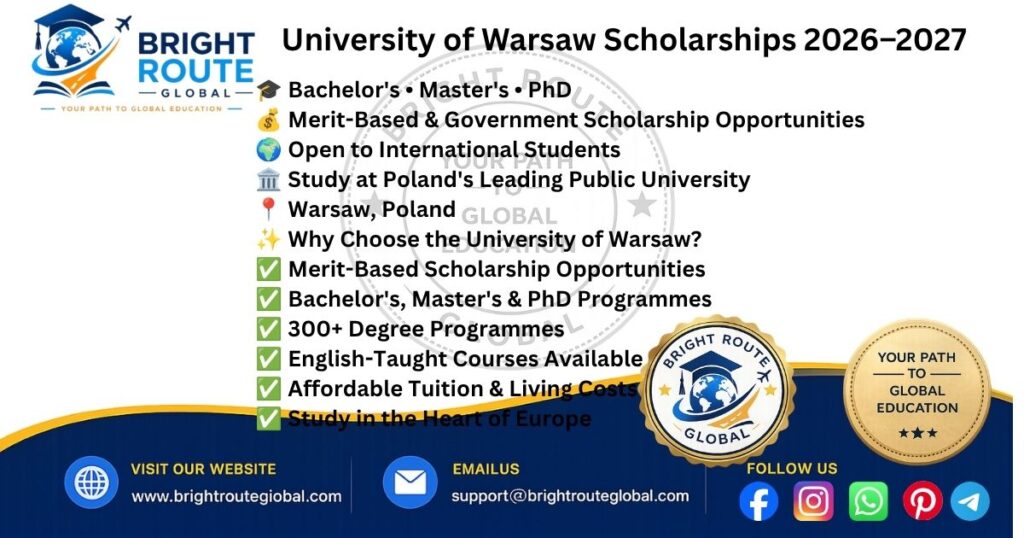
For the 2026–2027 academic year, the university offers more than 300 degree programmes across various disciplines. International students can apply for Bachelor’s, Master’s, long-cycle Master’s, and Doctoral programmes taught in both Polish and English. The university also provides several financial aid opportunities, including merit-based scholarships, Rector’s Scholarships, the “Scholarship to Start,” and access to Polish government scholarships administered through the Polish National Agency for Academic Exchange.
Whether you dream of becoming a researcher, business leader, diplomat, engineer, lawyer, or scientist, studying at the University of Warsaw provides an excellent foundation for a successful international career.
Scholarship Overview
| Category | Details |
|---|---|
| University | University of Warsaw |
| Country | Poland |
| Scholarship Type | Merit-based, Need-based & Government Scholarships |
| Degree Levels | Bachelor’s, Master’s, Long-cycle Master’s, PhD |
| Programmes Available | 300+ |
| Language of Instruction | English & Polish |
| International Students | Eligible |
| Application Mode | Online |
| Financial Support | Tuition support, merit scholarships, monthly stipends (depending on scholarship) |
University Overview
The University of Warsaw is Poland’s largest and one of its highest-ranked public universities. It consistently attracts outstanding students and researchers from across Europe and beyond. With over two centuries of academic history, the university combines tradition with innovation, offering modern teaching methods, internationally recognized research, and extensive global partnerships.
Students benefit from:
- Modern research laboratories
- International exchange opportunities
- Extensive library resources
- Active student organizations
- Strong links with industry and research institutions
- Career development services
- International conferences and research projects
The university is also an active participant in European initiatives such as Erasmus+, Horizon Europe, and the 4EU+ Alliance, creating additional opportunities for international collaboration.
Why Choose the University of Warsaw?
The University of Warsaw offers much more than a degree. It provides an academic environment that encourages innovation, research, leadership, and international cooperation.
Some of the biggest advantages include:
- One of the highest-ranked universities in Poland
- Internationally recognized degrees
- More than 300 academic programmes
- Affordable tuition compared to many European universities
- Numerous scholarship opportunities
- Excellent research facilities
- Diverse international student community
- Strong graduate employability
- Central location in Europe’s capital city of Warsaw
- Access to Erasmus+ exchange programmes
The university emphasizes practical learning, interdisciplinary research, and critical thinking, preparing graduates for successful careers in academia, business, government, and international organizations.
About Poland
Poland has become one of Europe’s fastest-growing destinations for international students. The country combines affordable education with high academic standards, a rich cultural heritage, and a rapidly developing economy.
Country Overview
| Feature | Information |
|---|---|
| Capital | Warsaw |
| Currency | Polish Złoty (PLN) |
| Official Language | Polish |
| EU Member | Yes |
| Schengen Area | Yes |
| Population | Approximately 38 million |
| Climate | Four seasons |
| Student-Friendly | Yes |
Studying in Poland allows students to enjoy a lower cost of living than many Western European countries while earning a degree recognized across Europe and internationally.
Why Study in Poland?
Poland has become increasingly popular among international students for several reasons.
Affordable Education
Compared with many universities in Western Europe, tuition fees and living costs remain relatively affordable.
High Academic Standards
Polish universities follow the Bologna Process, ensuring internationally recognized degrees and academic quality.
Excellent Location
Situated in the heart of Europe, Poland offers easy travel to countries such as Germany, the Czech Republic, Slovakia, Lithuania, and other Schengen destinations.
Safe Student Environment
Major student cities, including Warsaw, provide modern public transportation, student services, and a welcoming international community.
Career Opportunities
Students gain access to internships, research opportunities, and an expanding job market in sectors such as information technology, engineering, finance, healthcare, and business.
Degree Levels
International students can apply for various study levels.
| Degree | Duration |
|---|---|
| Bachelor’s | 3–4 Years |
| Master’s | 1.5–2 Years |
| Long-cycle Master’s | 5–6 Years |
| Doctoral (PhD) | 3–4 Years |
The university also offers exchange programmes, postgraduate studies, and research opportunities for international scholars.
Available Fields of Study
With over 300 programmes available, students have access to one of the most diverse academic portfolios in Central Europe.
Business and Economics
Students can pursue programmes in:
- Business Administration
- Economics
- Finance
- Accounting
- International Business
- Marketing
- Management
Graduates develop analytical, leadership, and strategic decision-making skills that are highly valued by multinational employers.
Computer Science and Artificial Intelligence
The university offers modern programmes covering:
- Computer Science
- Artificial Intelligence
- Data Science
- Cybersecurity
- Software Engineering
- Information Systems
Students gain practical experience through research projects and collaboration with technology companies.
Engineering and Natural Sciences
Popular fields include:
- Physics
- Chemistry
- Mathematics
- Environmental Science
- Biotechnology
- Geology
- Materials Science
Students have access to advanced laboratories and research infrastructure.
Law and Political Science
The University of Warsaw is internationally respected for programmes in:
- Law
- International Law
- European Studies
- Political Science
- International Relations
- Public Policy
Many graduates pursue careers in diplomacy, government, international organizations, and legal practice.
Humanities and Social Sciences
Available disciplines include:
- Psychology
- Sociology
- History
- Philosophy
- Linguistics
- Journalism
- Cultural Studies
- Anthropology
Students develop strong research, communication, and analytical skills applicable across many industries.
Medicine and Health-Related Sciences
Although the University of Warsaw is not primarily a medical university, it offers several programmes related to health sciences, psychology, and interdisciplinary biomedical research through its faculties and collaborative initiatives.
Arts and Languages
Students interested in creative and language-focused disciplines can choose programmes in:
- Fine Arts
- Musicology
- Modern Languages
- English Studies
- Translation Studies
- Literature
- Theatre Studies
These programmes combine theoretical learning with practical experience and international exchange opportunities.
Scholarship Benefits
The University of Warsaw offers several funding opportunities to support outstanding international students. While not every admitted student automatically receives financial aid, eligible students can apply for university scholarships, government-funded scholarships, and external financial support programs. The university also provides merit-based awards such as the Rector’s Scholarship and the Scholarship to Start for high-achieving students.
Scholarship Benefits Overview
| Benefit | Description | Who Can Benefit |
|---|---|---|
| Tuition Fee Support | Available through selected scholarships and government programmes | Eligible international students |
| Rector’s Scholarship | Merit-based financial support for outstanding academic achievements | High-performing students |
| Scholarship to Start | Award for exceptional first-year students and doctoral candidates | Eligible new students |
| Government Scholarships | Financial assistance through Polish government programmes | Eligible applicants |
| Research Opportunities | Access to funded research projects | Master’s & PhD students |
| Erasmus+ Mobility | Exchange opportunities across Europe | Eligible enrolled students |
| Career Development | Internships, workshops, and career services | All students |
Why These Benefits Matter
Unlike many universities where financial support is limited to tuition reductions, the University of Warsaw provides opportunities that recognize academic excellence, research achievements, and extracurricular accomplishments.
Students may benefit from:
- Reduced financial burden
- Recognition for academic excellence
- Better research opportunities
- Access to international exchange programmes
- Improved career prospects after graduation
Hidden Costs You Should Consider
Even with a scholarship, students should prepare for personal expenses that are generally not covered.
| Expense | Estimated Cost |
|---|---|
| Student Visa | Depends on nationality |
| Residence Permit | Administrative fee |
| Flight Ticket | Varies by country |
| Accommodation Deposit | Usually one month’s rent |
| Monthly Food | €180–300 |
| Transportation | €15–30 |
| Health-related Personal Expenses | Variable |
| Books & Study Materials | €30–80 per semester |
| Mobile & Internet | €15–30 monthly |
| Personal Expenses | Depends on lifestyle |
Preparing a realistic budget before arriving in Poland helps students avoid unnecessary financial stress.
Eligibility Criteria
Admission requirements differ by programme, but international applicants generally need to satisfy the following criteria.
Academic Qualification
Applicants should possess the required educational qualification appropriate for their chosen degree level.
| Degree | Minimum Requirement |
|---|---|
| Bachelor’s | Secondary School Certificate or equivalent |
| Master’s | Bachelor’s Degree |
| PhD | Master’s Degree |
Language Requirements
Programmes taught in English require applicants to demonstrate English language proficiency through accepted language qualifications or other approved proof of proficiency, depending on programme requirements.
Additional Programme Requirements
Certain programmes may also require:
- Entrance examinations
- Portfolio submissions
- Interviews
- Subject-specific qualifications
Applicants should carefully review the admission requirements for their selected programme.
Required Documents
Preparing complete and accurate documents significantly improves the application process.
Document Checklist
| Document | Required |
|---|---|
| Online Application Form | ✔ |
| Valid Passport | ✔ |
| Academic Certificates | ✔ |
| Official Transcripts | ✔ |
| English Language Certificate (if applicable) | ✔ |
| Passport-size Photograph | ✔ |
| CV/Resume (for selected programmes) | As Required |
| Motivation Letter | For many programmes |
| Recommendation Letters | If required |
| Portfolio | For arts-related programmes |
Document Preparation Tips
Passport
Ensure your passport remains valid for the visa process and the beginning of your studies.
Academic Documents
Certificates and transcripts should be officially translated if they are not in Polish or English.
Motivation Letter
A strong motivation letter should explain:
- Why you chose the University of Warsaw
- Why you selected your programme
- Your academic background
- Career goals
- How studying in Poland will help your future
Recommendation Letters
If required, recommendations should come from professors, supervisors, or employers who know your academic or professional abilities.
Step-by-Step Application Process
The University of Warsaw uses the Internet Recruitment of Candidates (IRK) system for admissions. Applicants must complete their online application, upload required documents, and follow programme-specific instructions. The admissions schedule and deadlines vary by programme.
| Step | Action |
|---|---|
| 1 | Choose your preferred degree programme. |
| 2 | Review admission requirements. |
| 3 | Create an account in the IRK online admission system. |
| 4 | Complete the online application form. |
| 5 | Upload all required documents. |
| 6 | Pay the application fee (if applicable). |
| 7 | Attend entrance examinations or interviews if required. |
| 8 | Wait for admission results. |
| 9 | Submit original documents after acceptance. |
| 10 | Apply for your student visa and prepare for arrival. |
Application Timeline
The exact schedule depends on the programme, but the main admissions cycle for first- and long-cycle programmes follows this timeline:
For many English-taught and second-cycle programmes, deadlines may differ. Always verify the dates for your chosen programme before applying.
Selection Criteria
Applications are evaluated based on several factors.
| Criterion | Importance |
|---|---|
| Academic Performance | Very High |
| Entrance Examination (if applicable) | High |
| Language Proficiency | High |
| Motivation Letter | Medium to High |
| Portfolio (selected programmes) | High |
| Interview (if required) | Medium |
Competitive applicants usually demonstrate consistent academic performance and meet all programme-specific requirements.
Accommodation & Living Costs
The University of Warsaw offers student dormitories, although places are limited. Many international students also choose private accommodation.
Accommodation Options
| Type | Estimated Monthly Cost |
|---|---|
| University Dormitory | €120–250 |
| Shared Apartment | €250–450 |
| Private Apartment | €450–800 |
Estimated Monthly Living Expenses
| Expense | Estimated Cost |
|---|---|
| Accommodation | €120–800 |
| Food | €180–300 |
| Transportation | €15–30 |
| Mobile & Internet | €15–30 |
| Personal Expenses | €80–150 |
Overall, Warsaw remains more affordable than many major Western European capitals while offering a high standard of education and student life.
Part-Time Jobs
International students may be able to work part-time in Poland, subject to their residence status and applicable regulations.
Common student jobs include:
- English Tutor
- Retail Assistant
- Restaurant & Café Staff
- Customer Support
- Research Assistant
- Administrative Assistant
- Freelance Digital Services
- Translation
- Graphic Design
- IT Support
Balancing work with academic responsibilities is essential for maintaining good academic performance.
Student Visa Process
After receiving your admission letter, you should begin your visa application promptly.
Typical requirements include:
- Valid Passport
- University Admission Letter
- Proof of Financial Resources
- Accommodation Details
- Health Insurance
- Visa Application Form
- Passport-size Photographs
Processing times vary depending on your country of residence, so applying early is strongly recommended.
Tips from Previous Applicants
- Apply as early as possible.
- Research your programme thoroughly before submitting your application.
- Prepare certified translations of documents well in advance.
- Write a personalized motivation letter.
- Monitor your email regularly for updates from the admissions office.
- Keep digital and printed copies of every submitted document.
Common Mistakes to Avoid
- Missing application deadlines
- Uploading incomplete documents
- Ignoring programme-specific requirements
- Using a generic motivation letter
- Providing incorrect translations
- Waiting until the last day to apply
Frequently Asked Questions
1. Can international students apply?
Yes. The University of Warsaw welcomes applicants from around the world.
2. Are scholarships available?
Yes. Students may be eligible for university, government, and external scholarships, including the Rector’s Scholarship and Scholarship to Start.
3. Is IELTS required?
It depends on the programme. Accepted proof of English proficiency varies by course.
4. How many programmes are available?
More than 300 degree programmes are offered.
5. Can students work while studying?
Yes, subject to Polish immigration and employment regulations.
6. Is Warsaw affordable for students?
Yes. Compared with many European capitals, Warsaw offers a relatively affordable cost of living.
7. When do admissions open?
For the main intake, online registration opens in June, though dates vary by programme.
8. Is university accommodation guaranteed?
No. Dormitory places are limited and allocated according to university procedures.
9. Are English-taught programmes available?
Yes. The university offers numerous English-language programmes.
10. Can I apply to multiple programmes?
Yes, depending on the admission rules and application procedures in the IRK system.
Conclusion
The University of Warsaw is an outstanding choice for international students seeking a world-class education in Europe. With its excellent academic reputation, affordable tuition, diverse scholarship opportunities, and vibrant international community, the university provides an ideal environment for personal and professional growth.
If you’re planning to study in Poland, begin preparing your application early, carefully review the admission requirements for your chosen programme, and submit a complete application before the deadline. A well-prepared application can significantly improve your chances of joining one of Central Europe’s leading universities.
Disclaimer: This post is for informational purposes only. Bright Route Global does not own or manage the opportunities shared. Please verify details on the official website before applying