Maastricht University Netherlands 2027: Admissions, Scholarships and Study Guide
University Overview
Explore Maastricht University 2027 admissions, scholarships, tuition fees, programmes, eligibility and application process for international students.
Maastricht University (UM) is an internationally oriented public research university in Maastricht, the Netherlands. Established in 1976, it is known for its innovative Problem-Based Learning (PBL) approach, international classroom environment and interdisciplinary education.
UM has nearly 23,000 students and almost 5,000 staff members. According to its latest 2025 figures, 61% of enrolled students were international, representing 128 nationalities. The university offered 26 bachelor’s and 97 master’s programmes in 2025.
The university has six faculties covering areas such as business and economics, law, health and medicine, psychology and neuroscience, arts and social sciences, and science and engineering.
At a Glance
| Feature | Details |
|---|---|
| University | Maastricht University |
| Location | Maastricht, Netherlands |
| Type | Public research university |
| Established | 1976 |
| Students | 22,933 in 2025 |
| International Students | 61% in 2025 |
| Student Nationalities | 128 |
| Faculties | 6 |
| Bachelor’s Programmes | 27 currently listed |
| Master’s Programmes | Wide range across 6 faculties |
| Teaching Approach | Problem-Based Learning |
| Main Languages | English and Dutch, depending on programme |
| Academic Year | 2027/28 |
| Application System | Studielink + UM application portal |
| Scholarships | Several UM and external scholarships |
Why Study at Maastricht University?
Problem-Based Learning
One of UM’s strongest features is its Problem-Based Learning approach. Instead of relying mainly on traditional lectures, students work in small groups to analyse real-world problems, discuss different perspectives and develop solutions.
International Learning Environment
Maastricht University has a highly international student population. Its latest official figures show students from 128 nationalities, while the university describes itself as the most European university in the Netherlands.
Strong Academic Choice
Students can choose from a broad selection of programmes. UM currently lists 27 bachelor’s programmes, while its master’s portfolio covers a wide range of disciplines across six faculties.
European Location
Maastricht is located in the southern Netherlands, close to Belgium and Germany. Its location provides students with easy access to other European cities and countries.
Research and Career Opportunities
UM combines teaching with research and works with organisations and partners in the Netherlands and internationally. The university has more than 70 research institutes and centres across its academic community.
Degree Levels
Maastricht University offers study opportunities at several levels.
Bachelor’s Programmes
UM currently lists 27 bachelor’s programmes across six faculties. Programmes cover areas including:
- International Business
- European Studies
- Global Studies
- Psychology
- Biomedical Sciences
- Data Science
- Economics
- Arts and Culture
- Liberal Arts and Sciences
- Health-related subjects
Some bachelor’s programmes are selective and have additional admission procedures.
Master’s Programmes
Maastricht University offers a wide range of master’s degrees, including one-year and two-year programmes.
Examples include:
- Artificial Intelligence
- Business Intelligence and Smart Services
- Digital Business & Economics
- Economics
- Finance
- Data Science for Decision Making
- Globalisation and Law
- International Business
- Psychology
- Public Policy and Human Development
- Sustainability Science and Policy
- Global Health
- Healthcare Policy, Innovation and Management
The exact programme list, duration and admission requirements vary by faculty.
Pre-Master’s Programmes
Students whose previous education does not directly meet the admission requirements of a master’s programme may be eligible for a pre-master’s programme.
UM currently lists 24 pre-master’s programmes designed to bridge academic gaps before entering selected master’s degrees.
Popular Study Areas
International students can explore programmes in:
- Business and Economics
- Artificial Intelligence and Data Science
- Computer Science
- Psychology and Neuroscience
- Health and Medicine
- Law
- European Studies
- Globalisation and Development
- Sustainability
- Politics and Society
- Arts and Culture
- Engineering and Science
Students should check individual programme pages because admission criteria, tuition fees and deadlines can differ.
Scholarships for International Students
Maastricht University offers several scholarships for international students. These are competitive and programme-specific, so students should not assume that every applicant will receive funding.
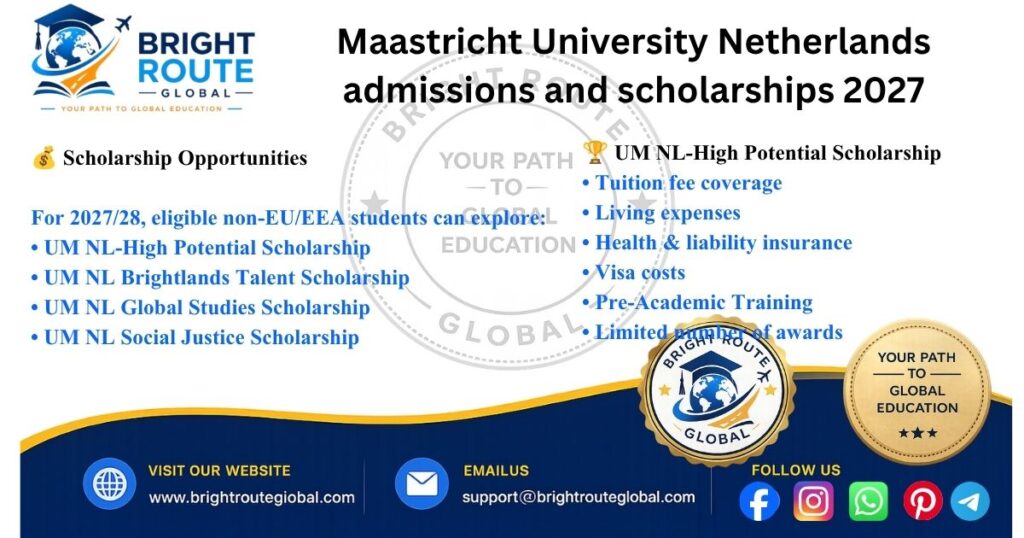
For academic year 2027/28, UM currently lists four major university scholarships open to eligible non-EU/EEA applicants:
| Scholarship | Level | Eligible Students | 2027/28 Application Period |
|---|---|---|---|
| UM NL-High Potential Scholarship | Master’s | Non-EU/EEA | Oct 1, 2026–Feb 1, 2027 |
| UM NL Brightlands Talent Scholarship | Master’s | Non-EU/EEA | Oct 1, 2026–Feb 1, 2027 |
| UM NL Global Studies Scholarship | Bachelor’s | Non-EU/EEA | Oct 1, 2026–Feb 1, 2027 |
| UM NL Social Justice Scholarship | Master’s | Non-EU/EEA | Oct 1, 2026–Feb 1, 2027 |
Applicants must first apply for an eligible Maastricht University study programme before applying for a UM scholarship. Students can apply for only one UM scholarship.
UM NL-High Potential Scholarship
One of the most significant funding opportunities is the UM NL-High Potential Scholarship.
For 2027/28, Maastricht University offers 18 full scholarships for talented students from outside the EU/EEA who are admitted to participating master’s programmes.
The scholarship includes:
- Tuition fee coverage
- Living expenses
- Health and liability insurance
- Visa application costs
- Pre-Academic Training costs
- International Student Ambassador Programme costs
For a one-year master’s programme, the scholarship duration is 13 months. For a two-year master’s programme, it is 25 months.
The published living allowance is €20,150 for 13 months or €38,750 for 25 months, subject to change for future academic years.
A room is also allocated to scholarship recipients during the first scholarship year. Students on a two-year programme must arrange accommodation for the second year themselves.
The scholarship is highly competitive, with UM stating that approximately 2% of applicants receive an award.
Scholarship Eligibility
For the 2027/28 UM NL-High Potential Scholarship, applicants must generally:
- Be a national of a country outside the EU/EEA, Switzerland or Surinam
- Meet Dutch visa/residence requirements
- Apply for a participating full-time master’s programme
- Submit a complete master’s application by December 10, 2026
- Meet the admission requirements of the selected master’s programme
- Have not previously participated in a degree-seeking higher education programme in the Netherlands
- Generally be no older than 35 on September 1, 2027
- Have excellent previous academic results
- Have a latest GPA of at least 7.5/10 or equivalent
- Be willing to participate as a UM ambassador
Because only a small number of scholarships are available, meeting the minimum requirements does not guarantee selection.
Tuition Fees
Tuition fees at Maastricht University depend on nationality, programme and study level.
For 2027/28, the statutory tuition fee for eligible EU/EEA students is generally €2,771 for full-time bachelor’s and master’s programmes.
For non-EU/EEA students, institutional tuition fees vary according to the programme category:
| Programme Category | 2027/28 Full-Time Tuition |
|---|---|
| Low-cost Bachelor’s | €13,400 |
| Low-cost Master’s | €21,800 |
| High-cost Bachelor’s | €18,700 |
| High-cost Master’s | €25,500 |
| Top Bachelor’s/Master’s | €32,000 |
Some programmes have additional or special rates. Students should check the specific tuition-fee guide for their programme before budgeting.
Hidden Costs
Tuition is only part of the cost of studying in the Netherlands.
| Expense | What Students Should Budget For |
|---|---|
| Accommodation | Monthly rent/housing costs |
| Food | Groceries and meals |
| Health insurance | Required according to applicable rules |
| Transportation | Local and regional travel |
| Study materials | Books, software and supplies |
| Visa/residence | Applicable fees for non-EU students |
| Residence permit | Applicable immigration costs |
| Airfare | Travel to and from the Netherlands |
| Personal expenses | Clothing, phone, leisure and other costs |
| Housing deposit | Depending on accommodation |
Scholarship coverage differs significantly between programmes. Students should carefully check exactly what their scholarship covers.
Admission Requirements
Admission requirements depend on the selected programme.
In general, applicants should expect requirements related to:
- Previous academic qualification
- Relevant subjects or academic background
- Academic performance
- English language proficiency for English-taught programmes
- Mathematics or other subject prerequisites where applicable
- Motivation or selection documents for certain programmes
Some programmes are selective and may have additional selection procedures.
For example, the Global Studies bachelor’s programme is selective and has its own admission and matching requirements.
English Language Requirements
English-taught programmes may require proof of English proficiency.
The exact minimum score depends on the programme and applicant’s educational background.
Applicants should therefore check the language requirements on their specific programme page rather than relying on one university-wide score.
Accepted qualifications can vary and may include internationally recognised English tests or exemptions based on previous education.
Required Documents
The documents required depend on the programme and applicant.
| Document | Common Requirement |
|---|---|
| Passport/ID | ✓ |
| Academic diploma | ✓ |
| Academic transcripts | ✓ |
| English language evidence | Where required |
| CV | Programme-dependent |
| Motivation letter | Programme-dependent |
| Reference letters | Programme-dependent |
| Portfolio | Selected programmes |
| Course descriptions | Sometimes required |
| Additional academic documents | Programme-dependent |
Applicants should upload clear and complete documents through the UM application system.
Step-by-Step Application Process
| Step | What to Do |
|---|---|
| 1 | Choose a Maastricht University programme |
| 2 | Check academic and language requirements |
| 3 | Check the programme-specific deadline |
| 4 | Register through Studielink |
| 5 | Receive your UM student number |
| 6 | Activate/access the UM application environment |
| 7 | Complete your application in the MyApplication portal |
| 8 | Upload academic and supporting documents |
| 9 | Complete any programme-specific selection or matching activities |
| 10 | Submit the complete application before the deadline |
| 11 | Wait for the admission decision |
| 12 | If eligible, apply separately for a UM scholarship |
| 13 | Complete enrolment and tuition requirements |
| 14 | Complete visa/residence procedures if applicable |
| 15 | Arrange accommodation and prepare for arrival in Maastricht |
For scholarship applicants, remember that the study programme application comes first. UM specifically requires applicants to apply for an eligible programme before submitting a scholarship application.
Application Timeline for 2027/28
There is no single deadline for every Maastricht University programme. Deadlines vary by programme and nationality.
For example, the Global Studies Bachelor’s programme lists:
- Application opens: October 1, 2026
- Non-EU/EEA deadline: April 1, 2027
- EU/EEA/Swiss deadline: May 1, 2027
- Enrolment tasks deadline: August 31, 2027
The University College Maastricht bachelor’s programme has an earlier non-EU/EEA deadline of February 1, 2027.
For the UM NL-High Potential Scholarship, applications for 2027/28 run from October 1, 2026 to February 1, 2027 at 23:59 CET, while the complete admission application for the participating master’s programme must be submitted by December 10, 2026.
Always check your chosen programme’s page before relying on a deadline.
Accommodation and Living Costs
Finding accommodation should be treated as an important part of the application process.
Maastricht University provides international student support related to housing and directs students to services such as Maastricht Housing and UM Guesthouse.
Students should arrange accommodation as early as possible because housing availability can be limited.
For scholarship recipients of the UM NL-High Potential Scholarship, accommodation is included during the first scholarship year under the scholarship conditions. Students on a two-year programme need to arrange housing for the second year themselves.
Part-Time Jobs
International students may be able to work part-time in the Netherlands, but employment rules depend on nationality, residence status and other legal conditions.
Students should check the latest Dutch immigration and employment rules before starting a job.
Part-time work should be viewed as supplementary financial support rather than the primary method of financing tuition and living expenses.
Student Visa and Residence Permit
Non-EU/EEA students generally need immigration permission to study in the Netherlands.
Maastricht University provides international student support covering visa and residence procedures.
Successful applicants should follow the university’s instructions and submit the required documents within the specified timeframe.
Scholarship recipients may have visa costs covered if their specific scholarship provides this benefit. For example, the UM NL-High Potential Scholarship covers visa application costs.
Tips for Applicants
- Start by selecting your exact programme rather than applying based only on the university name.
- Read the programme-specific admission requirements carefully.
- Check whether your previous degree matches the required academic background.
- Start the Studielink application early.
- Prepare certified academic documents when required.
- Check English-language requirements well in advance.
- If applying for a scholarship, complete the programme admission application first.
- Apply early when programmes have limited places or rolling selection.
- Begin looking for accommodation as soon as you receive a positive admission decision.
- Never assume that one scholarship covers every Maastricht University programme.
Common Mistakes
- Applying to the university without checking programme-specific requirements
- Missing an earlier deadline for a selective programme
- Assuming all master’s programmes have the same tuition fee
- Applying for multiple UM scholarships
- Submitting a scholarship application before completing the required programme application
- Ignoring accommodation and living costs
- Uploading incomplete academic documents
Frequently Asked Questions
1. Is Maastricht University good for international students?
Yes. UM has a strongly international learning environment, with 61% of enrolled students classified as international in its 2025 figures and students from 128 nationalities.
2. Does Maastricht University offer scholarships for international students?
Yes. UM offers several scholarships for international bachelor’s and master’s students, subject to nationality, programme and other eligibility conditions.
3. Is there a fully funded scholarship at Maastricht University?
The UM NL-High Potential Scholarship provides extensive funding, including tuition, living expenses, insurance, visa costs and other specified benefits. It is highly competitive and limited to eligible participating master’s programmes.
4. Can Bangladeshi students apply?
Bangladeshi applicants can apply to Maastricht University programmes if they meet the relevant academic, language and nationality requirements. Non-EU/EEA applicants should also check visa and residence requirements.
5. How many bachelor’s programmes are available?
UM currently lists 27 bachelor’s programmes.
6. How many master’s programmes are available?
The university offers a broad master’s portfolio across six faculties; its current programme listings include programmes in business, economics, law, health, psychology, science, sustainability and other areas.
7. What is Problem-Based Learning?
It is UM’s teaching approach in which students work actively in small groups to analyse problems, exchange ideas and develop solutions rather than relying only on traditional lectures.
8. How much is tuition for non-EU students?
For 2027/28, institutional tuition fees range from €13,400 to €32,000 for full-time bachelor’s/master’s programmes depending on the programme category.
9. What is the UM NL-High Potential Scholarship deadline?
For 2027/28, the scholarship application deadline is February 1, 2027 at 23:59 CET. The complete application for the participating master’s programme must be submitted by December 10, 2026.
10. Can I apply for more than one UM scholarship?
No. UM states that applicants can apply for only one UM scholarship.
11. Do I apply for admission and scholarship at the same time?
You first need to apply for an eligible UM study programme. Once you have the required UM student number, you can submit the scholarship application where applicable.
12. Does Maastricht University offer pre-master’s programmes?
Yes. UM currently lists 24 pre-master’s programmes.
13. Are all programmes taught in English?
No. UM offers programmes in English and Dutch, depending on the programme. Many programmes are available in English, but applicants should check the language listed on their specific programme page.
14. Is accommodation guaranteed for international students?
Students should arrange accommodation themselves unless their scholarship specifically provides it. UM provides housing-related support and services, but students should not assume that university accommodation is automatically guaranteed.
15. Where do I apply?
Most applicants start the application through Studielink and then complete the Maastricht University application through its MyApplication portal, following the instructions for their chosen programme.
Conclusion
Maastricht University is an attractive option for international students looking for an internationally focused education in the Netherlands. Its Problem-Based Learning model, international student community and broad selection of bachelor’s, master’s and pre-master’s programmes make it particularly interesting for students who prefer interactive and interdisciplinary study.
For 2027/28, non-EU/EEA applicants can also explore several university scholarships, including the highly competitive UM NL-High Potential Scholarship, which offers substantial financial support to selected master’s students.
However, admission and scholarship requirements vary considerably between programmes. Students should therefore choose their programme first, carefully check its requirements and deadline, and then explore the scholarships for which they qualify.