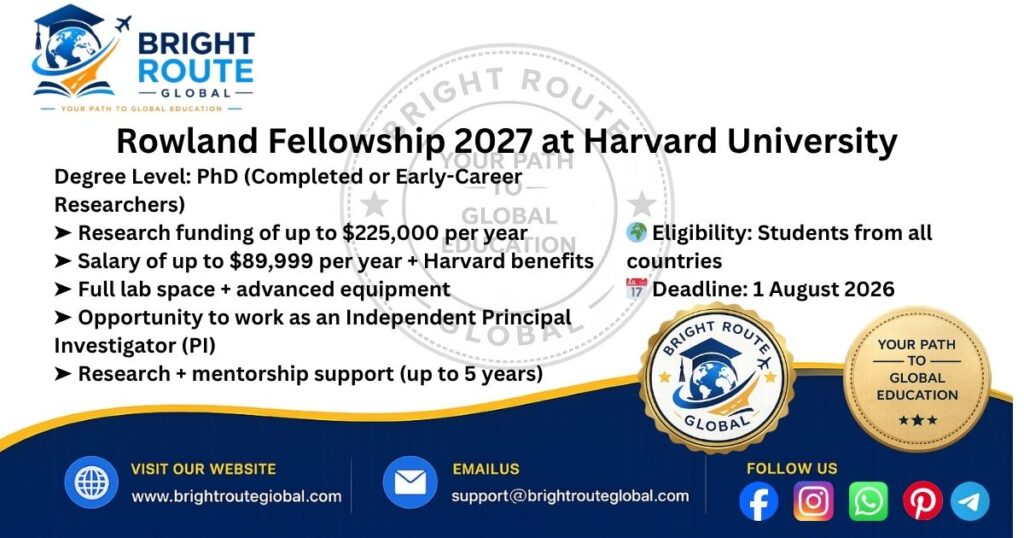
Rowland Fellowship 2027 at Harvard University, USA | Fully Funded Research Fellowship
Apply for the Rowland Fellowship 2027 at Harvard. Learn about benefits, eligibility, deadline, and application process.
Are you an early-career scientist or engineer with a groundbreaking research idea? The Rowland Fellowship 2027 at Harvard University offers one of the most prestigious opportunities for young experimental researchers worldwide. Hosted by the Rowland Institute at Harvard, this fellowship enables outstanding scientists and engineers to establish and lead their own independent research programs while benefiting from Harvard’s world-class academic environment.
Unlike many postdoctoral positions, the Rowland Fellowship provides fellows with principal investigator (PI) status, allowing them to build their own research groups, manage research budgets, and pursue innovative experimental projects with significant independence. The fellowship is open to applicants from all countries and supports research across a broad range of scientific and engineering disciplines.
Fellowship Overview
| Category | Details |
|---|---|
| Host Country | United States |
| Host Institution | Harvard University |
| Institute | Rowland Institute at Harvard |
| Fellowship Name | Rowland Fellowship 2027 |
| Fellowship Duration | Up to 5 Years |
| Eligible Applicants | International Applicants |
| Research Fields | Experimental Science & Engineering |
| Funding Type | Fully Funded |
| Location | Cambridge, Massachusetts, USA |
| Application Mode | Online |
Application Deadline
| Event | Date |
| Application Deadline | August 1, 2026 (11:59 PM EDT) |
| Recommendation Letter Deadline | August 15, 2026 |
| First-Round Interviews | October 2026 |
| Finalist Interviews | November 2026 |
| Final Selection Announcement | December 2026 |
| Fellowship Start Period | July–December 2027 |
Applicants should begin preparing their materials well in advance because the fellowship requires multiple research-focused documents and strong recommendation letters.
About the Rowland Institute at Harvard
The Rowland Institute was founded by inventor Edwin Land in 1980 to support high-risk, innovative experimental research. It later became part of Harvard University and continues to focus on advancing the careers of exceptional early-career scientists and engineers. The institute encourages interdisciplinary collaboration and supports researchers pursuing ambitious ideas that may not fit within traditional academic boundaries.
The fellowship is particularly attractive because it allows researchers to develop independent laboratories while receiving extensive institutional support, mentorship, and access to Harvard’s research infrastructure.
Fellowship Benefits
The Rowland Fellowship is considered one of the most generous research fellowships available to early-career scientists.
| Benefit | Detailed Description |
| Independent Research Laboratory | Fellows receive dedicated laboratory space and the freedom to establish their own research programs as independent investigators. Unlike many postdoctoral positions, fellows operate their own labs and direct their research agendas. |
| Principal Investigator Status | Fellows enjoy full PI rights, allowing them to supervise research personnel, manage budgets, and pursue innovative projects independently. |
| Annual Research Budget | Each fellow receives a research budget starting at approximately $225,000 per year to support laboratory operations, equipment purchases, travel, and research personnel. |
| Competitive Salary | Fellows receive a salary beginning at approximately $89,999 annually, along with Harvard employee benefits. |
| Equipment Funding | Significant startup funding is available for specialized scientific equipment and laboratory infrastructure needed to conduct cutting-edge research. |
| Research Staff Support | Fellows can hire postdoctoral researchers, research assistants, post-baccalaureate researchers, and undergraduate students to assist with their projects. |
| Access to Harvard Facilities | Researchers gain access to Harvard’s advanced research facilities, shared equipment centers, and interdisciplinary research networks. |
| Mentorship and Career Development | Fellows receive professional guidance on leadership, laboratory management, grant writing, budgeting, mentoring, and long-term career development. |
| Teaching Opportunities | Fellows may have opportunities to interact with and mentor Harvard students, gaining valuable teaching experience. |
| Global Prestige | Being selected as a Rowland Fellow significantly enhances future academic and industry career prospects due to the fellowship’s highly competitive nature. |
Research Fields
The fellowship supports experimentally focused research in nearly all areas of science and engineering. Researchers are encouraged to propose innovative, interdisciplinary projects.
Physics
Researchers may explore quantum science, condensed matter physics, optics, photonics, materials physics, and emerging experimental technologies. The fellowship encourages projects that push the boundaries of fundamental scientific understanding.
Chemistry
Experimental chemists can pursue projects related to chemical synthesis, catalysis, analytical chemistry, materials chemistry, sustainable energy solutions, and molecular engineering.
Biology
Biologists may conduct experimental research involving cellular biology, genetics, molecular biology, biotechnology, synthetic biology, and bioengineering.
Engineering
The fellowship supports mechanical, electrical, biomedical, chemical, and interdisciplinary engineering projects that address real-world scientific and technological challenges.
Neuroscience
Researchers interested in brain function, neural circuits, cognition, neurotechnology, and related experimental studies are encouraged to apply.
Materials Science
Projects involving advanced materials, nanotechnology, energy storage systems, electronic materials, and smart materials are highly relevant to the fellowship’s mission.
Interdisciplinary Research
One of the unique aspects of the Rowland Fellowship is its strong support for interdisciplinary research that bridges traditional academic disciplines and creates new scientific directions.
Eligibility Criteria
Applicants must satisfy the following requirements.
| Requirement | Detailed Description |
| Academic Qualification | Applicants must be completing a PhD or have received their PhD after May 1, 2025. |
| Degree Completion | Candidates must complete their doctoral degree before beginning the fellowship. |
| Research Focus | Proposed research must be experimentally focused in science or engineering. |
| International Eligibility | Applicants from any country are welcome to apply. |
| Scientific Excellence | Candidates should demonstrate exceptional research achievements and future leadership potential. |
| Innovation Potential | Projects should demonstrate originality, creativity, and the potential for significant scientific impact. |
Human-subject clinical research is generally not supported under the fellowship’s experimental laboratory structure.
Required Documents
Applicants must prepare a comprehensive application package.
| Document | Detailed Description |
| Elevator Pitch | A concise 250-word summary explaining research goals in language understandable to a broad audience. This statement should clearly communicate the significance and potential impact of the proposed work. |
| Research Statement | A research proposal of up to three pages describing the planned research program, objectives, methodology, expected outcomes, and supporting preliminary work. |
| Curriculum Vitae (CV) | A detailed academic CV outlining educational background, publications, presentations, awards, research experience, grants, teaching activities, and professional achievements. |
| Vision Statement | A one-page statement explaining how personal experiences, leadership philosophy, and values will contribute to building a productive and supportive research environment. |
| Reference Information | Contact information for three to four professional references who can provide detailed recommendation letters evaluating the applicant’s scientific potential and leadership abilities. |
| Supporting Publications | Applicants may include significant publications that demonstrate research productivity and expertise in their field. |
Application Process
| Step | Action | Detailed Explanation |
| Step 1 | Review Eligibility | Confirm that you meet the fellowship’s academic and research requirements before beginning the application. |
| Step 2 | Develop Research Vision | Create a clear and innovative experimental research proposal that demonstrates originality and long-term impact. |
| Step 3 | Prepare Required Documents | Gather and prepare all required materials, including the research statement, CV, elevator pitch, and vision statement. |
| Step 4 | Identify Referees | Select respected academic mentors or supervisors who can provide strong recommendation letters. |
| Step 5 | Submit Online Application | Complete the official application through Harvard’s online application system before the deadline. |
| Step 6 | Recommendation Submission | Ensure that referees submit recommendation letters by the required deadline. |
| Step 7 | Initial Review | Applications are evaluated based on scientific excellence, innovation, leadership potential, and research vision. |
| Step 8 | First-Round Interview | Selected candidates participate in virtual interviews with the selection committee. |
| Step 9 | Finalist Visit | Finalists visit Harvard for presentations, symposium participation, and interviews with faculty and current fellows. |
| Step 10 | Fellowship Award | Successful applicants receive official fellowship offers and begin preparations for relocation and research program development. |
Why the Rowland Fellowship Is Unique
Most postdoctoral researchers work under the supervision of senior faculty members. The Rowland Fellowship is different because it gives young scientists immediate independence, substantial funding, and the opportunity to establish their own laboratories. This structure accelerates career development and prepares fellows for future faculty positions, research leadership roles, and entrepreneurial ventures.
Many former Rowland Fellows have gone on to become professors at leading universities, founders of successful technology companies, and leaders of major research initiatives.
Tips to Increase Selection Chances
- Develop a highly innovative research proposal.
- Demonstrate strong publication records.
- Highlight interdisciplinary research potential.
- Showcase leadership and mentoring experience.
- Obtain exceptional recommendation letters.
- Clearly communicate the broader impact of your research.
- Present a compelling vision for building an independent laboratory.
Frequently Asked Questions (FAQs)
Is the Rowland Fellowship fully funded?
Yes. The fellowship provides salary support, laboratory funding, research budgets, equipment funding, and access to Harvard resources.
Can international applicants apply?
Yes. Applicants from all countries are eligible. Harvard can assist selected fellows with visa procedures.
How long does the fellowship last?
The fellowship lasts up to five years.
What types of research are supported?
Experimental research across science and engineering disciplines is supported.
Final Thoughts
The Rowland Fellowship 2027 represents a remarkable opportunity for talented early-career scientists and engineers to launch independent research careers at Harvard University. With substantial funding, state-of-the-art facilities, mentorship, and academic freedom, the fellowship provides an ideal platform for groundbreaking scientific discovery. Researchers with bold experimental ideas should strongly consider applying before the deadline.
Disclaimer: This post is for informational purposes only. Bright Route Global does not own or manage the opportunities shared. Please verify details on the official website before applying
University of Manitoba Scholarships & Admissions 2027
University of Manitoba International Admissions & Scholarships 2027 Explore University...
Read More

Jefferson Scholars Program 2026 | Complete Scholarship Guide
Jefferson Scholars Program 2026: The Complete Guide to One of...
Read More
Florida State University Admissions 2026–2027
Florida State University Admissions 2026–2027 | Complete Guide for International...
Read More
Yale University Admissions 2026–2027 | Study in USA
Yale University Admissions 2026–2027 | Complete Guide for International Students...
Read More